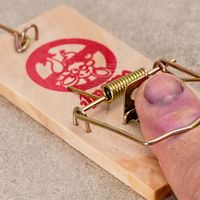
Fear and control are the basis for all human religions. From this common beginning the paths diverge dramatically, splinter, multiply, and finally terminate in different places. But each one is an att...
Mark 5:36, Psalm 34:4, Isaiah 41:10, Matthew 9:22, Philippians 4:6-7, Job 3:25
Medical literature is replete with case reports of patients dying, not from actual illness, but from believing they were sick, from the fear they were going to die.
Isaiah 30:15-16, James 1:2-4, Romans 5:3-5, 1 Peter 4:12-13, Hebrews 12:1-2
A typical response to threat and burden is to want to flee it. It’s evacuation as the cure for trouble. If only I could get away is our mantra. Then I would be safe. Then I could enjoy my life. But wh...
Core beliefs can be hard to change because they’ve generally been with us for a long time, and we assume that they’re true. Perhaps the biggest obstacle to changing our core beliefs is that they are s...
Remember that fear always lurks behind perfectionism. Confronting your fears and allowing yourself the right to be human can, paradoxically, make you a far happier and more productive person.
When we are regularly shamed away from thoughts that venture near spirituality and transcendence, we learn to avoid it altogether, even in our thoughts. We develop a resistance to thoughts that would ...
Matthew 6:34, Philippians 4:6-7, 1 Peter 5:7, Isaiah 26:3, Matthew 8:26, Luke 12:25-26, Proverbs 3:5-6, Jeremiah 17:7-8
One day, a house-dog, standing at the window, was barking his head off at a passing mailman. The dog's owner, irritated, asks the dog, "Why do you always bark at that poor mailman?" The ...
In recent years, an entire discipline of modern psychology has developed called cognitive behavioral therapy. This breakthrough teaching reveals that many problems, from eating disorders to relational...
If you are distressed by anything external, the pain is not due to the thing itself, but to your estimate of it; and this you have the power to revoke at any moment.
George MacDonald, The Scottish author who had a profound effect on C.S. Lewis among others, once wrote a letter to his father about what he believed would be a great obstacle to his faith; that once h...
Galatians 1:10, Colossians 3:23, Psalm 139:13-14, Proverbs 29:25, Romans 8:31, 1 Thessalonians 2:4, 1 Samuel 16:7, Romans 12:2, John 1:12
George Herbert Mead, an influential early 20th-century sociologist, coined the term “generalized other” to describe the vague group we consider when shaping our actions. How often do we behave a certa...
1 John 3:8, 2 Thessalonians 2:9-10, Matthew 13:19, 2 Corinthians 11:14, John 8:44, James 4:7, 1 Peter 5:8
The psychotherapist M. Scott Peck spent many years of his practice as an agnostic. He, along with thousands upon thousands of his colleagues were taught that evil was a social construct, and therefore...
The famous American psychotherapist M. Scott Peck was for many years an agnostic. He learned his psychiatry according to the standard model in which there was no such thing as evil. But at around the ...
Psychologists tell us that one of the most difficult conditions a person can be forced to bear is light deprivation. Darkness, in fact, is often used in military captivity or penal institutions to bre...
I believe that there is a profound difference between shame and guilt. I believe that guilt is adaptive and helpful – it’s holding something we’ve done or failed to do up against our values and feelin...
Job 3:1-26, Psalm 94:19, 1 Peter 5:7, Matthew 14:22-33
We greet the world with a cry and a scream, with clenched fists grasping after what we so desperately need. None of us remember the shock and drama of being born, but have you seen a baby’s birth? I r...
Do not be afraid of being free thinkers. If you think strongly enough you will be forced by science to the belief in God, which is the foundation of all Religion. You will find science not antagonisti...
In ordinary times we get along surprisingly well, on the whole, without ever discovering what our faith really is. If, now and again, this remote and academic problem is so unmannerly as to thrust its...
According to the groundbreaking book The Power of Habit by Charles Duhigg, his research tells us that cravings drive our “habit loops.” Some of us crave escape or relaxation through the habit of a g...
Psychologists have estimated that we have anywhere between twelve thousand and sixty thousand thoughts a day. The majority of those—as high as 80 percent—are thought to be negative: obsessing about mi...