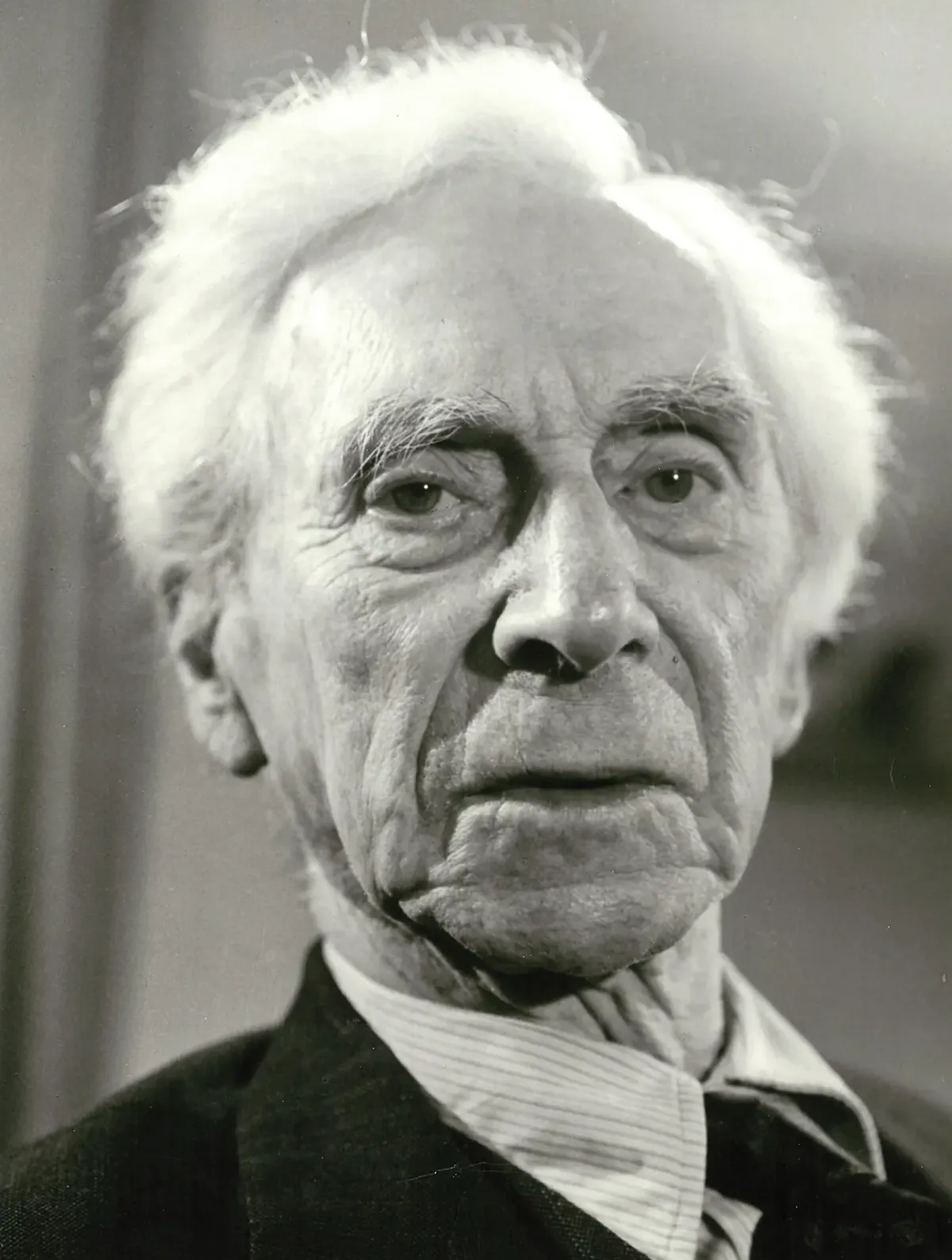
Bertrand Russell
Bertrand Russell (1872–1970) was a British philosopher, logician, mathematician, social critic, and pacifist, widely regarded as one of the most influential thinkers of the 20th century. Born into an aristocratic family, Russell was educated at Cambridge University, where he developed a profound interest in philosophy and mathematics. It is no understatement to say that Russell is one of the most pivotal thinkers in modern logic and mathematics. Much of his career was dedicated to the ambitious project of showing that mathematics could be derived from simple, logical axioms. The simple theory was exploded by a paradox aptly called “Russell’s Paradox,” requiring him to develop a much more complex theory, which stretched into three volumes (published with Alfred North Whitehead in 1910-13). Perhaps more important than his conclusions were the advances in logic developed along the way.
Russell’s work in philosophy of language and logic is often cited as the start of the analytic philosophical tradition (together with the work of Gottlob Frege), which is one of the most influential philosophical traditions in the English-speaking world.
As a public intellectual, Russell was involved in many of the political and social questions of his day. He is well-known for opposing war and militarism. He was even imprisoned for opposing World War I. The Beatles cited him as the source of opposition to the Vietnam War. He advocated against nuclear weapons. He also was an advocate of socialism (but not communism, which he rejected). He received the Nobel Prize in Literature in 1950.
Russell famously rejected Christianity, writing “Why I Am Not a Christian,” and debating Frederick Copleston in 1948 and 1959 on the BBC. Russell famously is said to have replied that he would defend his atheism before God (should he be proven wrong after death) by saying, “Not enough evidence, God! Not enough evidence.”