Isaiah 25:6, Matthew 26:26-28, Acts 2:42-46, Psalm 23:5-6, 1 Corinthians 10:16-17, John 6:56, Revelation 3:20
For Christians, to share in the Eucharist, the Holy Communion, means to live as people who know that they are always guests – that they have been welcomed and that they are wanted. It is, perhaps, the...
What, for example, does it mean to celebrate the Eucharist as food (bread and wine) in a place where we are increasingly obsessed with and yet deeply afraid and ashamed of food, where we idolize and d...
Romans 12:1-2, Hebrews 13:15-16, Matthew 5:23-24, Mark 10:17-22, Luke 9:21-27, John 15:13, 1 John 3:16-18, Genesis 32:22-31
From what is common in all these expressions, we can extract the dictionary definition of sacrifice: “the surrender of something of value for the sake of something else.” That is a good definition, bu...
In one stream of church history, this can help explain worshiping in a dead language like Latin—holy language that honors God but leaves the church bewildered. It’s believed that the incantation “hocu...
Why worship in our native language? Well, for one thing, it can keep people from distorting the Christian faith into a superstition: In one stream of church history, this can help explain worshipi...
Luke 22:19-20, 1 Corinthians 11:23-26, Matthew 26:26-28, Acts 2:42, Acts 20:7, John 6:35, 1 Corinthians 10:21
Paul talks about “the table of the Lord” in 1 Corinthians 10:21. We are hosted by Jesus. In Roman Catholicism the bread itself is effectively the host, because it hosts the physical presence of Christ...
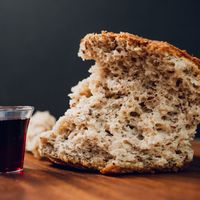
The smell of freshly baked bread is enough to make people want to sit down, get comfortable, and enjoy several slices. The visible, aromatic, and tactile presence of a warm loaf invites sharing and co...
Have you heard the acronym “K. I. S. S”? It stands for “Keep It Simple, Stupid.” Paul doesn’t exactly call the Corinthians stupid (in 1 Cor. 15), though elsewhere Paul sounds tempted to do so, when ...
Every meal—not just Communion, but including Communion—is a reminder that we are dependent on God as creatures. We are not self-sustaining. Much of our food is grown, processed, distributed, and possi...
John 15:13, Romans 5:8, 1 John 3:16, Matthew 5:9, Micah 6:8, Isaiah 53:5, Hebrews 12:2
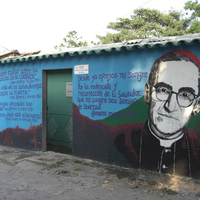
At a funeral Mass for a friend of Archbishop Romero who was murdered by the government because of her faith in Christ, Romero invited those present to follow this Lord who died, this God who sacrifice...
Every Communion is an embodiment of God’s grace. We hear God’s grace in the words that are spoken. But we also see it, hear it, touch it, and taste it in the bread and wine. God in his kindness, knowi...
1 Peter 1:3, Luke 24:1-12, Mark 16:1-8, Matthew 28:1-10, John 11:25-26, John 20:1-18, 1 Corinthians 15:3-8, 1 Corinthians 15:54-55
This vortex of dying and rising—Jesus’ and ours in him—is the paschal mystery. Christians still tell it and taste it, especially when we gather for worship on Sunday. Christ’s Pascha—the word for the...
In this excerpt from a sermon on the Lord’s Supper delivered by Augustine of Hippo to a group of Catechumens, (a Christian believer preparing for Baptism) the great bishop compares the process in whic...
Luke 22:19-20, 1 Corinthians 11:23-26, Matthew 26:26-28, Acts 2:42, Acts 20:7, John 6:35
If we are honest with ourselves, for many of us who celebrate the sacraments on a regular basis, at times we take them for granted. We lose sight of their nature to inspire and remind us of our covena...
John 13:25, Luke 7:38-39, Luke 15:1-2, Luke 19:5-7, Revelation 3:20
It would be impossible to overestimate the impact these meals must have had upon the poor and the sinners. By accepting them as friends and equals Jesus had taken away their shame, humiliation, and gu...
I never met my father-in-law; he died when my wife was a young girl. But I admire him tremendously because of the intuition he had as a new husband. At church the day after his wedding, having consumm...
Let’s call her Roberta; she was clearly near the end of a very long journey toward death’s door. Roberta’s cancer was a particularly nasty variety; by now it had eaten its way into most of her vital o...
John 13:34-35, Galatians 3:28, 1 Peter 4:9, Matthew 25:35, Luke 14:12-14, Romans 12:13, Hebrews 13:2
In his helpful book Peace Catalysts , Rick Love shares a poignant example of how sharing a meal can break down the familiar walls of status, power, and economics: In 2011, my wife, Fran, and I we...
2 Timothy 3:16-17, Romans 15:4, Hebrews 4:12-13, 2 Peter 1:19-21, Matthew 4:4, Matthew 4:4, Matthew 24:35
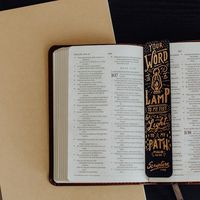
Christians feed on Scripture. Holy Scripture nurtures the holy community as food nurtures the human body. Christians don’t simply learn or study or use Scripture; we assimilate it, take it into our li...
I once asked a circle of people from church, if Jesus is the “bread of life,” what kind of bread is He? Not a one of them said, “He’s that small round wafer we use at Communion.” I wrote down their an...
Think of a contract. Think perhaps of an employment contract or a memorandum of sale or an IOU. What you hold in your hand is a sheet of paper with a series of commitments written on it. This is what ...
Luke 7:36-50, Romans 5:8, John 4:7-26, Matthew 11:19, Luke 19:5-10, Mark 2:15-17
Why did it disturb the religious leaders that Jesus ate with “sinners”? To eat with someone is an important symbol of fellowship. And in those days, the Jews had a rule: one is not to have such fellow...
At the heart of [his prayer for daily bread] stood a central biblical symbol of the kingdom: the great festive banquet. Which God has prepared for his people— The whole point of the Kingdom…isn’t abou...
Acts 2:42-47, Acts 20:7, Luke 24:30-31, 1 Corinthians 11:23-26, 1 Corinthians 10:16-17, Luke 14:15-16
Numerous modern thinkers have noted the spiritual nature of eating meals in community. I wonder if this is why “Sunday Brunch” is such a popular alternative to attending church services. The Orthodox ...
Philippians 2:6-8, John 1:10-11, Isaiah 53:3-4, Matthew 11:19, Mark 15:34, Isaiah 53:12, Luke 15:20-24, Revelation 7:13-14
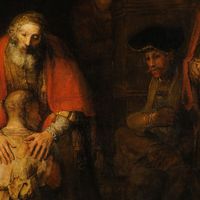
In this excerpt, the French monastic leader Frere Pierre Marie, shares an interpretation of Jesus as the true prodigal son—bringing all of us home with him: He, who is born not from human stock, or ...
We become who we are in the environment of home. We are shaped by our families. Home is formative. Sociologist Cody C. Delistraty explored the most recent scientific literature for Atlantic Monthly an...
New Testament scholar and Anglican bishop N. T. Wright recalls being at a party once when someone decided to read a portion of the seventeenth-century Prayer Book for laughs. The Prayer Book includes ...
“Act” is a good word. Baptism and Communion are like mini-dramas. And we are not just in the audience; we are part of the cast. We do not look on from afar, merely learning information. We participate...
Food is a holy and humbling mystery. Every time a creature eats it participates in God’s life-giving yet costly ways, ways that simultaneously affirm creation as a delectable gift, and as a divinely o...
Isaiah 53:4-5, 1 Samuel 17:, 1 John 12:24-25, Matthew 16:25, Psalm 116:15
Whoever seeks to avoid danger at all costs may ultimately lose the fullness of life, but the one who, out of love for Christ, dedicates themselves to serving others discovers a life that endures. Arch...