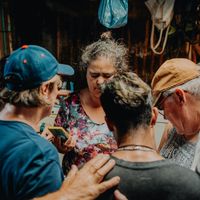
Heavenly Father, we confess that we often place our hopes in the powers that we see in the world, allowing ourselves to be lifted and brought down by people and institutions that are flawed and fleeti...
The advantage that cities and traditional neighborhoods have over sprawling suburbs with respect to interdependence is that they allow people of a greater variety of ages to participate meaningfully i...
Colossians 3:13, Ephesians 4:31-32, Luke 6:37, Mark 11:25, James 5:16
We forgive persons, not institutions. We forgive persons for what not for what they are. We forgive persons for what they do to seriously wound us. We forgive persons for what they do to wrong us when...
Exodus 3:7-10, Isaiah 58:6-10, Micah 6:6-8, Matthew 23:27-28 , James 1:26-27, Psalm 146:7-9
A major stumbling block for many earnest seekers is the compelling evidence throughout history that terrible things have been done in the name of religion. This applies to virtually all faiths at some...
Intellect is therefore a vital force in history, but it can also be a dissolvent and destructive power. Out of every hundred new ideas ninety-nine or more will probably be inferior to the traditional ...
The ways that social structures and institutions systematically work against the interest of people of color is called institutional racism. Institutional racism and historic racism are not unrelated ...
There have been times in my life when I’ve wondered if I have failed to accomplish what God intended for me in my professional life. I have worried that I have not lived up to my potential. I judge my...
Destructive to marriage is the self-fulfillment ethic that assumes marriage and the family are primarily institutions of personal fulfillment, necessary for us to become “whole” and happy. The assumpt...
Have you ever noticed the similarity between the words “hospitality” and “hospital?” That’s because both developed out of the need for accommodations during the medieval period, specifically when peop...
God built into the creation a variety of cultural spheres, such as the family, economics, politics, art, and intellectual inquiry. Each of these spheres has its own proper "business" and nee...
To inhabit a place is to dwell there in a practised way, in a way which relies upon certain regular, trusted, habits of behaviour. Our prevailing, individualistic frame of mind has led us to forget th...
Colossians 3:17, Romans 12:2, John 15:4-5, Matthew 5:14-16, 2 Corinthians 5:20, Acts 1:8
This impotence of “systems” is a main reason why Jesus did not send his students out to start governments or even churches as we know them today, which always strongly convey some elements of a human ...
Cultural legacies are powerful forces. They have deep roots and long lives. They persist, generation after generation, virtually intact, even as the economic and social and demographic conditions that...
Culture consists of concepts, values, and assumptions about life that guide behavior and are widely shared by people. . . . [These] are transmitted generation to generation, rarely with explicit instr...
Here is the uncomfortable truth: Humans run to a much slower evolutionary clock than our inventions. To use an engineering term, we are the “gating factor” that keeps a process from running faster. It...
Think of a contract. Think perhaps of an employment contract or a memorandum of sale or an IOU. What you hold in your hand is a sheet of paper with a series of commitments written on it. This is what ...
The lower classes of society are “not only disproportionately vulnerable to injustice, but usually disproportionately actual victims of injustice. Injustice is not equally distributed. One has to deci...
Churches are not the kingdom of God, but are primary and inevitable expressions, outposts, and instrumentalities of the presence of the kingdom among us.
Galatians 5:22-23, Ruth 1:16, Luke 10:38-42, Luke 10:25-37, Colossians 3:17, 1 John 3:18, Matthew 22:37-40
Identities—what makes us who we are, the kind of people we are—is what we love. More specifically, our identity is shaped by what we ultimately love or what we love as ultimate—what, at the end of the...
Now the covenant mutually binds us. God binds himself to give grace to us, and we bind ourselves to live for God…So sacraments on God’s part are signs and seals of the promise of grace; on our part, t...
Luke 19:1-10, Luke 7:36-50, Matthew 14:13-21, Matthew 26:20-25, 1 Corinthians 11:28-29, Luke 15:1-2
We have seen some gatekeeping or fencing-the-table language already beginning to rear its head in this context. One needed to be baptized to take the meal; one needed to repent to take the meal; one n...
The Church is not a human society of people united by their natural affinities, but the Body of Christ, in which all members, whoever different, must share the common life, complementing and helping o...