Writing to his parents while imprisoned on the day of Pentecost, the German Dietrich Bonhoeffer said this: At the tower of Babel all the tongues were confounded, and as a result men could no longe...
Ezra 4:7–24, Daniel 2:4–49, Nehemiah 8:1–8, Mark 5:41 , John 19:19–22, Acts 2:1–13
One development of the exile was an additional language for the Jewish people. The Babylonians and Persians spoke Aramaic, and out of necessity the Jews learned it. Some even became more conversant in...
Across all barriers of land and language, wealth and poverty, knowledge and ignorance, we are one, created from the same dust, subject to the same laws, and destined for the same end. With this compas...
Hebrews 11:13-16, 2 Corinthians 5:1-2, John 14:2-3, Revelation 21:3-4, Matthew 8:19-20, Luke 9:57-58
In her book Keeping Place: Reflections on the Meaning of Home , Jen Pollock Michel reflects on the nature of home in a transient age. In this short excerpt, Michel focuses on the language associate...
The living human community that language creates involves living human bodies. We need to talk together, speaker and hearer here, now. We know that. We feel it. We feel the absence of it. Speech conne...
Time talks. It speaks more plainly than words. The message it conveys comes through loud and clear. Because it is manipulated less consciously, it is subject to less distortion than the spoken languag...
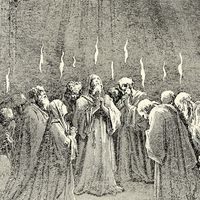
It is well known that Pentecost reverses Babel. The people who built the tower of Babel sought to make a name, and a unity, for themselves. At Pentecost, God builds his temple, uniting people in Chris...
How many of you have ever been told that women talk more than men? How many of you have heard this statistic, on average women use 20,000 words a day to men’s 7,000? I know I’ve heard this quote in se...
Years ago, the story goes, a San Diego bank hired a private investigator to track down a bank robber and retrieve stolen funds. The search led to Mexico. The investigator crossed the border and then, ...
My wife and I don’t cuss—we were taught not to—-and we taught our children not to. Unfortunately, we taught them by never using cuss words. This more went without being said—literally. While we were m...
Luke 15:11-32, Matthew 18:22-35, Luke 16:19-31, Matthew 13:3-8, Matthew 20:1-16, Matthew 13:24-33, Matthew 13:44-50, Mark 4:26-29
The Parable is a form of speech that has a style all of its own. It is a way of saying something that requires the imaginative participation of the listener. Inconspicuously, even surreptitiously, a p...
For thousands of years human beings have communicated with one another first in the language of dress. Long before I am near enough to talk to you on the street, in a meeting, or at a party, you annou...
My husband says my ability to talk is what first attracted him to me. He loved how I could work a room, making the shy ones feel included. I could converse with the college president and yuck it up wi...
Across all barriers of land and language, wealth and poverty, knowledge and ignorance, we are one, created from the same dust, subject to the same laws, and destined for the same end. With this compas...
All that I ever really needed to know about uncivil language I learned in the fifth grade. At a small Dutch Calvinist school in a New Jersey city, I was playing with other students just before classes...
Nonverbal communication can make a huge difference in how a question is received. Only 7 percent of what we say is conveyed through words, 38 percent through vocal element (tone), and the remainder th...
[W]hat makes the word koinonia untranslatable, and therefore a good candidate for direct appropriation into English (or any language where it may be needed), is the profound and singular connotation o...
Modern Language Version Almighty God, who has given us this good land for our heritage: We humbly ask that we may always prove ourselves a people mindful of your favor and glad to do your will. Bles...
Mother’s Day is complicated for a pastor. Among the happy families that are celebrating, there are children who were abused by mothers, mothers who lost lost a child, and women suffering from inferti...
I knew I'd pay for it later, but I drank it anyway. Have you had one of those energy drinks? The ones that have lots of caffeine and other ingredients meant to keep you awake? I don’t recommend t...
Some time ago, I read about the work of a Wycliffe Bible translator in a remote village in Papua New Guinea. When the opening chapters of Genesis were first translated into the native language, the at...
Adam was called by God to take care of Eden. But it was too much work for one man. Eden was massive. Adam was incapable of gardening the whole thing. He needed help. That’s why God created Eve. Go...
While I was born much too late to be the legal property of a person in America, I have been the recipient of racism. When a classmate called me a racial epithet in my first year of college, I was deva...
Psalm 107:null, John 21:15-19, Ruth 1:16-17, Matthew 22:37-39, Isaiah 61:3, Romans 5:8
A Valentine’s Day Tradition What better way to say, “I love you,” than passing your beloved some sugar, corn syrup, dextrose, and glycerin wrapped in a chalkly Necco wafer heart? Maybe some of you re...
God of all nations, Savior of the Church and Lord of our hearts: We come to You, at this time, with our hands empty and our souls crying out: “Lord, help us!” “Do what only You can do!” Change the cou...
O gracious Father, who opens your hand and fills all living things with abundance: Bless the lands and waters, and multiply the harvests of the world; send your Spirit into the world, that it may rene...
Almighty God, whose loving hand has given us all that we possess: Grant us grace that we may honor you with our wealth and belongings, and, remembering the account which we must one day give, may be f...








![[W]hat makes the word koinonia](https://images.unsplash.com/photo-1569292567777-e5d61a759322?ixid=M3w1NzU0OTZ8MHwxfHNlYXJjaHwzfHxmZWxsb3dzaGlwfGVufDB8MHx8fDE3MTIwNzM5MDl8MA&ixlib=rb-4.0.3&q=80&auto=compress&fit=crop&w=200&h=200)