God of grace, power and glory–Creator, Redeemer, and Sustainer–and our Father: When we’re tempted to think it’s all up to us: to change the world, to overcome evil, to establish Your kingdom, to make ...
God–our Father, Lord and indwelling Spirit of grace and power: Thank you for hearing us when we pray whether in songs of rejoicing or through tears of sorrow. Thank you for gifts–for the gifts of musi...
Heavenly Father, in your Word you have given us a vision of that holy City to which the nations of the world bring their glory: Behold and visit, we pray, the cities of the earth. Renew the ties of mu...
Abba – Father: Because of Your love and strength, we trust You … believing You are faithful, true and gracious. Thank You for coming into our world when we could not and would not come to You. You wal...
Isaiah 40:31, Philippians 4:4-7, Ruth 1:16, Luke 10:25-37, Mark 4:35-41, Philippians 4:6-7, Isaiah 41:10
Lord – You are good …and Your goodness knows no bounds. When we were lost, You sought us out, found us and brought us home. When we were alone, You came near to us, and You gave us a new circle of fri...
Cities aren’t full of poor people because cities make people poor, but because cities attract poor people with the prospect of improving their lot in life. [Thereofre] we should worry more about place...
What will be remembered about the twenty-first century…is the great, and final, shift of human populations out of rural, agricultural life and into cities. We will end this century as a wholly urban s...
The advantage that cities and traditional neighborhoods have over sprawling suburbs with respect to interdependence is that they allow people of a greater variety of ages to participate meaningfully i...
In a knowledge-based economy, the way we make ourselves seen and even validated is through more work. Busyness shows us that we’re valuable, contributing members to society. So whether we can’t stop c...
The ways that social structures and institutions systematically work against the interest of people of color is called institutional racism. Institutional racism and historic racism are not unrelated ...
More than 50 percent of Americans live in suburbs, and many of them desire to live a Christian life. Yet often the suburbs are ignored (“Your place doesn’t matter, we’re all going to heaven anyway”), ...
Never in history has distance meant less. . . . Figuratively we “use up” places and dispose of them much in the same way we dispose of Kleenex or beer cans. We are witnessing a historic decline in the...
More people of color than whites live in the city of Dallas and in the city of Fort Worth. But they are more likely to live in poorer inner-city areas while whites live in the more affluent suburbs. D...
In the past three centuries in the West—the period of “modernity”—place has come to be not only neglected but actively suppressed. Owing to the triumph of the natural and social sciences in this same ...
The ultimate challenge of Jesus' ministry was to go to the city, the city of Jerusalem. This city, which was the center of education, religion, and politics, was also the place where corruption an...
To inhabit a place is to dwell there in a practised way, in a way which relies upon certain regular, trusted, habits of behaviour. Our prevailing, individualistic frame of mind has led us to forget th...
There has been a paradigm shift going on in neighborhoods in the United States since the end of WWII. For decades before the 1940s, neighborhoods were places where people were known and were active. W...
Entering a place that is new to us, or seeing a familiar place anew, we move from part to part, simultaneously perceiving individual persons and things and discovering their relationships, so that, wi...
Retail therapy gives us the thrill of the hunt and a hit of dopamine (the love hormone) as we anticipate a purchase, but it cannot feed our hungers. We know this. But we return each time, hoping it wi...
Genesis 11:1-9, Isaiah 30:1-5 , Proverbs 14:12, Matthew 7:24-27, James 4:13-17, Psalm 127:1-2
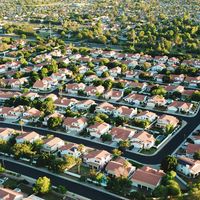
Take the cul-de-sac, for example, which is my metaphor for the world of suburban monotony and triviality that so many Western Christians find themselves trapped in. The literal cul-de-sac (i.e., a dea...
Never in history has distance meant less. . . . Figuratively we “use up” places and dispose of them much in the same way we dispose of Kleenex or beer cans. We are witnessing a historic decline in the...
ABC News ran a story about neighborhood roads that have literally become commercial thoroughfares because GPS systems are routing traffic there, rather than along larger highways. There are other prob...
Perhaps there is no object more desired than a house in America. Meghan Daum writes in her hilarious and poignant book Life Would Be Perfect If I Lived in That House, “There is no object of desire qui...
There is a paradigm shift going on in the realm of forestry. For years there had been a consensus among ecologists that all trees were independent operators, each tree an island unto itself, the fores...
Not everyone living in a distressed neighborhood is associated with gang members, parole officers, employers, social workers, or pastors. But nearly all of them have a landlord. —Matthew Desmond, E...
What is God up to in our neighborhoods and communities? How do we join with what God is doing in these places? Church questions are a subset of these far more important questions.”




![[A Neighborhood is] the place where you](https://a-us.storyblok.com/f/1016915/1200x800/64e33a2f9a/neighbor.jpg/m/200x200/smart)