Mythology by its nature seeks to explain how the world works and how it came to work that way, and therefore includes a culture’s “theory of origins.” We sometimes label certain literature as “myth” b...
In Understanding Genesis , Nahum Sarna argues that a critical distinction between Genesis and the stories of contemporary pagan societies is that Genesis is not myth . Myth is associated with ritual...
Nahum Sarna writes in Understanding Genesis: Perhaps nowhere is the contrast between the mythological and the Israelite conceptions more striking and more illuminating than in their respective descr...
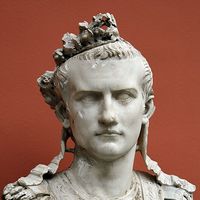
During each full moon, believing himself equal to the Roman gods, the Roman emperor Caligula would summon the moon goddess to share his bedchamber. When he asked Aulus Vitellius—a member of the Roman ...
Descents are everywhere. From Hercules and Orpheus venturing into Hades, to Harry Potter following the pipes down into the Chamber of Secrets, to the Sheriff and Joyce Byers frantically searching for ...
According to Greek mythology, people once knew in advance their exact day of death. Everyone on earth lived with a deep sense of melancholy, for mortality hung like a sword suspended above them. All t...
Why a story? We all think of our lives as stories, each with a main character (us) theme, and plot (interesteing so far, but as yet unfinished). We also love to hear stories about others and even abou...
In Greek mythology, Narcissus was a handsome young man who caught sight of his reflection in a pond, fell in love with his own image, toppled into the water and drowned. So “narcissism” is an excessiv...
Many of the modern controversies surrounding the Bible—for example, human sexuality, creationism and the “openness” of God—revolve around questions concerning hermeneutics. The science of hermeneutics...
I grew up as a Christmas and Easter Methodist. Our family called ourselves Christians, but it was not an important part of our lives. I found church boring. When I turned eighteen, something happened ...
Kate Bowler is a gifted scholar and writer who, as a young wife and mom, was diagnosed with stage 4 colon cancer—kept going six months at a time thanks to immunotherapy. She writes honestly about how ...
Zechariah 9:9, Matthew 21:1-11, Mark 11:8-11, Luke 19:36-44, John 12:16-19
Palm Sunday is the Trojan horse of the church year. You remember the story from Greek mythology: a huge, splendid wooden horse was accepted by the Trojans as a present from the Greeks (so it really ou...
Whether the Hebrew Genesis account was meant to be science or not, it was certainly meant to convey statements of faith. As will be shown it is part of the biblical polemic against paganism and an int...
Luke 15:11-32, Matthew 18:22-35, Luke 16:19-31, Matthew 13:3-8, Matthew 20:1-16, Matthew 13:24-33, Matthew 13:44-50, Mark 4:26-29
The thrust of the parables is to subvert the distorted myths in which people live their lives. To understand what we mean by “living in a myth” just think of a couple of our own contemporary myths. Ta...
Names in the ancient world were associated with identity, role and function. Consequently, naming is a typical part of the creation narratives. The Egyptian Memphite Theology identifies the Creator as...
The Greek god Prometheus descended from the race of the Titans, the gods that ruled the world before the reign of the Olympians, who were headed by the ruthless Zeus. The playwright Aeschylus portrays...
The cosmology of the ancient world was dramatically different from the way that we think of ours. Scholar John Walton writes in The Lost World of Genesis One , “Old world cosmic geography is based on...
The Hebrew cosmology represents a revolutionary break with the contemporary world, a parting of the spiritual ways that involved the undermining of the entire prevailing mythological world-view... The...
There may have been a time when people found it easy to believe anything. But we are finding it vastly easier to disbelieve anything. Both processes save the human mind from the disgusting duty of dis...
Every person in Scripture lived out a personal story incarnated by an even greater story about God, life, and the world. That story came from the politics, theology, and culture ingrained in their mem...
Stories, after all, are one of the most basic modes of human life and are a characteristic expression of worldview. Human life is constituted by a series of stories, implicit and explicit, that makes ...
John 1:3, Psalm 104:24, Genesis 2:2-3, Genesis 1:27, Genesis 1:31
The Jews were not the only religious people in the ancient world. There were others, such as the Akkadians, Egyptians, and Phoenicians, and they had their own creation stories. When one compares the ...
Isaiah 9:6-7, Hebrews 1:1-3, Colossians 1:15-17, Philippians 2:6-8, John 3:16-17, John 1:1-4, Luke 1:30-35
In the ancient world, a place where the veil between the earthly and spiritual was easily pierced, rumors and gossip about great leaders being born of the gods, especially amongst royals, was somewhat...
From a historical perspective it is atheism that was old and the Christian faith and its good news that burst on the world as new. Once commonly called “atomism,” the genealogy of atheism can be trace...
Story is the primary way in which the revelation of God is given to us. The Holy Spirit’s literary genre of choice is story. Story isn’t a simple or naive form of speech from which we graduate to the ...
Religion is the business of appeasing gods. In the old days, you’d take some unfortunate animal to a temple, give it to a priest, and the priest would dispatch of it for you before the watchful eyes o...
Human spectacle making is like sorcery—an enchantment, a spell, the creation of an image that calls for a response from our inner longings. Idolatry is the original tele-vision, the bringing of a far-...
Psalm 73:25-26, Matthew 6:21, 1 John 2:17, Colossians 3:1-2, Psalm 63:1
I met a man who watches The Lord of the Rings movies every night. When he told me this I pushed back: “Every night?” He said that when he gets off work he goes home, fixes his dinner, turns on the m...
Aeschylus was the founding father of Greek tragedy. He believed life was vicious, the gods were brutal, and all were doomed to meet a tragic end, either at the hand of fate or the gods, neither of whi...
In the Bible, this [The Mystery of Christ] concept is referred to not only as the mystery of Christ, but also as the mystery of God (or of God’s will), the mystery of the kingdom, and the mystery of t...