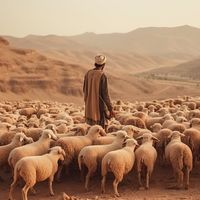
There is a profound difference between adaptability and conformity. The “greats” seem to instinctively understand this difference, and while they disdain conformity, they cherish the courageous abilit...
Most of us have genes that make us as hardy as dandelions: able to take root and survive almost anywhere. A few of us, however, are more like the orchid: fragile and fickle, but capable of blooming sp...
[Jonathan] Sacks comments on this passage, tying it back to his study of adaptive leadership concepts. In the first occasion, Moses was faced with a technical challenge: the people needed food. On the...
Here is the uncomfortable truth: Humans run to a much slower evolutionary clock than our inventions. To use an engineering term, we are the “gating factor” that keeps a process from running faster. It...
In their book Leadership on the Line, Ronald Heifetz and Marty Linsky describe adaptive challenges as the work confronting a leader when there is no known fix to a problem. It’s when “best practices” ...
In this short excerpt, professor and pastor Tod Bolsinger describes how the changing world of ministry (in the West) has led some pastors to simply give up trying: About twelve years ago, I heard a ...
The great San Francisco 49ers football coach Bill Walsh, when asked about legendary wide receiver Jerry Rice said, “Rice was considered too slow for NFL greatness.” But, when you studied the film fr...
All great jazz musicians have at least three things in common: (1) they have gone into the practice room and learned and internalized all the scales, which are simply organized sequences of notes, unt...
Psalm 52:8, John 15:1-10, Ephesians 2:19-22, Romans 11:11-24, 1 Peter 2:9-10
A couple years ago I got to take a tour of the Huntington Library in Pasadena, California. The name is a bit misleading because what they are most known for are there amazing gardens. And so we were o...
James 1:2-4, Romans 5:3-5, 1 Peter 1:6-7, 2 Corinthians 4:16-18, Isaiah 40:31
It’s human nature to resist change—particularly when it comes in the form of adversity or challenges. But change is inevitable, and developing the trait of resilience helps us not only survive change,...
Crises, and pressures for change, confront individuals and their groups at all levels, ranging from single people, to teams, to businesses, to nations, to the whole world. Crises may arise from extern...
The word resilience derives from the Latin term resilire , which means “to recoil or rebound,” and made its debut in the English language in 1627. The first entry in the Oxford English Dictionary...
Humans are wired for stability and continuity, so we are deeply grateful for a good manager who keeps everything running well. But leading change is disruptive. And everything within us resists disrup...
Resilience is not about becoming smarter or tougher; it’s about becoming stronger and more flexible. It’s about becoming tempered. Which takes us back to the blacksmith’s shop. Tempered. Let the word ...
Peter Drucker suggests that we should always sustain two streams of learning and self-improvement. And though he is speaking specifically about work and career, what he says is equally applicable whet...
Nassim Nicholas Taleb, a best-selling statistician, argues that it is not even mere resilience we need, but what he calls antifragility . He groups things into three categories. First, fragile...
Too many people hear the word capacity and assume it’s a limitation. They assume their capacity is set—especially if they’re beyond a certain age. People give up on the idea that their capacity or the...
Many of life’s annoyances just have to be ignored. That doesn’t mean that we suppress, ignore, or deny every pain. Serious pain has to be confronted. But one mark of resilience is learning to tell whi...
The wonderful word master used to describe the person who is at the top of his or her craft, whatever the profession. It was a title that one could work toward and with some degree of confidence ascri...
Does it ever seem like the world around us is changing at breakneck speed? Well, it turns out, you’re right. A team of researchers have concluded that the Western world’s “environment and social order...
Romans 12:1-2, Colossians 2:8, 1 John 2:15-17, 1 Corinthians 10:23-33, Mark 7:8-9
When my grandparents were in their eighties, their television developed a fault that made the screen permanently bright green. It was good for viewing garden shows or nature programs, but it was prett...
Isaiah 43:18-19, John 21:17, Luke 22:61-62, Romans 5:3-5, Micah 7:8, Psalm 73:26, Proverbs 24:16
A common trait of human beings is a fear of failure. Most of us find ways of coping with it, but whenever failure rears its ugly head, it’s difficult not to experience the sting of feeling like we are...
Adoption was clearly not a foreign concept in the Greco-Roman world. But it’s important to note how differently Paul and his communities would have heard that word! Our contemporary concept of adoptin...
The bottom line is this: never grow complacent. Never grow tired of learning. As soon as we stop learning we lose the capacity to grow and mature in our work and our relationships. This continual lear...
The more complicated the landscape, the more the wanderer relies on patience. The more confusing the scene, the more tolerant his outlook becomes. He not only has an awareness of his own ignorance, bu...
Ecclesiastes 3:1-8, James 4:13-15, Matthew 24:42, Psalm 90:
Have you ever heard of "Stein’s Law"? Named after University of Virginia economics professor Herbert Stein, it states: "If something cannot go on forever, it will stop." Do you...
The animal behavior scientist Temple Grandin, who achieved significant success while struggling with autism, has this to say on the subject of progress: People are always looking for the single ma...
One of the many technological transformations of the twentieth century took place right on our dinner plates. Because of its cheapness and convenience, most Americans quickly accepted new ways of eati...
In this short poem, the psychologist Daniel Goleman (the developer of the concept of Emotional Intelligence (E.Q.)) builds on the work of R. D. Laing’s “knots.” The poem is a helpful reminder that our...
Walter Brueggemann writes that the movement of the psalms is from orientation to disorientation and then to new orientation. The psalms give us a language for transformation in desert spaces: we move ...