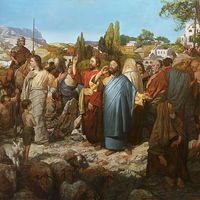
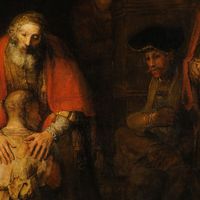
The biblical writers and reciters make extensive use of metaphors, parables and dramatic actions. Jesus does not say, “God’s love is boundless.” Instead, he tells the story of the prodigal son. He doe...
Mark 12:37, Matthew 19:24, Matthew 7:5, Mark 3:25, Mark 7:27, Mark 8:15, Luke 15:11–32, Luke 10:25–37, Luke 18:9–14-, 25:31–46
One of my daughters has been singing a song about Jesus that contains the line “Jesus was a story-tellin’ man.” When I first heard that line it seemed a bit flip, as so many contemporary Christian son...
Several years ago I was conducting a seminar in the interpretation of Scripture in a theological seminary…Our topic that day was Jesus’ parables…One of the priests, Tony Byrnne, was a Jesuit missionar...
Luke 15:11-32, Matthew 18:22-35, Luke 16:19-31, Matthew 13:3-8, Matthew 20:1-16, Matthew 13:24-33, Matthew 13:44-50, Mark 4:26-29
The thrust of the parables is to subvert the distorted myths in which people live their lives. To understand what we mean by “living in a myth” just think of a couple of our own contemporary myths. Ta...
Matthew 13:, Exodus 14:21-31, Daniel 3:13-30 , 1 Kings 18:20-40, Luke 15:11-32, Psalm 23:
In the second century before Christ the great rival to Roman power in the Mediterranean world was Carthage, the Phoenician city-state located on the north African coast. It had been founded in 822 B.C...
Luke 15:11-32, Matthew 18:22-35, Luke 16:19-31, Matthew 13:3-8, Matthew 20:1-16, Matthew 13:24-33, Matthew 13:44-50, Mark 4:26-29
The child became a man and the man became a preacher whose sermons were full of commonplace things: seeds and nets, coins and fishes, lilies of the field, and birds of the air. Wherever he was, he had...
Zechariah 9:9, Matthew 21:1-11, Mark 11:8-11, Luke 19:36-44, John 12:16-19
The entrance into Jerusalem was an acted parable. It gave the faithful the sign they had been waiting for. It inaugurated the Master’s final mission to his people and was a fitting prelude to the days...
The Danish philosopher Søren Kierkegaard once told a parable to illustrate the urgency of the gospel message—and the need for all believers, not just clergy, to share it. A traveling circus in Denm...
Philippians 2:6-8, John 1:10-11, Isaiah 53:3-4, Matthew 11:19, Mark 15:34, Isaiah 53:12, Luke 15:20-24, Revelation 7:13-14
In this excerpt, the French monastic leader Frere Pierre Marie, shares an interpretation of Jesus as the true prodigal son—bringing all of us home with him: He, who is born not from human stock, or ...
Jacob was on his way back to face his brother Esau whom he had wronged, and he wrestled with the angel until the break of day. When the angel tried to free himself from Jacob’s persistent grip, Jaco...
The Danish philosopher, Kierkegaard, tells a parable of a theater where a variety show is proceeding. Each show is more fantastic than the last, and is applauded by the audience. Suddenly the manager ...
Pearls were of much greater value in Jesus’ time than they are today. Queen Cleopatra is reputed to have had two pearls which together were worth around 15 million denarii. A denari was roughly a day’...
Matthew 13:, Philippians 3:1, 1 Samuel 3:1–10 , Exodus 7:12, Deuteronomy 6:4–9 , Psalm 136:
In the second century before Christ the great rival to Roman power in the Mediterranean world was Carthage, the Phoenician city-state located on the north African coast. It had been founded in 822 B.C...
Let us begin with a question. Do you really know how to enjoy the world? Do you know how to enjoy yourself? One of the greatest parables in the New Testament has to do with the search for enjoyment an...
In the day-to-day trenches of adult life, there is actually no such thing as atheism. There is no such thing as not worshipping. Everybody worships. The only choice we get is what to worship. And the ...
Nakedness is the subject of one of the most famous folk parables of power: Hans Christian Andersen’s tale “The Emperor’s New Clothes.” A vain emperor is visited by two “weavers” who promise that their...
In the day-to-day trenches of adult life, there is actually no such thing as atheism. There is no such thing as not worshipping. Everybody worships. The only choice we get is what to worship. And the ...
Matthew 2:1-4, Luke 15:3-7, John 8:1-11, Luke 19:10, John 1:16, Revelation 22:17
During a British conference on comparative religions, experts from around the world debated what, if any, belief was unique to the Christian faith. They began eliminating possibilities. Incarnation? O...
Matthew 28:19-20, 1 Corinthians 2:4-5, Ephesians 6:19-20, 2 Corinthians 4:2-4, Romans 1:16, Mark 16:15
With his fabulous tale to proclaim, the preacher is called in his turn to stand up in his pulpit as fabulist extraordinary, to tell the truth of the Gospel in its in its highest and wildest and holies...
Luke 2:22-24, 2 Corinthians 8:9, Isaiah 9:6-7, Philippians 2:6-8, John 1:14, Isaiah 61:1
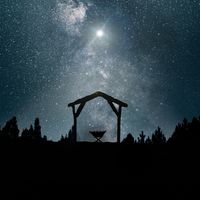
They were poor. We know this because the two young turtledoves Joseph and Mary brought was the smallest offering they were allowed as devout Jews and yet the largest they likely could afford. With tw...
Stories, after all, are one of the most basic modes of human life and are a characteristic expression of worldview. Human life is constituted by a series of stories, implicit and explicit, that makes ...
Our Scriptures that bring us the story of our salvation ground us in place. Everywhere they insist on this grounding. Everything that is critically important to us takes place on the ground. Mountains...
Luke 2:19, John 1:14, Matthew 2:9-11, Luke 2:8-12, Matthew 2:1-2, Luke 2:6-7
An angel came to me And I was unprepared To be what God was using. Mother I was to be A moment I despaired, Thought briefly of refusing. The angel knew I heard According to God’s word, ...
Sometimes great stories introduce the protagonist in the very first paragraph. In Charles Dickens’s Great Expectations, for example, we are immediately introduced to Pip, the central figure of the nov...
In his excellent book, The Prodigal God , Timothy Keller corrects the notion that this classic parable (The Parable of the Prodigal Son, Lk. 15) is not only about the lostness of the younger ...
Reaching back to the tradition of virtues and vices can also give us fresh eyes and expose new layers of meaning in our reading of scripture. Before I read Aquinas on sloth, I would have associated it...
1 Corinthians 12:8-12, John 1:, John 17:18, Philippians 2:6-11, 1 John 1:7, Romans 8:1, Colossians 1:13-14
The Cave One of the most famous passages in Plato's Republic is his "Allegory of the Cave," which is found at the beginning of book seven . Socrates imagines the human condition al...
Acts 1:8, Romans 6:4, Colossians 1:10, Matthew 7:16-20, Galatians 5:22-23, Luke 13:6-9
My mom studied horticulture and could make a dead stick grow leaves. I do not have her genes. So what I am telling you know comes from sources who do know about fig trees. Here’s what they tell me. Fi...
Numbers 21:4-9, Isaiah 53:, John 3:14-15 , Matthew 12:38-41, Psalm 107:23-32
The symbol of judgment and death, the serpent, is lifted up as Israel’s symbol of life. Jesus draws this parallel for us in John, hinting toward the way the tool of Roman execution, the cross, will be...
Let us not mock God with metaphor, analogy, sidestepping, transcendence; making of the event a parable, a sign painted in the faded credulity of earlier ages: let us walk through the door. …………………………...