In Jonathan Kozol’s book, Amazing Grace , he tells of the struggles and sufferings of people in a community in the Bronx, New York. He is amazed at the courage and resilience he found there. He then ...
What we need to realize, however, is that there is no such thing as autonomous or “self-grounding” knowledge. All systems of interpretation and all claims to true knowledge are ultimately grounded out...
Matthew 27:46, Hebrews 4:15, 1 Peter 3:18, John 19:30, 1 Peter 4:13
In Elie Wiesel’s Night , Eliezer is a Jewish teenager, a devoted student of the Talmud from Sighet, in Hungarian Transylvania. In the spring of 1944, the Nazis occupied Hungary. Increasingly repressi...
We all have shadows and skeletons in our backgrounds. But listen, there is something bigger in this world than we are, and that something bigger is full of grace and mercy, patience and ingenuity. The...
The people God used to record his words were themselves uncommonly moved by them. They said the Word of God is honey in my mouth (Ezekiel 3:3) spiritual food for the hungry (Job 23:12) dwel...
2 Corinthians 12:9, Isaiah 40:29, 2 Corinthians 3:5, Hebrews 4:16, James 4:6, 1 Peter 5:6-7
Brother Lawrence, a 16th-century Carmelite monk, spent his days scrubbing pots and mending shoes. Largely uneducated, he filled his free time writing letters and notes that, after his death, friends g...
1 Kings 18:41–45, Daniel 9:3–19 , Matthew 7:7–8 , Luke 18:1–8, Hebrews 4:16 , Psalm 145:18–19
“The Prince of Preachers”, Charles Haddon Spurgeon once shared a thoughtful analogy for the life of prayer in most people’s lives: Prayer pulls the rope down below and the great bell rings above i...
There’s a story that used to make the rounds about the German theologian Paul Tillich. Tillich’s theology was considered dangerous by many Christians in the U.S. Supposedly one time after delivering a...
Psalm 142:4-5, Isaiah 49:15-16, Psalm 34:18, Hebrews 4:15, Matthew 28:20, John 14:18, Romans 8:38-39, Lamentations 3:21-23, Psalm 40:1-12
This story is probably apocryphal, but conveys a truth nonetheless. During the early 19th century, following the Napoleonic Wars, a French soldier was captured and imprisoned. He was thrown into a...
Matthew 6:14-15, Colossians 1:13-14, Luke 6:37, Titus 3:5, Hebrews 4:16, 2 Corinthians 12:9, Romans 3:23-24
At the beginning to the musical Les Misérables , the lead character Jean Valjean is arrested by the police, with silver he has stolen from a kindly bishop who had given him shelter. Valjean is plainl...
“Empathy” literally means “in-feeling”—it is to project myself into another person’s feelings so that I begin to understand what it is like to have his experiences. If I want to gain empathy for a nei...
A student who had recently lost his sight was sent to the Seeing Eye Institute for the Blind in Morristown, New Jersey, for specialized training. Upon arrival, he was greeted by another young ma...
Matthew 6:32; 11:28-30, Luke 12:7, Hebrews 4:15- 16, 1 Peter 5:7
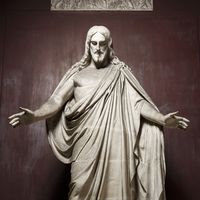
When Albert Berte Thorwaldsen, the renowned Dutch sculptor, finished the clay model of his statue of Christ with arms raised in blessing, he left it to harden overnight in his studio. The next morni...
After I graduated from seminary, I stopped reading the Bible. It’s been said that for all the gain that comes from dissecting a frog, all the hands-on knowledge one amasses from cutting out the organs...
In Book Eight of Confessions , St. Augustine recounts how, in a state of deep inner turmoil, he “heard from a nearby house a voice, as of a boy or girl, I know not which, chanting repeatedly, ‘Ta...
James 2:13, Titus 3:5, Hebrews 4:16, Ephesians 2:4-5, Lamentations 3:22-23, Matthew 5:7
When Johann Sebastian Bach sought to convey the heart of Christian truth through music, he chose the Mass as his foundation. His B Minor Mass begins with a heartfelt plea from the full chorus and orch...
Psalm 34:17-18, 2 Corinthians 1:3-4, 2 Corinthians 12:9-10, Hebrews 4:15-16, Hebrews 2:18, Matthew 26:38, Matthew 11:28-30
When do we hear God’s voice most clearly? It is often in our deepest struggles that we hear God’s voice. In the 1640s, George Fox, who would later establish the Quaker or Friends movement, wandered th...
John 5:39-40, Hebrews 4:12, 2 Peter 3:9, 1 Corinthians 1:27, Mark 9:14-29, Acts 17:27, Luke 8:9-14
The famous entertainer W. C. Fields, known for his humor, love of drink, and agnosticism, found himself bedridden in his final illness. When a longtime friend visited and noticed Fields reading the Bi...
Matthew 6:9-11, Luke 11:2-3, Romans 8:15, Hebrews 4:16, Philippians 4:6-7
The Lord’s Prayer is designed to help us make this change: a change of priority, not a change of content. This prayer doesn’t pretend that pain and hunger aren’t real. Some religions say that; Jesus d...
The Lord’s Prayer, like all prayer, is part work and part rest, Perhaps the only work we do is getting ourselves there. Once we’ve gotten ourselves there—to prayer—whatever mains of productivity is Go...
1 John 1:9, Romans 10:9-10, Hebrews 4:14, Matthew 10:32, 2 Samuel 12:
I missed that confession is not just a commandment, not just one of the “steps to salvation”—it is a means of God’s grace. The word confess, which means to assent or agree, is the English translation ...
Exodus 20:3-7, 12-17, Deuteronomy 5:12-15, Mark 2:27-28, Matthew 12:8, Luke 6:5, Hebrews 4:9-10, Isaiah 58:13-14
Interpretation series editor Patrick Miller has shrewdly observed that the fourth commandment on Sabbath is the “crucial bridge” that connects the Ten Commandments together. The fourth commandment loo...
2 Timothy 3:16-17, Romans 15:4, Isaiah 55:11, Hebrews 4:12-13, 2 Peter 1:19-21, Matthew 4:4, Matthew 24:35
Many people these days feel an absence in their lives, expressed as an acute desire for “something more,” a spiritual home, a community of faith. But when they try to read the Bible they end up throwi...
The lesson of Genesis is that the first work of rest is to cease from our own effort. All that needs to be done has already been done. The work of God was finished long before we ever came on the scen...
Psalm 23:1-3, Psalm 62:1, Matthew 11:28-30, Hebrews 4:9-10
In his highly insightful work, Inside Job , Stephen W. Smith shares the importance of finding ways to rest and relax as part of a healthy, balanced life: I once read a book in which the author sa...
2 Timothy 3:16-17, Romans 15:4, Isaiah 55:11, Hebrews 4:12-13, 2 Peter 1:19-21, Matthew 4:4, Matthew 24:35
The Bible contains rules, but it’s not helpful to think of it as a rule book. As important as rule books are, they don’t inspire devotion. Imagine curling up with a cup of coffee and your company’s em...
Matthew 5:1-48, Matthew 6:1-34, Matthew 7:1-29, 2 Timothy 3:16-17, Romans 15:4, Isaiah 55:11, Hebrews 4:12-13, Matthew 4:4, Matthew 24:35
After a sojourn in the United States where he experienced the vibrancy of Black churches, Dietrich Bonhoeffer returned to Germany in 1931 to teach at the University of Berlin. His pastoral ministry co...
2 Timothy 3:16-17, Romans 15:4, Isaiah 55:11, Hebrews 4:12-13, 2 Peter 1:19-21, Matthew 4:4, Matthew 24:35, Isaiah 40:8
The Bible has, amazingly—no doubt with supernatural grace—survived its critics. Thirty to sixty million copies are produced annually. The harder tyrants try to eliminate it and skeptics dismiss it, th...
2 Timothy 3:16-17, Romans 15:4, Isaiah 55:11, Hebrews 4:12-13, 2 Peter 1:19-21, Matthew 4:4, Matthew 24:35
In the book A Peculiar Glory , John Piper describes how he maintained a traditional view of scripture, even after he went on to advanced theological studies in California and Germany. He describes hi...
2 Timothy 3:16-17, Psalm 119:105, Hebrews 4:12, John 4:14
The Bible is like a vast geographical basin in which tributary streams feed into the currents of a parent river on its course to the ocean. The riverbanks are interspersed with openings where the trib...