Philippians 2:6-7, Galatians 2:20, John 10:30, Ephesians 5:21, Colossians 1:19-20, John 15:13, Matthew 20:28
There are two wonderful Greek words that the early church theologians used to describe the Trinity: kenōsis and perichōrēsis. Kenosis is the act of self-giving for the good of another. It is found in ...
Philippians 2:null, 1 Corinthians 15:22, Romans 6:4, John 12:24, Luke 24:5-6, Matthew 20:28
In the Christian story God descends to reascend. He comes down; down from the heights of absolute being into time and space, down into humanity; down further still, if embryologists are right, to reca...
Philippians 2:6-8, John 1:10-11, Isaiah 53:3-4, Matthew 11:19, Mark 15:34, Isaiah 53:12, Luke 15:20-24, Revelation 7:13-14
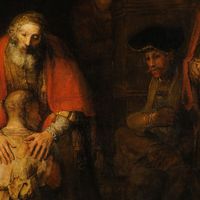
In this excerpt, the French monastic leader Frere Pierre Marie, shares an interpretation of Jesus as the true prodigal son—bringing all of us home with him: He, who is born not from human stock, or ...
Psalm 51:7, 2 Corinthians 7:10, Matthew 5:4, Luke 6:21, James 4:8-10
Traditional Eastern Orthodox theology asserts that tears cleanse, renew and make way for the kingdom. When sin and the brokenness of the world give rise to godly sorrow, our hearts soften toward God a...
Ezekiel 47:9, Galatians 6:2, Romans 12:4-5, Matthew 28:19-20, 1 John 1:7
The ancient Greek word for intimate fellowship is koinonia. In the church, we can suffer from what might be called koinonitus: fellowship turned in on itself; cliques and enclaves and tight-knit group...
Mark 15:39, Hebrews 4:15, John 11:35, Luke 22:44, Psalm 22:1, 2 Corinthians 4:8-10, Isaiah 53:5
I am a Christian because of that moment on the cross when Jesus, drinking the very dregs of human bitterness, cries out, My God, my God, why hast thou forsaken me? . . . The point is that he felt huma...
Isaiah 26:3, 2 Corinthians 5:17, John 15:5, Colossians 3:3-4, Luke 9:23, Philippians 2:3-5, Romans 12:1-2
The word eccentric comes from a combination of the Greek terms ex (out of) and kentron (center). When combined, ekkentros means “out of center.” The term gained currency in the late Middle Ages, when ...
Ephesians 2:4-5, Hebrews 2:14-15, 1 Peter 2:24, Philippians 2:6-8, Isaiah 53:5, John 3:16-17, 1 John 4:9-10
Why should I, who have been living from all eternity in the enjoyment of the Father’s love, go to cast myself into such a furnace for them that never can requite me for it? Why should I yield myself t...
In class I often use a show-and-tell example to illustrate the central point for the understanding of ministry. I invite a student to join me at the front of the class. I always pick a large, strongly...
This being born again is no longer the active transfer of our will from the realm of inclination into that of obedience. It is, in the sense of the third chapter of the Gospel according to St. John, t...
Christ was led by His love for others into the world, to forget Himself in the needs of others, to sacrifice self once for all upon the altar of sympathy. Self-sacrifice brought Christ into the world....
Union with Christ fundamentally and irrevocably changes our relationship to sin. Our old self has been crucified (Rom. 6:6), and sin has no dominion over us (v. 14). This doesn’t mean a part of us cal...
If you could reduce the gospel to one word, most scholars would choose metanoia—the Greek word translated “repentance” in the New Testament… Most of the time we translate both “meta-noeo” and “meta-no...
Matthew 25:35-40, James 1:27, Philippians 2:3-4, John 13:3-5, Micah 6:8, Isaiah 58:6-7, 1 John 3:18
An ancient legend tells of a well-respected rabbi who would vanish from his synagogue for a few hours each Sabbath. His mysterious absences sparked curiosity among his students, who wondered if their ...
Matthew 14:19-20, John 9:6-7, Mark 2:3-4, John 13:4-5, Mark 1:40-42, Luke 2:7, John 1:14
The gospels are earthy. People are close to the earth. They travel here and there by foot. They eat the live heads of grain growing from the soil as they walk through the fields. They get grubby and h...
Isaiah 30:15, Psalm 46:10, 2 Corinthians 4:18, Romans 8:26, John 14:26, 1 John 16:7
The other thing that helps me deal with my compulsion to control things through my direct involvement and my fear of missing out is what Henri Nouwen has called “the ministry of absence.” Jesus modele...
John Wesley’s covenant prayer demonstrates a level of sacrifice and devotion to Jesus that has been rarely matched. How many of us have asked for suffering, in order to experience the humility and the...
1 Peter 1:3, Luke 24:1-12, Mark 16:1-8, Matthew 28:1-10, John 11:25-26, John 20:1-18, 1 Corinthians 15:3-8, 1 Corinthians 15:54-55
This vortex of dying and rising—Jesus’ and ours in him—is the paschal mystery. Christians still tell it and taste it, especially when we gather for worship on Sunday. Christ’s Pascha—the word for the...
1 Corinthians 4:15-17, James 5:7, Matthew 25:31-32, Titus 2:13, Revelation 22:12-13
Paul’s term for the return of Jesus is called the parousia. Parousia was used to describe an imperial visit by a king to a city. People would send a delegation outside the city gates to greet the dign...
In his devotional guide on preparing for the rite of confession in the Evangelical Lutheran Church, the nineteenth-century Danish philosopher Søren Kierkegaard says that true repentance from the persp...
C.S. Lewis on the Incarnation: We catch sight of a new key principle—the power of the Higher, just in so far as it is truly Higher, to come down, the power of the greater to include the less. . . . ...
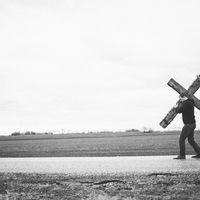
Please know that when I take up my cross every day I am not talking about my wheelchair. My wheelchair is not my cross to bear. Neither is your cane or walker your cross. Neither is your dead-end job ...
Lesslie Newbigin, the great missiologist and missionary, shares a powerful analogy of repentance from his days serving as a missionary in India. I remember once visiting a village in the Madras di...
Psalm 22:1 was on our Savior’s lips on the cross, and it is in that context a mystery: God forsaken by God! Christians have been trying to unravel this mystery for centuries, without reaching consensu...
Matthew 27:46, Hebrews 4:15, 1 Peter 3:18, John 19:30, 1 Peter 4:13
In Elie Wiesel’s Night , Eliezer is a Jewish teenager, a devoted student of the Talmud from Sighet, in Hungarian Transylvania. In the spring of 1944, the Nazis occupied Hungary. Increasingly repressi...
A Lutheran pastor friend—the Reverend Bill Vaswig—and I once were discussing Galatians 2:19 and wondering what it means to be crucified with Christ. I mean, what are we actually talking about? Bill sa...
One of the movements in the rhythm of discipleship and sanctification is the movement of dying. The practice of confession is where the “dying” of conversion repeatedly occurs. We come as though to th...
Colossians 2:13-14, 1 Corinthians 6:19-20, 1 Peter 1:18-19, Psalm 49:7-8, 2 Corinthians 5:15, John 8:36
Suppose I sell you a piece of commercial property on which I am already behind in my mortgage payments. You not only pay me a fair price for the property but also pay my overdue payments. Now the prop...
Christians are often accused of two wrong-headed views of the body. One is that we ignore the body in favor of a disembodied, spirits-floating-on-clouds spirituality. The other is that we are obsessed...
Colossians 3:23-24, Psalm 51:17, Luke 21:1-4, Matthew 22:37, 2 Corinthians 9:7, Mark 12:41-44, Romans 12:1
I heard a story about a little boy who wanted to give God an offering but had nothing to give. He sat on the floor, watching people pass by and place their offerings in large wicker baskets. How he lo...