After finishing a major project, have you ever stood back, taken in what you have accomplished, and said to yourself, “That’s pretty good”? I’ll admit that I have on numerous occasions, especially aft...
The great danger is to always single out some aspect of God’s good creation and identify it, rather than the alien intrusion of sin, as the villain. Such an error conceives of the good-evil dichotomy ...
Creation as it felt to God — since then every artist has felt an echo, a sympathetic vibration: a craftsman who squints at his finished product and reckons, “Very good”; a performer who cannot suppres...
Every creator, from a child with Play-Doh to Michelangelo, learns that creation involves a kind of self-limiting. You produce something that did not exist before, yes, but only by ruling out other opt...
Genesis 1:2, Exodus 14:21, 1 Kings 19:11-12, Psalm 104:3-4, Acts 2:2-4, John 3:8, Matthew 6:25-34
If birds could write books, their story of creation would no doubt read quite differently than ours. In the first place, I expect they would make quite a lot out of that wind of God that swept over th...
The South African politician Nic Diederichs—a prominent leader during the apartheid era—once made a rather provocative observation: God, he said, dislikes deadly uniformity. I hate to admit that I lik...
Matthew 6:26, Acts 17:24-25, Job 12:10, Matthew 10:29-31, James 1:17
We ought in the very order of things [in creation] diligently to contemplate God’s fatherly love . . . [for as] a foreseeing and diligent father of the family he shows his wonderful goodness toward us...
John 1:1-5, 14, Luke 4:16-21, Psalm 19:7-9 , Genesis 1:1-3, Exodus 3:4-10 , Isaiah 55:10-11
WORDS. We think words, hear words, speak words, sing words, write words, and read words—all the time. Every day. What do words have to do with Christianity? Almost everything. At every stage in redemp...
The Rabbi Jonathan Sacks, in his book The Home We Build Together , points out to the reader that in scripture the description of the creation of the universe in Genesis is given a mere thirty-fou...
Many of the modern controversies surrounding the Bible—for example, human sexuality, creationism and the “openness” of God—revolve around questions concerning hermeneutics. The science of hermeneutics...
Genesis 41:46-57 , Proverbs 31:10-31, Deuteronomy 8:17-18, Matthew 25:14-30, Luke 12:13-21, Psalm 128:1-2
Seeing that wealth is neither to be avoided nor praised but rather stewarded wisely and generously, how should we think about material wealth creation? This is an important question worthy of thoughtf...
Julian of Norwich was a fourteenth-century mystic-theologian who maybe understood the belovedness of creation and new creation better than anyone. In the fifth chapter of her book Revelations of Divin...
If God wanted to remain silent about His existence, He wouldn’t have bothered creating the stars; He wouldn’t have made the Milky Way, or Betelgeuse. In fact, He wouldn’t have made the majestic Rocky ...
Proverbs 3:5-6 , Exodus 31:1-5 , 1 Kings 3:5-12, James 1:5, Matthew 25:34-40, Psalm 37:23
George Washington Carver was one of our great scientists, and he often prayed, addressing God as “Mr. Creator.” One night he walked out into the woods and prayed, “Mr. Creator, why did you make the un...
This elementary wonder, however, is not a mere fancy derived from the fairy tales; on the contrary, all the fire of the fairy tales is derived from this…. We all like astonishing tales because they to...
Scientist John Haldane once proposed to the English priest Ronald Knox that, given the vast number of planets in the universe, the emergence of life by sheer chance was inevitable. Knox responded with...
Psalm 148:7, 10-13, Matthew 6:26, Job 12:7-10, Genesis 1:20-21, Psalm 104:12, 24, Mark 16:15, Colossians 1:16-17
Unlike most of us, Francis of Assissi's love of preaching extended beyond just human beings. On one of his journeys through the valley of Spoleto, near Bevagna, Francis of Assisi came upon a large...
Genesis 2:7, 2 Corinthians 4:18, James 1:17, John 1:9, Job 12:7-10
Robert Burns was a widely heralded poet and lyricist (1759-1796), considered by many as the National Poet of Scotland. Burns’ poems continue to be read around the world and many have been put to song,...
Isaiah 49:15, John 10:14, Luke 12:6-7, Psalm 139:1-3, 2 Timothy 2:19, Isaiah 43:1, Matthew 10:29-31, Psalm 91:4, Deuteronomy 32:11, Job 39:1-2, Luke 15:4-6
The guillemot, a small Arctic seabird, nests in dense colonies on the rocky cliffs of the North Atlantic and Arctic. Thousands of these birds gather in tight spaces, with hundreds of females laying th...
In 1879, the preservationist and explorer John Muir took his first trip to Alaska. As he explored the fjords and rocky landscapes of Alaska’s now famous Glacier Bay, a powerful feeling struck him all ...
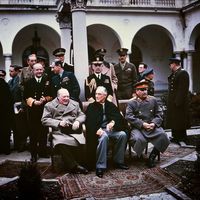
Franklin D. Roosevelt had hoped the Yalta conference (which discussed the future of Europe and Germany post-WWII) wouldn’t last more than five or six days. Winston Churchill, however, remarked, “I do ...
Robert Ingersoll, the well-known agnostic, once visited Henry Ward Beecher, the abolitionist and celebrated American preacher of the time. While there, he noticed a stunning globe that displayed the s...
The words: "On the seventh day God finished His work" (Genesis 2:2), seem to be a puzzle. Is it not said: "He rested on the seventh day"? "In six days the Lord made heaven and...
The anthropologist Desmond Morris has written: ‘Human beings are animals. They are sometimes monsters, sometimes magnificent, but always animals.’ That statement is correct as far as it goes. We are c...
Genesis 15:5, Isaiah 41:8, Isaiah 2:2-4, Matthew 28:16-20, John 12:32, Acts 2:1-11
The central vision of world history in the Bible is that all of creation is one, every creature in community with every other, living in harmony and security toward the joy and well-being of every oth...
What we call “nature” isn’t the same nature our great-grandparents knew. Even if they lived as far south as Baltimore, they could cut eighteen-inch blocks of ice off ponds in the winter to cool their ...
Genesis 2:9, Colossians 3:2, Matthew 13:1-17, Matthew 13:16-17
Years ago, my family and I visited Sequoia National Park in California. The highlight of this trip was seeing the Giant Sequoia redwoods, after which the park is named. These trees are awe-inspiring, ...
In this short excerpt, the author and priest Robert Farrar Capon describes just how intricate and beautiful one single part of God’s creation is, the chicken egg: Forget for the moment the fantastic...
Since Jesus isn’t attached to the same things we are, he can take the God-view, which is about more than redeeming our individual lives. God means to redeem the world, which is going to require some m...
Where did the observation of a Sabbath come from? Nahum Sarna points out that it is never instituted within Scripture. Instead, it is taken for granted that the people already observe it: “There can...