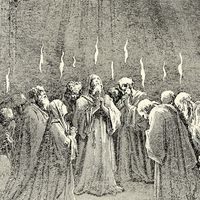
Acts 10:34-35, Acts 2:1-12, John 4:1-42, Romans 12:10, 1 John 4:20-21
God and Father of all, in your love you made all the nations of the world to be a family, and your Son taught us to love one another. Yet our world is riven apart with prejudice, arrogance, and pride....
Free will is not the liberty to do whatever one likes, but the power of doing whatever one sees ought to be done, even in the very face of otherwise overwhelming impulse. There lies freedom, indeed.
The British poet Samuel Taylor Coleridge was once engaged in a conversation with a man who believed children should never receive any kind of religious education or instruction, not until they were ol...
The current context of cultural and religious pluralism magnifies this development. After the disintegration of Christendom-a historical topical apparatus that gave cultural pride of place to Christia...
Most Christians are more than content to live out their lives surrounded by the trappings of our world, rather than to risk losing them in becoming a radical Christian. A radical Christian (by my defi...
Christians have no business thinking that the good life consists mainly in not doing bad things. We have no business thinking that to do evil in this world you have to be a Bengal tiger, when, in fact...
One of the areas often missed in a lot of Christian apologetics is the social setting in which a person encounters the gospel. For example, it is far easier to espouse "rational arguments" f...
John 10:6, John 17:21, 1 Corinthians 3:11, 1 Corinthians 1:10-13, Revelation 7:10
Before he was a household name, C. S. Lewis was a hardened atheist. From his teens to his early thirties, he vocalized many of the objections to Christianity that animate doubt in our age. After his s...
Christianity is without doubt the earthiest of all religions. Unlike most other religions, it doesn’t call you out of the physical, out of the body, or out of the world. Rather it tells you that God e...
We might say that convictions are firmly held moral or religious beliefs that guide our beliefs, actions, or choices…[M]ost Christians attach their convictions to Christ personally. In other words, we...
John 8:31-47, John 14:6, John 16:13, Luke 11:28, John 15:7, Matthew 7:24
Dallas Willard gave a series of lectures on the kingdom of God. In one, he discussed the popularity of the phrase, “The truth will set you free” by putting it in its proper kingdom context: The whole...
It has been my earnest endeavor ever since I have preached the Word, never to keep back a single doctrine that I believe to be taught of God. It is time that we had done with the old and rusty systems...
Anti-Intellectualism has been a problem in the church for some time now. Consider the words of the 17th century English clergyman Joseph Glanvill, who had this to say about the role of reason in faith...
In 1947, budding theologian Carl F. H. Henry wrote a short book titled The Uneasy Conscience of Modern Fundamentalism. In it he surveys the American fundamentalist movement’s engagement with the most ...
In one generation, the place of Christianity within culture dramatically shifted as we experienced what theologians and sociologists of religion call the “death of Christendom.” Christendom isn’t Chri...
Exodus 5:1-21, 1 Samuel 8:4-22, Isaiah 1:10-17 , Matthew 23:23-28 , Galatians 3:26-29, Psalm 146:3-9
One of the gravest dangers to the Christian faith is its wholesale appropriation of the larger culture. When this happens, the citizens of those places cannot recognize the difference between their cu...
Our business is to present the Christian faith clothed in modern terms, not to propagate modern thought clothed in Christian terms... Confusion here is fatal.
The man of pseudo-faith will fight for his verbal creed but refuse flatly to allow himself to get in a predicament where his future must depend upon that creed being true. He always provides himself w...
Matthew 22:39, Philippians 2:3-4, 1 Corinthians 10:24, Romans 15:1-2, Galatians 6:10, Romans 12:10, Acts 20:35, Matthew 25:35-40, Isaiah 58:6-7, Proverbs 19:17, Luke 10:30-37, James 2:15-16, 1 John 3:17, Proverbs 31:8-9, Matthew 25:40, Acts 11:29-30, 2 Corinthians 8:13-15, Acts 2:44-45, Acts 4:32-35, 1 Corinthians 12:25-26
Pursuing the common good has been a strong marker of the Christian church from the very beginning. The early church had many habits that they became known for, of course—including meeting frequently, ...
Truth-oriented Christians love studying Scripture and theology. But sometimes they’re quick to judge and slow to forgive. They’re strong on truth, weak on grace. Grace-oriented Christians love forgive...
Freedom of religion is one of the greatest gifts of God to man, without distinction of race and color. He is the author and lord of conscience, and no power on earth has a right to stand between God a...
Western Christianity has long taught that we are changed by what we believe and what we choose—that is, by the human will responding to God. Attachment to God would functionally replace the will as th...
Every other religion and philosophy says you have to do something to connect to God; but Christianity says no, Jesus Christ came to do for you what you couldn’t do for yourself. Every other religion s...
Matthew 2:1-4, Luke 15:3-7, John 8:1-11, Luke 19:10, John 1:16, Revelation 22:17
During a British conference on comparative religions, experts from around the world debated what, if any, belief was unique to the Christian faith. They began eliminating possibilities. Incarnation? O...
Most people today imagine that the point of Christianity is “to go to heaven when you die.” That’s what most believers believe. It’s what most unbelievers unbelieve. It’s certainly what journalists, b...