“Obedience” is not in favor today. American culture prizes everything that is rebellious, “edgy,” and—a favorite word of the cultural elite — “transgressive.” Staying within boundaries is nerdy; pushi...
There is an old story about a little boy who insisted on standing up on a pew during the church service. After several admonishments his mother severely threatened him if he stood up one more time. As...
After the fall of our first parents, boundaries were something to push past, to transgress. It’s worth pausing to note how we use the word transgression for “sin.” With its Latin roots, “across” and ...
Colossians 3:23-24, Psalm 51:17, Luke 21:1-4, Matthew 22:37, 2 Corinthians 9:7, Mark 12:41-44, Romans 12:1
I heard a story about a little boy who wanted to give God an offering but had nothing to give. He sat on the floor, watching people pass by and place their offerings in large wicker baskets. How he lo...
Isaiah 29:13, Amos 5:21-24, Proverbs 1:7, James 1:22-25 , Matthew 23:27-28, Psalm 51:16-17
We artful dodgers act as if we do not understand the New Testament, because we realize full well that [if we let on that we did] we should have to change our way of life drastically. That is why we in...
Genesis 45:1-15, Matthew 18:21-35, Ephesians 4:32, Romans 5:10, Mark 11:25, Colossians 3:13, Matthew 5:44
Frederick William I was a king of Prussia in the early 18th century. Personality-wise, he was described as exacting, frugal and austere. He was known to beat his children when they disappointed him. H...
1 Peter 5:7, Philippians 4:6-7, Matthew 6:25-27, Psalm 37:5, Psalm 46:1, 1 John 1:
When I think of the way God allows His servants to suffer, I can’t help but remember the classic story of poor Jack, who was out jogging. As he passed a cliff, he got a little too close to the edge, a...
Galatians 5:17, 1 Peter 2:25, Romans 8:7, James 4:4, Ephesians 2:1-2, Isaiah 59:2, 1 John 3:4
In the New Testament sin is not merely an individual, privatized transgression of a moral standard (sins is typically used for specific transgressions). It is far more radical than that. Sin is a mist...
Galatians 5:17, 1 Peter 2:25, Romans 8:7, James 4:4, Ephesians 2:1-2, Isaiah 59:2
In the New Testament sin is not merely an individual, privatized transgression of a moral standard (sins is typically used for specific transgressions). It is far more radical than that. Sin is a mist...
One of humanity’s problems is forgetfulness. Forgetfulness can happen at multiple levels, from a simple problem of recall to a posture of hard-heartedness and disobedience toward the command-giver. Wh...
One of humanity’s problems is forgetfulness. Forgetfulness can happen at multiple levels, from a simple problem of recall to a posture of hard-heartedness and disobedience toward the command-giver. Wh...
God intended man to have all good, but in . . . God’s time; and therefore all disobedience, all sin, consists essentially in breaking out of time. Hence the restoration of order by the Son of God ha...
Think for a second what it would be like if Satan were to tell the truth when he tempted people? Could you picture what that would look like? Imagine if Satan tried to tempt us honestly; it might go s...
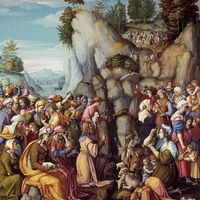
Why did Moses strike the rock? He was a man of faith, whose life had been characterized by trust in God (see, for example, the description of Moses in (Heb 11:24-29). So why did he fall into unbelief ...
Hebrews 13:20, Genesis 1:26-28, Genesis 1:26, Genesis 3:14-19, Genesis 3:14, Genesis 8:20-9, Genesis 9:5-6, Genesis 12:1-3, Galatians 3:16, John 8:56-58, 2 Corinthians 3:7-9, Deuteronomy 30:1-10, Deuteronomy 30:1, 2 Samuel 7:4-17, Luke 1:31-33, Acts 1:6, Revelation 19:16, Matthew 26:28, Mark 14:24, Luke 22:20, Hebrews 8:8-12, Galatians 3:13-20
Eternal covenant, Heb 13:20—The redemptive covenant before time began, between the Father and the Son. By this covenant we have eternal redemption, an eternal peace from the ‘God of peace’, through th...
Relational needs are not a by – product of the fall. Likewise, the need for rest, or Sabbath, is not an aftertaste of human sinfulness, unlike our chronic inability to receive rest. In fact, as we sha...
In the Bible, the children of Israel fall into disastrous behavior patterns whenever they abandon the majestic authority of God revealed to them through Moses at Mount Sinai. In fact, they commenced r...
After the fall of our first parents, boundaries were something to push past, to transgress. It’s worth pausing to note how we use the word transgression for “sin.” With its Latin roots, “across” and ...
1 Peter 2:12, Galatians 3:26-28, 1 Corinthians 12:12-13, John 13:34-35, Acts 2:42-47, Matthew 28:19-20, James 2:17-18
In Silence, Shusaku Endo writes of the journey of Portuguese Jesuits journeying to Japan. It is a conversation about those who intend to take the path of Jesus, only to find they are on the path of Ju...
Romans 6:1-2, 1 John 1:9, 1 Corinthians 6:18, James 1:14-15, Matthew 5:27-28, Hebrews 13:4, Proverbs 6:32
Some years ago I had a pastoral relationship with a couple of people who were deeply in love with each other. They believed that God wanted them to get married so they could consummate their love. The...
In his Rule for monasteries, St. Benedict considered grumbling a serious offense against community life. He wrote, “If a disciple grumbles, not only aloud but in his heart … his action will not ...
In Easter Everywhere: A Memoir, Darcey Steinke recounts how she, the daughter of a Lutheran minister, left her Christian profession. Moving to New York City she entered a life of club hopping and se...
In 1988, I (Randy) moved with my wife and two sons (ages two and eight weeks) from Texas to Sulawesi, an island north of Australia and south of the Philippines. We served as missionaries to a cluster ...
John 3:30, Philippians 2:3-4, James 4:6, 1 Peter 5:5-6, Matthew 23:1-12, Galatians 6:14
One of the cardinal rules of improvisational theater is that actors must never steal scenes. In her book Improvisation for the Theater , Viola Spolin bluntly puts it this way: “Any player who ‘st...
After the fall of our first parents, boundaries were something to push past, to transgress. It’s worth pausing to note how we use the word transgression for “sin.” With its Latin roots, “across” and “...
Deuteronomy 6:4-5, Exodus 19:5-6, Matthew 7:24-27, Luke 11:28, John 14:23, Psalm 40:6-8
It would seem that hearing is but a narrow channel pouring into the deep sea of doing. Yet the etymological dictionary taught me that the sharp distinction between hearing and doing is the result of h...
Solitude is the most radical of the disciplines for life in the spirit. In penal institutions, solitary confinement is used to break the strongest of wills. It is capable of this because it excludes i...
Genesis 22:1-14 , Daniel 3:16-28 , Esther 4:14-16 , Philippians 1:20-24 , Luke 9:23-25 , Psalm 31:14-15
In Four Quartets , T. S. Eliot writes that “any action is a step to the block.” He means that our actions always draw us closer to death, and in that sense every action we take is a wager of our ...
Genesis 3:7-8, Proverbs 28:13, 1 John 1:7-9, James 5:16, Galatians 6:1-2
Shame has two conflicting instincts. It needs to isolate and hide, and it needs a community in which to be transparent. Hiding, of course, usually wins. It is the easier and more natural of the two. B...
Psalm 46:10, 1 Kings 19:9-18, Matthew 5:5-15, Daniel 3:19-27, Exodus 13:21-22, Mark 1:35-39, Luke 5:16, Matthew 4:1-11, Mark 1:12-13, Genesis 32:24-30, Psalm 62:1, Hosea 2:14, Habakkuk 2:1, 1 Samuel 3:1-10, Isaiah 26:3
A certain brother went to Abbot Moses in Scete, and asked him for a good word. And the Elder said to him: Go, sit in your cell and your cell will teach you everything. An elder said: The monk’s ce...





![What If Satan Told The Truth When He Tempted Us? [Part 1 of 2]](https://a-us.storyblok.com/f/1016915/1836x1286/29ae46946e/dore-satan.jpg/m/200x200/smart)