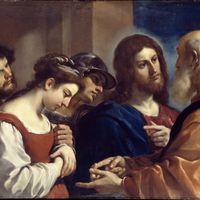
It was this…intention that made the primitive Christians such eminent instances of piety, that made the goodly fellowship of the Saints and all the glorious army of martyrs and confessors. And if you ...
Proverbs 22:6, Hosea 1:1-4, Matthew 18:1-5, Ephesians 6:4, Psalm 127:3
There’s a story about philosopher John Dewey walking with his young son on a cold, wet, and windy day. The boy, barefoot, was gleefully splashing in a puddle despite the weather. A concerned friend pa...
Ecclesiastes 4:9-12, 1 John 4:7-8, Mark 12:31, 1 Thessalonians 5:11, John 13:34
Mike Mason recounts how his friend Daniel Adair once said: Whenever I meet someone new, I take that person and fix him or her in my heart. To do this, I literally see that person as a star, and I ...
Beholding beauty produces fascination, and fascination is the best way to transform a person. Consider a young man in love. Parents, professors, mentors, and friends can plead with a young man to chan...
Joshua 24:14-15, 1 Kings 18:21, Daniel 1:8, Luke 9:62, Acts 4:19-20, Psalm 119:10-11
It was this…intention that made the primitive Christians such eminent instances of piety, that made the goodly fellowship of the Saints and all the glorious army of martyrs and confessors. And if you ...
1 Kings 17:8-16, Exodus 16:16-18, Matthew 25:31-46 , Luke 10:25-37, 2 Corinthians 9:6-8, Psalm 41:1-3
Robert Lupton offers insight into the complexities of human impoverishment, reminding us that in spite of our best intentions sometimes our philanthropic efforts can yield unintended consequences: “Wh...
Galatians 5:22-23, Ruth 1:16, Luke 10:38-42, Luke 10:25-37, Colossians 3:17, 1 John 3:18, Matthew 22:37-40
Identities—what makes us who we are, the kind of people we are—is what we love. More specifically, our identity is shaped by what we ultimately love or what we love as ultimate—what, at the end of the...
There is no mere world or matters of fact for covenant theology; there is always the wonder and duty to the concrete moment at hand, where God’s illimitable gift of life is given into our hands – to h...
Place is a quintessentially human concept in that it is part of our creatureliness. E. Casey, who has done the most comprehensive work on the philosophy of place, notes that “to be in the world, to be...
John 1:14, Matthew 9:36, Luke 19:10, John 15:15, Mark 10:45, Philippians 2:5-7, 1 John 4:9-10
The ways Jesus goes about loving and saving the world are personal: nothing disembodied, nothing abstract, nothing impersonal. Incarnate, flesh and blood, relational, particular and local. The ways em...
Luke 10:1-20, Galatians 2:20, Genesis 50:20, Genesis 37:50, Romans 8:28
You go nowhere by accident. Wherever you go, God is sending you. Wherever you are, God has put you there. God has a purpose in your being right where you are. Christ, who indwells you by the power of...
[Paying attention to those suffering most in a community] is a fundamental and paradoxical principle that goes to the heart of the gospel and the nature of eschatological existence.
You never really know a person until you know how that person perceives himself. I’m sure you have had experiences like I’ve had when you were sharing with another person, and that sharing became dee...
Christ as incarnate Word does not ‘exercise an influence’ on finite agents like that of ordinary finite causal agencies, nor does he introduce extra causal factors into the finite world or simply init...
The living human community that language creates involves living human bodies. We need to talk together, speaker and hearer here, now. We know that. We feel it. We feel the absence of it. Speech conne...
Entering a place that is new to us, or seeing a familiar place anew, we move from part to part, simultaneously perceiving individual persons and things and discovering their relationships, so that, wi...
The human being is defined through otherness. It is a being whose identity emerges only in relation to other beings, God, the animals and the rest of creation.
To inhabit a place is to dwell there in a practised way, in a way which relies upon certain regular, trusted, habits of behaviour. Our prevailing, individualistic frame of mind has led us to forget th...
Ephesians 5:18-21, Proverbs 20:1, 1 Corinthians 10:23-24, Colossians 3:5, James 1:12-15, Matthew 6:19-24, Ecclesiastes 6:9
In her thought-provoking book, Teach us to Want , Jen Pollock Michel describes the tension in listening to our deepest desires: some of them these desires are integral to our identity, but they a...
It is always easier for us to want to purify other people, and attempt a moral reformation among our neighbors. (Yet) how much have I helped to make her what she is?
Prayer, therefore, is not introspection. It does not look inward but outward. Introspection easily can entangle us in the labyrinth of inward-looking analysis of our own ideas, feelings, and mental pr...