The word [oxymoron], which appears in English for the first time in 1640, has an interesting etymology. In ancient Greek oxus means “sharp or pointed” and moros means “dull, stupid, or foolish.” So ox...
Luke 16:13, Matthew 6:21, 1 Corinthians 14:33, 2 Corinthians 5:17, Titus 2:11-12, 1 Peter 1:14-16
Less is more. Coined by Robert Browning and popularized by the German-born American architect Ludwig Mies van der Rohe, nothing could be further from the literal truth. But when people use this exp...
Philippians 2:5-8, Luke 2:6-7, Isaiah 53:2-3, John 13:4-5, Hebrews 2:14-17, Luke 22:27, Mark 10:42-45
Humble. Before Jesus, almost no pagan author had used “humble” as a compliment. Yet the events of Christmas point inescapably to what seems like an oxymoron: a humble God. The God who came to earth ca...
Matthew 23:11, Mark 9:35, Luke 17:33, 2 Corinthians 6:10, James 1:2
Paradox...comes from two ancient Greek words, para meaning “beyond” and doxa meaning “opinion.” Literally, it means “beyond opinion,” but it originally conveyed the sense of “being beyond the pale of ...
One of the great lies humans have been told is that if we gain enough power and influence, we can be remembered and make a lasting impact. In his short poem Ozymandias , Percy Bysshe Shelley highligh...
While summarizing the work of Joel Marcus, professor Lauren Winner describes the irony that in crucifixion, the victim is literally elevated above the rest of the crowd: As Joel Marcus explains, this...
Let us not mock God with metaphor, analogy, sidestepping, transcendence; making of the event a parable, a sign painted in the faded credulity of earlier ages: let us walk through the door. …………………………...
The very nature of light provides contrast. In juxtaposition, differing levels of light illuminate in extraordinary ways, helping us to see what we’ve been missing. In the late 1400s, the art world ma...
Matthew 4:10, James 4:7, 2 Corinthians 11:14, Ephesians 6:11-12, 1 Peter 5:8
There are two equal and opposite errors into which our race can fall about the devils. One is to disbelieve in their existence. The other is to believe, and to feel an excessive and unhealthy interest...
I witnessed a ritual sacrifice in the middle of a cool, third-wave coffee shop the other day. It’s the sort of place that attracts herds of bearded hipsters and where they brew your coffee by hand, on...
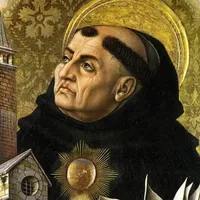
Of the medieval church’s many intellectual leaders, none has had more influence than the philosophical theologian Thomas Aquinas. He was born to a noble family near Naples, Italy, and joined the Domin...
In this short excerpt, Robert Farrar Capon makes a toast to the fact that all of creation, including our food, are in some sense superfluous. That is to say, God did not have to create anything, inclu...
Revelation 5:1-14, Matthew 25:31, Revelation 21:3-4
When you go into one of the great homes of the late Roman empire and you see a mosaic of Christ enthroned at the far end, you’re looking at the place where the emperor would sit. And the emperor would...
The man who prosecuted the infamous Manson family for their murders later wrote a book titled Helter Skelter. This phrase was taken from a song performed by a well-known rock music group. Manson...
John 1:5, Isaiah 53:3, Romans 5:8, Luke 23:33, Psalm 88:18
In 1998, Nick Cave, an Australian rock/pop artist, was asked by the Vienna Poetry Academy to give a series of talks on the nature of song-writing. A year later he gave a slightly revised version of th...
Matthew 23:12, Romans 12:3, 1 Peter 5:5, Daniel 4:37, Philippians 2:3-4
One of the great ironies of sin is that when human beings try to become more than human beings, to be as gods, they fall to become lower than human beings. To be your own God and live for your own glo...
There is, of course, that major obstacle in our way: that the Trinity is seen not as a solution and a delight, but as an oddity and a problem. In fact, some of the ways people talk about the Trinity o...
The Hebrew word for “fool” is very close to the Hebrew for “noble,” with only one letter different, and it is sometimes only in the outcome of their lives that the people considered noble by the peopl...
Human spectacle making is like sorcery—an enchantment, a spell, the creation of an image that calls for a response from our inner longings. Idolatry is the original tele-vision, the bringing of a far-...
I remember playing a game as a child in which we would bend one knee and grab our foot behind us and then try to race—limping, stumbling and falling over as we struggled across the grass toward a fini...
In this beautiful poem by the English Divine John Donne, our nature as both redeemed and still sinful is eloquently described: We think that Paradise and Calvary, Christ’s Cross and Adam’s Tree, ...
The Athenian general and politician Themistocles eventually alienated a large number of Greek City-States that came under their rule in the late 6th and early 5th centuries B.C. With his fleet of ship...
1 John 4:20, Matthew 6:6-8, Matthew 15:7-9, Titus 1:16, Proverbs 26:24-26, Romans 12:9
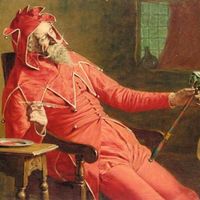
The ancient Greek word for actor was hypocritēs (ὑποκρῐτής), which, at first, only implied someone who explained or interpreted something. But by New Testament times, it was more negative. It suggest...
All kinds of competition are comparisons of the abilities or performance of one person or team to that of another. From elementary school spelling bees to professional sports, contestants compare thei...
Bumper stickers—and their counterparts on social media—make Simplicism seem virtuous: “Look at me! I’m a good and brave person for distilling this complex issue down to its essence and righteously tak...
Chesterton observes that when we grow up we tend to think that repetition as a sign of deadness, “like a piece of clockwork. People feel that if the universe were personal it would vary, if the sun we...
1 Corinthians 1:18, 2 Corinthians 13:4, Luke 24:5-6, John 16:20, Revelation 21:4
The cross of Jesus is the world’s supreme example of anguish, suffering and injustice, but it has nothing to do with tragedy as we experience it in Aeschylus, Sophocles, Euripides and Shakespeare—trag...
Remember Aesop’s Fox? Having spied some ripening grapes on a lofty branch, he tried with all his might to jump and take them. Once it dawned on him that he would not—could not—succeed, sulked away, sa...
In 1951, Isaiah Berlin wrote an essay about War and Peace and gave it a room-emptying title: “Leo Tolstoy’s Historical Skepticism.” Berlin’s publisher loved the essay but hated the headline, so he cha...