Romans 12:1, Isaiah 58:10, Philippians 2:3-4, Matthew 20:26-28, 1 Timothy 6:17-19, Luke 9:23
Merciful Jesus Give us courage to deny privilege to lay down favor and safety in order to take up the cross of opportunity and justice Too often we fail to do this Merciful Jesus Give us courage to d...
This prayer may be offered with or without the congregational response. Due to its length, consider using two or more liturgists to lead the prayer. VOICE ONE: God of Creation, God of Life, In your j...
Good farmers, who take seriously their duties as stewards of Creation and of their land's inheritors, contribute to the welfare of society in more ways than society usually acknowledges, or even k...
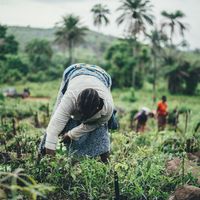
[W]e cannot really solve the problem of our world’s injustices by merely giving a little more of our surplus to fight hunger. More deeply, we need to be freed from our reliance on material consumption...
There is no escaping the need to manage nature. The best we can do is to observe the following rule: So manage nature as to minimize the need to manage nature. . . . We are destined to work our way ac...
The care of the Earth is our most ancient and most worthy, and after all our most pleasing responsibility. To cherish what remains of it and to foster its renewal is our only hope.
Whenever I have encountered any kind of deep problem with civilization anywhere in the world—be it the logging of rain forests, ethnic or religious intolerance or the brutal destruction of a cultural ...
Ironically, the best way to develop an attitude of responsibility toward the future is to cultivate a sense of responsibility toward the past. … We are born into a world that we didn’t make, and it is...
Food production entails at every stage judgments and practices that bear directly on the health of the earth and living creatures, on the emotional, economic, and physical well-being of families and c...
Our enormously productive economy demands that we make consumption our way of life, that we convert the buying and use of goods into rituals, that we seek our spiritual satisfactions, our ego satisfac...
To grow food and eat in a way that is mindful of God is to collaborate with God’s own primordial sharing of life in the sharing of food with each other. It is to participate in forms of life and frame...
The concept of shalom resonates with vision of an ideal society in other cultures as well, notably in Asia and Africa. In Asia, sangsaeng is an ancient concept “of sharing community and economy togeth...
James 1:2-4, Romans 5:3-5, 1 Peter 1:6-7, 2 Corinthians 4:16-18, Isaiah 40:31
It’s human nature to resist change—particularly when it comes in the form of adversity or challenges. But change is inevitable, and developing the trait of resilience helps us not only survive change,...
Sadly, the need for recovery is often viewed as evidence of weakness rather than an integral aspect of sustained performance. The result is what we give almost no attention to renewing and expanding o...
The single greatest lesson the garden teaches is that our relationship to the planet need not be zero-sum, and that as long as the sun still shines and people still can plan and plant, think and do, w...
Precisely because our frenzy is fundamentally aimless while remaining driven, we set ourselves goals whose main purpose is to keep the frenzy going until it consummates itself in sloth. If at present ...
The most exemplary nature is that of the topsoil. It is very Christ-like in its passivity and beneficence, and in the penetrating energy that issues out of its peaceableness. It increases by experienc...
If you walk into a woods and select a ten-foot sapling, you can bend that sapling over, let it go, and it will return to its normal height and straightness. However, if you bend it again, this time a ...
Almighty God, in giving us dominion over things on earth, you made us fellow workers in your creation: Give us wisdom and reverence so to use the resources of nature, that no one may suffer from our a...
Societies the world around are currently in desperate straits trying to produce people who are merely capable of coping with their life on earth in a nondestructive manner.
What we call “nature” isn’t the same nature our great-grandparents knew. Even if they lived as far south as Baltimore, they could cut eighteen-inch blocks of ice off ponds in the winter to cool their ...



![[W]e cannot really solve the problem](https://images.unsplash.com/photo-1556527255-48a2b13c9981?ixid=M3w1NzU0OTZ8MHwxfHNlYXJjaHw4fHxiZWdnYXJ8ZW58MHwwfHx8MTc0MTcwNjAyMHww&ixlib=rb-4.0.3&q=80&auto=compress&fit=crop&w=200&h=200)