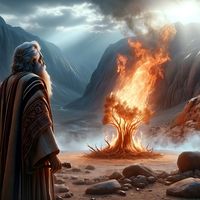
Isaiah 55:1–3, Exodus 3:1–12, Proverbs 9:1–6, Matthew 11:28–30, John 1:35–39, Psalm 3:4:8
One of the reasons I love a good invitation is that I get tired of being told what to do. As the very responsible oldest daughter of a pastor and someone who entered vocational ministry at a young age...
Exodus 3:11–12, 1 Kings 19:9–12, Isaiah 55:8–9, Luke 1:34–38 , John 20:24–29, Psalm 13:1–2
Larry King, who has made his living speaking to people as a television talk show host, believes that asking questions is the secret of good conversation. He says, "I'm curious about everythin...
On February 24, 1791, Christian revivalist and pastor John Wesley penned a letter to encourage a Christian walking through some faith challenges: Unless the divine power has raised you up . . . I...
In his book “Where Is God When It Hurts?”, author Philip Yancey shares an unfortunate, yet central dynamic related to how Americans respond to pain: we do everything possible to avoid it. That means p...
A number of mature Christians have described the Christian journey as one in which the follower of Jesus experiences different levels of grace. Let us imagine . . . that there are many rooms in t...
When the Reformers broke with Rome and claimed the view that the Bible was to be the supreme authority of the church (sola Scriptura), they were very careful to define basic principles of interpretati...
John 1:1-5, 14, Luke 4:16-21, Psalm 19:7-9 , Genesis 1:1-3, Exodus 3:4-10 , Isaiah 55:10-11
WORDS. We think words, hear words, speak words, sing words, write words, and read words—all the time. Every day. What do words have to do with Christianity? Almost everything. At every stage in redemp...
Genesis 12:1–3, Exodus 3:1–12, Isaiah 53:, Matthew 22:15–22 , John 4:1–42 , Acts 17:16–34
The world of Jesus was not the Old Testament Hebrew world. Like the United States now, Israel was multicultural, including a combination of Aramaic, Greek, and Roman influences. The people looked Jewi...
Exodus 3:7–10, Isaiah 58:6–10 , Amos 5:21–24, Luke 4:16–21, James 2:1–7, Psalm 9:9–10
I can count on the fingers of one hand the number of times that I have heard a sermon on the meaning of religion, of Christianity, to the man who stands with his back against the wall. It is urgent th...
We all live between two worlds. We are planted here on earth while our hope is in heaven. We are given work to do in temporary soil that, we’re told, has the potential to spring up into unending fruit...
Genesis 37:50 , Exodus 3:4, 1 Samuel 16:, John 8:1-11, Romans 2:2, Psalm 139:13-16
Author David Seamands once wrote, “Children are the best recorders but the worst interpreters.” I remember a lot about being a kid. I remember colors and moments, arguments and smells… Though my me...
Isaiah 65:17-25, Micah 4:1-4, Exodus 3:7-10 , Luke 4:18-19, Matthew 5:1-12, Psalm 146:7-9
Author and Episcopal priest Stephanie Spellers suggests that instead of imagining a kingdom, a better way for us to understand what Jesus had in mind when he spoke of this script, this new way of livi...
Psalm 84:5-7, John 4:5-26, Luke 2:41-50, 1 Kings 19:3-13, Exodus 3:1-12, Genesis 12:1-4
A pilgrimage is a way of praying with your feet. You go on a pilgrimage because you know there’s something missing inside your soul, and the only way you can find it is to go to sacred places, places ...
One of the great problems of history is that the concepts of love and power have usually been contrasted as opposites, polar opposites, so that love is identified with a resignation of power, and powe...
Genesis 27:18-29, Exodus 3:11-14, Ecclesiastes 2:10-11, Luke 15:11-32, Matthew 23:27-28 , Psalm 139:23-24
Thomas Merton once said, “Every one of us is shadowed by an illusory person: a false self, This is the man I want myself to be but who cannot exist, because God does not know anything about him. A...
Phillips Brooks, the author of the famous hymn “O Little Town of Bethlehem.” He wrote: Sad will be the day for every man when he becomes absolutely contented with the life he is living, with the thoug...
Exodus 3:7-10, Isaiah 58:6-10, Micah 6:6-8, Matthew 23:27-28 , James 1:26-27, Psalm 146:7-9
A major stumbling block for many earnest seekers is the compelling evidence throughout history that terrible things have been done in the name of religion. This applies to virtually all faiths at some...
Within the Christian community this leads to a prominence of teaching on the will of God and how to know it. Russ Johnston draws upon his own wide experience to remark how this continues to be one of ...
There are also many historical examples of Christians faithfully using political means to fight for justice and righteousness. William Wilberforce: Politician and Abolitionist William Wilber...
Exodus 3:7-10, Micah 6:8, Matthew 25:40, Galatians 6:2, Psalm 82:3-4
In 1830, the Indian Removal Act led to what’s known as the Trail of Tears, in which almost fifty thousand indigenous people were removed from the southeastern United States and relocated west of the M...
Genesis 12:1-4 , Exodus 3:1-12, Micah 6:8, Matthew 4:18-22 , Ephesians 2:10, Psalm 90:12 , Matthew 9:9
It is helpful to understand the call of God in three distinct ways. First, there is the call to be a Christian. The God of creation invites us to respond to his love. This call comes through Jesus, wh...
G. Campbell Morgan offers some sharp insight on the topic of hearing God’s voice. He observes that when God speaks to us, His word often arrives as a disruptive force in our lives. He elaborates furth...
There are no vowels in the Hebrew (YHWH), which makes it impossible to know exactly what the word is. Some old translations say ‘Jehovah’. Modern scholars tend to speak of ‘Yahweh’. When the word appe...
“When Abram came to Egypt, the Egyptians saw that Sarai was a very beautiful woman” (Gen 12:14). What is considered beautiful is one of those things that often goes without being said. Sarah was about...
Whether the Hebrew Genesis account was meant to be science or not, it was certainly meant to convey statements of faith. As will be shown it is part of the biblical polemic against paganism and an int...
Aseity refers to God’s self-existence (a—from, se—oneself). God exists ‘from himself.’ God owes his existence and completeness as God to nothing outside himself. . . . God’s act of creation was not c...
The temptation to sculpt God according to our expectations and presuppositions, to make this God much like another, is strong with us. You see it all down through history: in the Middle Ages it seemed...
God uses our identity crises to reveal who we are and who he is. Sometimes these crises come out of nowhere. Something devastating happens. Someone close to us dies. We are diagnosed, or someone we kn...
Especially in the Hebrew Bible, wilderness is the privileged site where God comforts the Hebrew people or their representatives at times of crisis in their lives. In the wilderness God calls and leads...