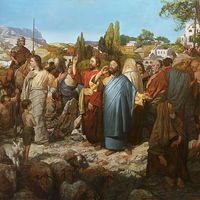
John 13:25, Luke 7:38-39, Luke 15:1-2, Luke 19:5-7, Revelation 3:20
It would be impossible to overestimate the impact these meals must have had upon the poor and the sinners. By accepting them as friends and equals Jesus had taken away their shame, humiliation, and gu...
Ecclesiastes 3:1-8, Ecclesiastes 3:11, Luke 15:11-32, Proverbs 20:29, Psalm 90:10-12
Someone once quipped that we spend the first half of our lives struggling with the sixth commandment ( Thou shalt not commit adultery ) and the second half of our lives struggling with the fifth comma...
After the fall of our first parents, boundaries were something to push past, to transgress. It’s worth pausing to note how we use the word transgression for “sin.” With its Latin roots, “across” and ...
Mending is an act that requires courage. To mend can be to repair a relationship, as described in the line above from Shakespeare’s Much Ado About Nothing . In this splendid play, Benedick and Be...
Shame makes its way into our stories at an early age. So early, in fact, that we usually have no conscious memory of our initial encounters with it. This can take place as early as fifteen to eighteen...
If you think of your identity and heart as an engine, you could say there is a kind of fuel that powers it cleanly and efficiently—and a kind of fuel that is not only polluting but also destroys the e...
Mark 12:37, Matthew 19:24, Matthew 7:5, Mark 3:25, Mark 7:27, Mark 8:15, Luke 15:11–32, Luke 10:25–37, Luke 18:9–14-, 25:31–46
One of my daughters has been singing a song about Jesus that contains the line “Jesus was a story-tellin’ man.” When I first heard that line it seemed a bit flip, as so many contemporary Christian son...
In her memoir, Confessions of a Good Christian Girl, Tammy describes the internal turmoil she experienced trying to be a good, rule-following Christian who had unexpectedly built an entire life arou...
There were three annual festivals in Israel—Passover along with the Feast of Unleavened Bread, The Feast of Weeks (Pentecost), and the Feast of Tabernacles. You can read about them in Leviticus 23 and...
Carl Jung, one of the early pioneers of modern psychology, wrote this from his years of experience as a therapist: The acceptance of oneself is the essence of the moral problem and the epitome of ...
Genesis 2:18-25, Exodus 16:2-12 , Proverbs 3:11-12, Psalm 1:4, Matthew 18:1-4, Luke 15:11-32, Matthew 18:3
Desire is part of what it means to be a child, as implied in Jesus’ words to his disciples when he tells them, “Truly I tell you, unless you change and become like little children, you will never ente...
Genesis 4:1-16, 1 Samuel 16:6-13, Jonah 3:4 , Luke 15:25-32, Philippians 3:4-9, Psalm 103:8-12
In her book, Grace for the Good Girl , Emily P. Freeman charts her early years growing up in the church believing in grace but living according to the rules of perfection. One thing that would, a...
I once asked a psychologist who had been in practice for over forty years what is the most common regret his clients felt. Without hesitation, he said, “Selfishness.” Why was I not the spouse or paren...
Isaiah 49:15, John 10:14, Luke 12:6-7, Psalm 139:1-3, 2 Timothy 2:19, Isaiah 43:1, Matthew 10:29-31, Psalm 91:4, Deuteronomy 32:11, Job 39:1-2, Luke 15:4-6
The guillemot, a small Arctic seabird, nests in dense colonies on the rocky cliffs of the North Atlantic and Arctic. Thousands of these birds gather in tight spaces, with hundreds of females laying th...
Matthew 13:, Exodus 14:21-31, Daniel 3:13-30 , 1 Kings 18:20-40, Luke 15:11-32, Psalm 23:
In the second century before Christ the great rival to Roman power in the Mediterranean world was Carthage, the Phoenician city-state located on the north African coast. It had been founded in 822 B.C...
Genesis 4:6-7, 1 Samuel 1:6-8, 18 , Luke 15:28-32, Jonah 4:1-4 , Ephesians 4:31-32, Psalm 55:22
Sometimes we have to “step over” our anger, our jealousy, or our feelings of rejection and move on. The temptation is to get stuck in our negative emotions, poking around in them as if we belong there...
Genesis 27:18-29, Exodus 3:11-14, Ecclesiastes 2:10-11, Luke 15:11-32, Matthew 23:27-28 , Psalm 139:23-24
Thomas Merton once said, “Every one of us is shadowed by an illusory person: a false self, This is the man I want myself to be but who cannot exist, because God does not know anything about him. A...
Genesis 3:1-24, Isaiah 6:1-8, Genesis 50:15-21, John 8:1-11, Luke 15:11-32, Psalm 51:1-17
In Guilt and Grace , Swiss physician and Christian, Paul Tournier, writes… I cannot study this very serious problem of guilt with you without raising the very obvious and tragic fact that rel...
David Seamands (1922-2006) was an author, scholar, evangelical renewal leader and counselor. In an article for Christianity Today , he shares his earnest experience of many of his patients who we...
Genesis 50:15-21 , Exodus 16:2-15 , Jonah 3:4, Psalm 103:8-12 , Matthew 20:1-16 , Luke 15:11-32
One of the biggest challenges in the Christian journey is grasping the heart of grace. Oftentimes there is an internal battle between our theology and our lived experience. In this short excerpt, Fred...
2 Samuel 23:1-7, Psalm 23:, 2 Samuel 7:5-16, John 10:1-18, Matthew 18:12-14, Luke 15:3-7, Ezekiel 34:11-16
Do you remember seeing the golden sarcophagus of the pharaoh Tutankhamun ? What has he got in his hands? If you remembered that he was holding a shepherd’s crook, you’re right (he is also holding a...
In his excellent book, The Prodigal God , Timothy Keller corrects the notion that this classic parable (The Parable of the Prodigal Son, Lk. 15) is not only about the lostness of the younger ...
Philippians 2:6-8, John 1:10-11, Isaiah 53:3-4, Matthew 11:19, Mark 15:34, Isaiah 53:12, Luke 15:20-24, Revelation 7:13-14
In this excerpt, the French monastic leader Frere Pierre Marie, shares an interpretation of Jesus as the true prodigal son—bringing all of us home with him: He, who is born not from human stock, or ...
Luke 15:11-32, Matthew 18:22-35, Luke 16:19-31, Matthew 13:3-8, Matthew 20:1-16, Matthew 13:24-33, Matthew 13:44-50, Mark 4:26-29
The thrust of the parables is to subvert the distorted myths in which people live their lives. To understand what we mean by “living in a myth” just think of a couple of our own contemporary myths. Ta...
Let us begin with a question. Do you really know how to enjoy the world? Do you know how to enjoy yourself? One of the greatest parables in the New Testament has to do with the search for enjoyment an...
For all the wandering, this is the first question of the Old Testament—God coming to ask after you, “Where are you?” Where are you in your life? Where are you—from Me? To get where you want to go, t...
“I live in a small, rural community. There are lots of cattle ranches around here, and, every once in a while, a cow wanders off and gets lost . . . Ask a rancher how a cow gets lost, and chances are ...
1 Kings 19:1-18, Psalm 88:null, Psalm 102:7, Isaiah 53:3, Matthew 4:1-11, Luke 15:11-32
A therapist once told me that the most common complaint he heard from his patients was the feeling that they didn’t belong. The feeling of being an imposter, or of being outside things, of not fitting...
Psalm 42:1-2, 1 Samuel 1:9-18, Psalm 63:1, Luke 15:11-32, Lamentations 3:19-24, Romans 8:22-23, Exodus 2:23-25, Hosea 3:1, John 20:11-18
In 1998, Nick Cave*, an Australian rock/pop artist, was asked by the Vienna Poetry Academy to give a series of talks on the nature of song-writing. A year later he gave a slightly revised version of t...
Matthew 7:9-11, Luke 15:11-32, Galatians 4:6-7, 1 John 3:1, Proverbs 3:11-12, 2 Corinthians 6:18, Hebrews 12:7-10
In his excellent book, The Magnificent Story , James Bryan Smith shares a true story from Japanese culture that illustrates just how demanding strict disciplinarian fathers can be. The Japanese...