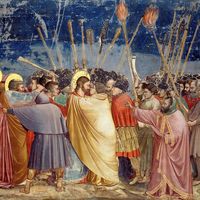
2 Chronicles 7:14, Luke 19:1-10, Luke 15:11-32, Isaiah 1:18, James 5:16
The Celebrant and People together, all kneeling Most holy and merciful Father: We confess to you and to one another, and to the whole communion of saints in heaven and on earth, that we have sinne...
[W]e cannot really solve the problem of our world’s injustices by merely giving a little more of our surplus to fight hunger. More deeply, we need to be freed from our reliance on material consumption...
Let us pray. Almighty, powerful, creator God So often we think we know best. We confess to you our sin alongside the sin of all humanity. We have tried to master creation rather than care for it. We ...
Galatians 5:17, 1 John 1:8, Proverbs 4:23, Romans 7:18-19, Mark 7:21-23, James 1:14-15
In a famous Earth Day 1971 Pogo comic strip by Walt Kelly, the titular Pogo and his companion Porkypine are enjoying nature when they come upon a clearing filled with trash. Pogo says the iconic line,...
Have you ever wondered the impact noise can have on our cognitive ability? Psychologist Arlene Bronzaft was curious to find out. Studying Public School 98 on the northern tip of Manhattan, Bronzaft fo...
No one likes to talk about human population. Christians in particular are rightly wary of the ways in which population discussions have sometimes served to denigrate the value of human life and the bl...
There is no escaping the need to manage nature. The best we can do is to observe the following rule: So manage nature as to minimize the need to manage nature. . . . We are destined to work our way ac...
Whenever I have encountered any kind of deep problem with civilization anywhere in the world—be it the logging of rain forests, ethnic or religious intolerance or the brutal destruction of a cultural ...
Our destruction of nature is not just bad stewardship, or stupid economics, or a betrayal of family responsibility; it is the most horrid blasphemy. It is flinging God's gifts into His face, as if...
Good farmers, who take seriously their duties as stewards of Creation and of their land's inheritors, contribute to the welfare of society in more ways than society usually acknowledges, or even k...
Romans 12:16, John 13:14-15, Luke 6:20-21, Matthew 7:12, Proverbs 22:2
I read George Orwell’s book about class and working conditions in early-twentieth-century England, The Road to Wigan Pier . The book’s most famous passage considers smell: Here you come to the...
When we insist on doing too much, we are not only inflicting the damage of this choice on ourselves, we are sharing this damage with those we love the most.
Almighty God, in giving us dominion over things on earth, you made us fellow workers in your creation: Give us wisdom and reverence so to use the resources of nature, that no one may suffer from our a...
From drugs and alcohol to TV and workaholism, we are increasingly a society that fulfills T.S. Eliot’s description of a people “distracted by distraction.” There is hardly a public menace we can name ...
Water is an essential requirement for any form of life. The earth is blessed with huge volumes of water at the surface, which is one of the main reasons why it is habitable. Seventy percent of the ear...
There is a pervasive form of contemporary violence to which the idealist most easily succumbs: activism and overwork. The rush and pressure of modern life are a form, perhaps the most common form, of ...
The great danger is to always single out some aspect of God’s good creation and identify it, rather than the alien intrusion of sin, as the villain. Such an error conceives of the good-evil dichotomy ...
Patience is like good motor oil. It doesn't remove all the contaminants. It just puts them into suspension so they don't get into your works and seize them up. Patient people have, so to speak...
Increasing urbanization also means that the capacity for a single disaster such as an earthquake or flood to affect a huge and growing number of people is now vastly increased, even compared to a cent...
What we call “nature” isn’t the same nature our great-grandparents knew. Even if they lived as far south as Baltimore, they could cut eighteen-inch blocks of ice off ponds in the winter to cool their ...


![[W]e cannot really solve the problem](https://images.unsplash.com/photo-1556527255-48a2b13c9981?ixid=M3w1NzU0OTZ8MHwxfHNlYXJjaHw4fHxiZWdnYXJ8ZW58MHwwfHx8MTc0MTcwNjAyMHww&ixlib=rb-4.0.3&q=80&auto=compress&fit=crop&w=200&h=200)