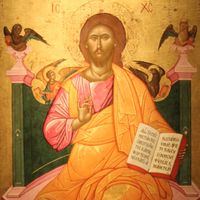
He who loves his dream of community more than the Christian community itself becomes a destroyer of the latter, even though his personal intentions may be ever so honest and earnest and sacrificial.
Luke 16:10, Acts 17:26-27, Zechariah 4:10, Matthew 25:21, Colossians 3:23-24
One of the seductions that continues to bedevil Christian obedience is the construction of utopias, whether in fact or fantasy, ideal places where we can live the good and blessed and righteous life w...
One of the seductions that continues to bedevil Christian obedience is the construction of utopias, whether in fact or fantasy, ideal places where we can live the good and blessed and righteous life w...
Every one of the great revolutionists, from Isaiah to Shelley, have been optimists. They have been indignant, not about the badness of existence, but about the slowness of men in realizing its goodnes...
1 Corinthians 13:13, Titus 2:11-13, Hebrews 11:1, Philippians 3:20, 1 Peter 1:3-4, 2 Corinthians 4:17-18, Romans 8:24-25
Hope is one of the Theological virtues. A continual looking forward to the eternal world is not as some modern people think, a form of escapism or wishful thinking. But it's one of the great thing...
There have been times, not least the time of the birth of Athenian democracy, when most of the people who thought and wrote about human wholeness concluded that no one could be a whole human being, no...
Philippians 4:8, Exodus 32:, Ecclesiastes 12:13, Matthew 19:16-30, Proverbs 4:23, Romans 12:2, 1 John 2:15-17
Orwell feared we would become a captive culture. Huxley feared that we would become a trivial culture. . . . Orwell feared that what we hate will ruin us. Huxley feared that what we love will ruin us.
Isaiah 65:17-25, Micah 4:1-4, Exodus 3:7-10 , Luke 4:18-19, Matthew 5:1-12, Psalm 146:7-9
Author and Episcopal priest Stephanie Spellers suggests that instead of imagining a kingdom, a better way for us to understand what Jesus had in mind when he spoke of this script, this new way of livi...
Matthew 25:34-40, Acts 2:42-47, Matthew 21:12-13, Luke 10:25-37, Romans 12:2, Matthew 5:13-16
To focus our expectation in an otherworldly salvation has the potential to dissipate our resistance to societal evil and the dedication needed to work for the redemptive transformation of this world.
Questions of implementation are of no consequence until the vision can be imagined. The imagination must come before implementation. Our culture is competent to implement almost anything and to imagin...
The mythologies of the digital age center around the idea that waiting is keeping you from obtaining what you want and holding you back from living a more fulfilling and productive life.
...left to ourselves we lapse into a kind of collusion with entrophy, acquiescing in the general belief that things may be getting worse but that there's nothing much we can do about them. And we ...
Disturb us, Lord, when we are too pleased with ourselves; when our dreams have come true because we dreamed too little; when we arrived safely because we sailed too close to the shore. Disturb us, Lo...
Luke 15:11-32, Matthew 18:22-35, Luke 16:19-31, Matthew 13:3-8, Matthew 20:1-16, Matthew 13:24-33, Matthew 13:44-50, Mark 4:26-29
The thrust of the parables is to subvert the distorted myths in which people live their lives. To understand what we mean by “living in a myth” just think of a couple of our own contemporary myths. Ta...
The manner in which Christians have thought about life after death, or about the world to come, has varied considerably from century to century and from place to place. It is easy enough to understand...
Revelation 21:1-4, John 14:2-3, Hebrews 13:14, Isaiah 65:17, 2 Peter 3:13, Philippians 3:20-21
In her book Keeping Place: Reflections on the Meaning of Home, Jen Pollock Michel reflects on the nature of home in a transient age. In this short excerpt, Michel describes the central longing in both...
Journey all over the universe in a map, without the expense and fatigue of traveling, without suffering the inconveniences of heat, cold, hunger, and thirst.
I believe like a child that suffering will be healed and made up for, that all the humiliating absurdity of human contradictions will vanish like a pitiful mirage, like the despicable fabrication of t...
Titus 3:4-5, Ephesians 2:8, Luke 15:11-32, 1 Corinthians 2:9, Psalm 30:5, Ruth 4:13-17
J. R. R. Tolkien coined the term "eucatastrophe" to refer to the unexpected happy ending at the end of a fairy tale, achieved by grace rather than effort. The consolation of fairy-stories,...
Revelation 21:1-2, 2 Peter 3:13, Titus 2:13, Romans 8:18, Isaiah 65:17, Matthew 6:10
Some people call religion the opiate of the people. Karl Marx had Christianity and our eschatological hope in mind when he said that. Some contend that pointing to the future as the Christian’s ultima...
Acts 17:6, Revelation 5:9-10, Galatians 3:28, Romans 8:17, Matthew 5:3
The kingdom of God turns the Darwinist narrative of the survival of the fittest upside down (Acts 17:6–7). When the church honors and cares for the vulnerable among us, we are not showing charity. We ...
Matthew 5:48, 1 John 3:2-3, Galatians 5:16-17, Philippians 3:13-14, Colossians 3:1-2, Ephesians 4:22-24
The scholastics used to say: Homo non proprie humanus sed superhumanus est —which means that to be properly human, you must go beyond the merely human.
God's Kingdom is "present in its beginnings, but still future in its fullness. This guards us from an under-realized eschatology (expecting no change now) and an over-realized eschatology (ex...
"Nothing discernible to the eye of the spirit is more brilliant or obscure than man; nothing is more formidable, complex, mysterious, and infinite. There is a prospect greater than the sea, and i...