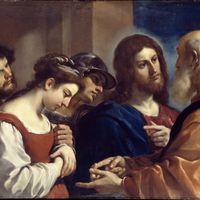
One of my favorite Bible illustrations of someone willing to go against the norms of society to befriend another based on love and forgiveness is found in the New Testament book of Philemon. It is a m...
Societies the world around are currently in desperate straits trying to produce people who are merely capable of coping with their life on earth in a nondestructive manner.
The distinction between drugs that are considered legal or illegal in a given society is often based on much more than just scientific information. Traditions, economics, religion, and the popular med...
The French sociologist Pierre Bourdieu put it this way. Each of us has what he called a habitus: a set of dispositions to respond more or less spontaneously to the world in particular ways, without mu...
As people seek out the social settings they prefer—as they choose the group that makes them feel the most comfortable—the nation grows more politically segregated—and the benefit that ought to come wi...
Our culture is no longer banded together by shared beliefs; it’s drawn together by shared spectacles. Like Halloween costumes designed to match the most popular movies, we seek our self-identity insid...
In every walk of life each man puts on a personality and outward appearance so as to look what he wants to be thought; in fact you might say that society is entirely made up of assumed personalities.
Our enormously productive economy demands that we make consumption our way of life, that we convert the buying and use of goods into rituals, that we seek our spiritual satisfactions, our ego satisfac...
The normal course of day-to-day human interactions locks us into patterns of feeling, thought, and action that are geared to a world set against God. Nothing but solitude can allow the development of ...
In reality, moral rules are directions for running the human machine. Every moral rule is there to prevent a breakdown, or a strain, or a friction, in the running of that machine. That is why these ru...
“Moral”…is an orientation toward understandings about what is right and wrong, just and unjust, that are not established by our own actual desires or preferences but instead are believed to exist apar...
But even in the much-publicized rebellion of the young against the materialism of the affluent society, the consumer mentality is too often still intact: the standards of behavior are still those of k...
Our judgements of good and evil ... presuppose God as the standard. If there's no God, there's neither good nor evil. There's just nature doing what it does.
Luke 18:14, Proverbs 29:23, Isaiah 2:11, 1 Peter 5:5, Romans 12:3, James 4:6, Proverbs 16:18
Up until the twentieth century, traditional cultures (and this is still true of most cultures in the world) always believed that too high a view of yourself was the root cause of all the evil in the w...
These, then, are the two points I wanted to make. First, that human beings, all over the earth, have this curious idea that they ought to behave in a certain way, and cannot really get rid of it. Seco...
The current popular notion that judging others is in itself a sin leads to such inappropriate maxims as 'I'm okay and you're okay.' It encourages a conspiracy of moral indifference whi...
Human life in the western world today... is characterized by an enormously wide range of incompatible truth claims pertaining to human values, aspirations, norms, morality, and meaning— A hyperplurali...
If we’re unable or unwilling to discern a norm to judge what is good and evil, the whole moral order will tumble into confusion. If we don’t get the moral facts straight, a variety of “crises” will co...
We really must understand that the lust for affluence in contemporary society is psychotic. It is psychotic because it has completely lost touch with reality. We crave things we neither need nor enjoy...
The idol of niceness refers to the ways we make ourselves pleasant, agreeable, acceptable, or likable in order to get something. We use niceness to achieve belonging or avoid conflict, but we also use...