Ezekiel 47:9, Galatians 6:2, Romans 12:4-5, Matthew 28:19-20, 1 John 1:7
The ancient Greek word for intimate fellowship is koinonia. In the church, we can suffer from what might be called koinonitus: fellowship turned in on itself; cliques and enclaves and tight-knit group...
In his enjoyable little book on Christian pilgrimage, British scholar N.T. Wright shares three propositions on the value that pilgrimage can bring to a Christian’s life: First, pilgrimage to holy pla...
Matthew 14:19-20, John 9:6-7, Mark 2:3-4, John 13:4-5, Mark 1:40-42, Luke 2:7, John 1:14
The gospels are earthy. People are close to the earth. They travel here and there by foot. They eat the live heads of grain growing from the soil as they walk through the fields. They get grubby and h...
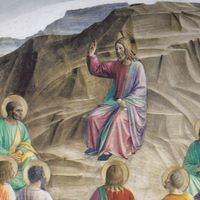
Pastor and Professor Darrell W. Johnson sets the scene for the Sermon on the Mount with great description. This could serve as a model for the beginning of a sermon on the S.O.M. They were sitting i...
Intertwined Narratives Jesus’ encounters with Jairus’ daughter and the bleeding woman are sandwiched together with the intention that the two narratives would unlock and help to interpret the other....
Pastor: “Truly I understand that God shows no partiality, but in every nation anyone who fears him and does what is right is acceptable to him. As for the word that he sent to Israel, preaching good n...
The presence of two anonymous disciples in the list in v. 2 [of John 21] (“…Simon Peter, Thomas called the Twin, Nathanael of Cana in Galilee, the sons of Zebedee, and two others of his disciples ...
This prayer may be offered with or without the congregational response. Due to its length, consider using two or more liturgists to lead the prayer. VOICE ONE: Almighty God, Maker of Heaven and Eart...
All of us share in what D. Elton Trueblood calls “the common ventures of life”—birth, marriage, work, death. Jesus, in his life and in his teaching, gave sacramental significance to these ordinary exp...
R. Paul Stevens, Professor Emeritus at Regent College, was visiting the Wedding Church in Cana of Galilee with his wife Gail when a hilarious event took place. After introducing himself to the residen...
John 20:29, Romans 10:17, Luke 24:31-32, Acts 9:1-6, 1 Corinthians 15:17-20, Hebrews 4:12, John 20:24-28
From his start in life, you would not have expected Andrei Borisovich Bloom to have ended up Metropolitan Anthony of Sourozh, founder of the Russian Orthodox diocese for Great Britain and Ireland. Bo...
Isaiah 11:6-9, Daniel 7:13-14, 1 Thessalonians 4:16-17, 2 Peter 3:10-13, Mark 1:15, Acts 2:38
N. T. Wright relates a story from Josephus that illustrates the meaning of "repent and believe" in the first century. Around AD 66, Josephus made a military expedition to Galilee to put dow...
Luke 10:25-37, Matthew 13:34-35, Acts 13:15, Mark 12:28-31, John 10:22-23
As in buying real estate, three principles are crucial to understanding a person’s words: location, location, and location. We cannot make sense of what someone says unless we understand the context i...
In all our pilgrimages, we begin by going back to our roots. When Christians go to the Holy Land today, we do not go because God is present there in a way in which he is not in New York or Nottingham,...
Acts 1:3, Luke 10:9, Matthew 10:7, John 3:16, Matthew 6:33, Luke 4:43
The call to 'believe in the gospel', or to 'believe in me', does not suggest that Jesus was inviting Galilean villagers to embrace a body of doctrine – not even a basic 'theory'...
Matthew 22:37-39, Matthew 25:35-40, Luke 3:11, Ephesians 5:2, Acts 2:42-47, James 2:14-17, Galatians 2:10, Psalm 72:12-14
A passage often referred to in order to describe the sacrificial, countercultural quality of the early church comes to us interestingly enough, from one of its strongest critics, known later to histor...
Shalom is the breadth, depth, climate, and smell of the kingdom of God. It’s a counter-story, with nothing missing and nothing lost for everyone who reads it. We become peacemakers when we, through th...
Shalom, “peace,” is one of the richest words in the Bible. You can no more define it by looking in the dictionary than you can define a person by his or her social security number. It gathers all aspe...
Matthew 25:35-40, John 8:1-11, Luke 19:1-10, John 4:1-26, John 8:10-11, Luke 19:10
In these acts of love Jesus created a scandal for devout, religious Palestinian Jews. The absolutely unpardonable thing was not his concern for the sick, the cripples, the lepers, the possessed . . . ...
Matthew 4:12-17, John 1:45-46, Matthew 13:31-32, Zechariah 4:10, Acts 1:8
In terms of time and space, the scale of Jesus’s earthly ministry was small—three years in a parcel of land where the corners of the world came together.
Romans 14:17, John 6:1-14, Matthew 5:7, Matthew 4:18-22, Luke 17:20-21
The call to ‘believe in the gospel’, or to ‘believe in me’, does not suggest that Jesus was inviting Galilean villagers to embrace a body of doctrine — not even a basic ‘theory’ about ‘salvation’ and ...
Shalom is a persistent vision of joy, well-being, harmony, and prosperity, many dimensions and subtle nuances: love, loyalty, grace, salvation, justice, blessing, righteousness.” [Shalom is] the freig...
John 10:11-18, Matthew 18:12-13, 1 Peter 2:25, Ezekiel 34:11-12, John 10:3-4, Luke 15:4-6, Isaiah 40:11
During the riots in Palestine in the middle thirties a village near Haifa was condemned to collective punishment by having its sheep and cattle sequestrated by the Government. The inhabitants however ...
A rabbi’s followers, known as his talmidim in Hebrew, went everywhere with him, not just to hang on his every word and learn theology from him. They followed him everywhere so that they could mimic wh...
Jesus made it fairly simple, at least to start. He said, “Follow me.” The word follow, diluted by our culture, begs for a biblical definition. In English, you can follow the directions (or not); you c...
Our Scriptures that bring us the story of our salvation ground us in place. Everywhere they insist on this grounding. Everything that is critically important to us takes place on the ground. Mountains...
The biblical writers and reciters make extensive use of metaphors, parables and dramatic actions. Jesus does not say, “God’s love is boundless.” Instead, he tells the story of the prodigal son. He doe...
James 1:27, Hebrews 13:2-3, 1 Peter 2:12, Galatians 6:10, Romans 12:13, Acts 2:44-45
The fourth-century emperor Julian (AD 331-336) feared [Christians] might take over the empire. Referring to Christians as “Galileans” and Christianity as “atheism” (because of their denial of the exis...