Stories are inherently interesting. Discourse we tolerate; to story we attend. Story entertains, informs, involves, motivates, authenticates, and mirrors existence. By creating a narrative world, stor...
Mark 12:37, Matthew 19:24, Matthew 7:5, Mark 3:25, Mark 7:27, Mark 8:15, Luke 15:11–32, Luke 10:25–37, Luke 18:9–14-, 25:31–46
One of my daughters has been singing a song about Jesus that contains the line “Jesus was a story-tellin’ man.” When I first heard that line it seemed a bit flip, as so many contemporary Christian son...
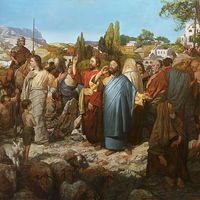
The key to interpreting most allegories [i.e., parables] lies in recognizing what a small handful of characters, actions or symbols correspond to and then fitting the rest of the story in with them.
1 John 3:18, John 13:1-17, Luke 10:25-37, Matthew 4:18-22, James 1:22, Romans 12:1, Mark 10:15
It is possible also to come at Christianity from a rather different point of view as well, seeing it as something not too difficult but too simple for us, too basic, something to be apprehended theref...
Matthew 28:19-20, 1 Corinthians 2:4-5, Ephesians 6:19-20, 2 Corinthians 4:2-4, Romans 1:16, Mark 16:15
With his fabulous tale to proclaim, the preacher is called in his turn to stand up in his pulpit as fabulist extraordinary, to tell the truth of the Gospel in its in its highest and wildest and holies...
Luke 15:11-32, Matthew 18:22-35, Luke 16:19-31, Matthew 13:3-8, Matthew 20:1-16, Matthew 13:24-33, Matthew 13:44-50, Mark 4:26-29
The Parable is a form of speech that has a style all of its own. It is a way of saying something that requires the imaginative participation of the listener. Inconspicuously, even surreptitiously, a p...
Every happening, great and small, is a parable whereby God speaks to us, and the art of life is to get the message. To see all that is offered us at the windows of the soul, and to reach out and rece...
Matthew 13:, Mark 4:1-20, Luke 8:4-15, Mark 4:30-32, Matthew 13:47-50, Luke 18:1-8, Matthew 13:44
Parables were the means Jesus used most frequently to explain the kingdom of God and to show the character of God and the expectations that God has for humans.
Matthew 5:14-16, Acts 1:8 , Mark 5:18-20, 1 Peter 3:15, John 4:28-30; 39-42, Romans 1:16 , 2 Timothy 1:7-8
Merciful God, you have moved and changed our lives in amazing ways, yet we have kept these stories to ourselves. We confess the times we have kept these stories to ourselves out of fear of rejection a...
Rabbis spoke of parables as handles for understanding Torah; before parables no one understood the Torah, but when Solomon and others created parables, then people understood.
Luke 15:11-32, Matthew 18:22-35, Luke 16:19-31, Matthew 13:3-8, Matthew 20:1-16, Matthew 13:24-33, Matthew 13:44-50, Mark 4:26-29
The child became a man and the man became a preacher whose sermons were full of commonplace things: seeds and nets, coins and fishes, lilies of the field, and birds of the air. Wherever he was, he had...
Luke 9:28-43, Matthew 17:1-3, Mark 9:2-13, Luke 9:19, Luke 9:22-27, Exodus 14:19-20, Numbers 9:15-16, Ezekiel 10:, Psalm 18:, Isaiah 4:, Daniel 7:9-14, Exodus 34:29-35, Deuteronomy 18:15-19, 2 Peter 1:16-18, John 1:4-9, John 1:14, Exodus 13:21, Exodus 24:15-18, Exodus 40:34-35, 2 Chronicles 5:13-14, Luke 9:37
The Context Introduction The Transfiguration stands out like, well, a bright light on a dark mountainside in the Gospel of Luke. The customary earthiness of the rest of the gospel falls away as heav...
Luke 15:11-32, Matthew 18:22-35, Luke 16:19-31, Matthew 13:3-8, Matthew 20:1-16, Matthew 13:24-33, Matthew 13:44-50, Mark 4:26-29
The thrust of the parables is to subvert the distorted myths in which people live their lives. To understand what we mean by “living in a myth” just think of a couple of our own contemporary myths. Ta...
Matthew 5:17-18, Mark 2:27-28, John 8:58, Luke 4:18-21, Matthew 5:7, John 8:1-11, Luke 24:13-27
Jesus appears in the Gospels as a theologian who begins with a mastery of the tradition and then reshapes it by offering a new vision centered on his own person.
The Fast-Paced Gospel “Immediacy” defines the Gospel of Mark’s rendition of Jesus’ ministry. Its fast pace reads like a comic strip of heroic proportions. Before one miraculous event is over another ...
Philippians 2:5-8, Mark 10:45, John 13:3-5, 12-15 , Matthew 25:21, Colossians 3:23-24, Matthew 6:3-4, 1 Peter 5:5-6
The Swiss-German novelist Hermann Hesse published a short story in 1932 called "Journey to the East." In it, a group of men go on a long journey. Throughout their trip, they are accompanied ...
The improvisational ability to lead adaptively relies on responding to the present situation rather than importing the past into the present and laying it on the current situation like an imperfect te...
Context This week’s lectionary text from Mark encompasses two distinct healing narratives, each of which has plenty of material for its own sermon. So the first decision for the preacher should be wh...
Context This week’s lectionary text from Mark encompasses two distinct healing narratives, each of which has plenty of material for its own sermon. So the first decision for the preacher should be wh...
Luke 5:1-11, Matthew 4:18-22, Mark 1:16-20, Isaiah 6:1-8, Jeremiah 16:14-21, Jeremiah 16:16
Peter's and Isaiah's Confessions Jesus calling the disciples from their fishing appears in Matthew 4:18-22; Mark 1:16-20, and Luke 5:1-11. Yet only Luke makes the beautiful connection between...
John's Imprisonment, Jesus' Debut John the Baptist is as good as dead when we hear of Jesus’ splash onto the Galilean landscape in Mark 1:14. Mark tells us that Jesus arrives in Galilee preac...
Mark 6:1-13, Isaiah 11:2, 1 Peter 2:8, Mark 9:42-47, Mark 14:27-29, Mark 4:16-17, 1 Corinthians 1:23
Context As we read the opening chapters of Mark, it becomes clear that Mark is not primarily interested in telling us things about Jesus but showing Jesus to us. We see Jesus the healer, the exor...
On retreat we stop avoiding the pain of the disconnect between our deepest desires and the way we are actually living. We have time and space to reflect on our life rhythms to see if they are really w...
Mark 6:1-13, Isaiah 11:2, 1 Peter 2:8, Mark 9:42-47, Mark 14:27-29, Mark 4:16-17, 1 Corinthians 1:23
Context As we read the opening chapters of Mark, it becomes clear that Mark is not primarily interested in telling us things about Jesus but showing Jesus to us. We see Jesus the healer, the exor...
Matthew 28:16-20, 2 Timothy 2:1-2, Luke 9:23-24, Mark 8:34, John 13:34-35, Colossians 1:28-29, 1 Corinthians 11:1, 1 Corinthians 4:14-16, 1 Thessalonians 1:6-7, Hebrews 6:11-12
One of the fastest ways to learn a language is by immersion . This term can mean a few different things, but the basic idea in all of them is that you are exposed to that language in your social inte...


![The key to interpreting most allegories [i.e., parables]](https://a-us.storyblok.com/f/1016915/1200x800/02a9b3a0ca/parables.jpg/m/200x200/smart)