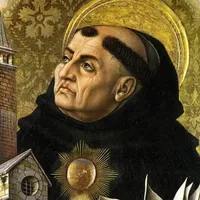
Of the medieval church’s many intellectual leaders, none has had more influence than the philosophical theologian Thomas Aquinas. He was born to a noble family near Naples, Italy, and joined the Domin...
1 Kings 6:7, Exodus 35:30–35 , Isaiah 28:16 , 1 Peter 2:4–5, Psalm 118:22–23 , Matthew 16:18
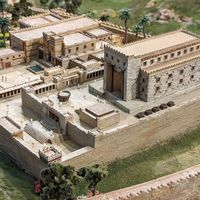
In the 1800s, a group of people were exploring just outside the ancient walls of Jerusalem, near the Damascus Gate, when they came across a hole in the ground. Curious, they began to dig—and uncovered...
Sir Alexander Fleming (1881–1955), the British microbiologist and co-recipient of the 1945 Nobel Prize for Medicine for the discovery of penicillin, often credited his breakthrough to a fortunate acci...
Micah 6:8, Exodus 23:2–3, 6, Proverbs 31:8–9, James 2:12–13 , Luke 6:36–37, Psalm 103:8–10
Christian civility does not commit us to a relativistic perspective. Being civil doesn’t mean that we cannot criticize what goes on around us. …Civility is a different matter, though. I can treat ...
We will have to start over, with a different and much older premise: the naturalness and, for creatures of limited intelligence, the necessity of limits.
I know quite certainly that I myself have no special talent. Curiosity, obsession, and dogged endurance, combined with self-criticism, have brought me to my ideas. Especially strong thinking powers (...
Exodus 35:30-35, Genesis 41:14-39 , Proverbs 8:22-31 , Matthew 14:28-31, Luke 10:38-42 , Psalm 1:1-3
The truly inventive state of mind approaches the plane of consciousness you’d hope to attain if you were driving down an icy highway and skidded into the path of an oncoming truck ... concentration is...
1 Kings 17:8-16, Exodus 16:16-18, Matthew 25:31-46 , Luke 10:25-37, 2 Corinthians 9:6-8, Psalm 41:1-3
Robert Lupton offers insight into the complexities of human impoverishment, reminding us that in spite of our best intentions sometimes our philanthropic efforts can yield unintended consequences: “Wh...
Leadership is lifting a person’s vision to higher sights, raising of a person’s performance to a higher standard, of building a personality beyond its normal limitations.
The wonderful word master used to describe the person who is at the top of his or her craft, whatever the profession. It was a title that one could work toward and with some degree of confidence ascri...
Now, technology is everywhere. I don’t mean just glowing screens and digital devices; I mean the whole apparatus of “easy everywhere” that has come into existence in just over the span of one human li...
Genesis 4:8-10, Exodus 23:2-3, 1 Kings 3:16-28 , Luke 18:1-8, Matthew 27:24 , Psalm 82:2-4
As any parent of small children will tell you, children have an amazingly acute sense of justice. Even the most fractional disparity in the distribution of the most trivial family good will be met wit...
James 3:17-18, 1 Timothy 3:2-3, John 8:32, Jeremiah 23:5, Isaiah 1:17, Proverbs 29:4, Exodus 18:21
If your success is defined as being well adjusted to injustice and well adapted to indifference, then we don’t want successful leaders. We want great leaders who love the people enough and respect the...
Genesis 15:1-6, Exodus 14:10-14, Job 1:42, Matthew 14:22-33, Psalm 23:
We should aim for rational confidence in these sorts of pursuits because certainty is a mere will-o’-the-wisp. Finite minds simply can’t pull it off. Though the distinction between aiming at certainty...
Resilience is not about becoming smarter or tougher; it’s about becoming stronger and more flexible. It’s about becoming tempered. Which takes us back to the blacksmith’s shop. Tempered. Let the word ...
Awe is more than an emotion; it is a way of understanding, insight into a meaning greater than ourselves. The beginning of awe is wonder, and the beginning of wisdom is awe.
Ambiguity may keep people up nights, but anyone seeking exquisite simplicity in his or her career ought to look for a non-leadership position. Leaders, by definition, have followers. Followers need di...
Daniel 1:8, Genesis 37:39–50, Exodus 2:4, 14–17, Matthew 4:1–11, 2 Corinthians 11:23–29, Psalm 46:
Resilience is not something that can be mustered in a moment of “rising to the occasion.” It is formed over a long period before the crisis of testing so that it can continue the transformation during...
In his poem Cocktail Party , T. S. Eliot captures a fundamental truth about human nature and the source of much hurt in the world. People’s actions are rarely driven by outright malice—intended t...
“Empathy” literally means “in-feeling”—it is to project myself into another person’s feelings so that I begin to understand what it is like to have his experiences. If I want to gain empathy for a nei...
Exodus 1:15–21, Daniel 3:16–18 , 1 Kings 3:16–28 , Matthew 4:1–11, Galatians 1:6–10, Psalm 73:
Pragmatism may be defined simply as the approach to reality that defines truth as “that which works.” The pragmatist is concerned about results, and the results determine the truth. The problem with t...
Excellence is an art won by training and habituation: we not act rightly because we have virtue or excellence, but rather have these because we have acted rightly; these virtues are formed in man by d...
Exodus 31:2-5, Isaiah 44:3-4, Zechariah 4:6-10, John 14:26, James 5:7-8, Psalm 1:2-3
Holy Spirit You are not just a whirlwind in the desert a tempest in a teapot You are also here in the slow growth of learning a nearly imperceptible accrual of wisdom Holy Spirit Inspire us from th...