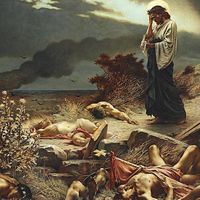
Human flourishing is first and foremost a flourishing of relationships—our relationship with God and with others. But human flourishing is also a product of fruitful work that reflects our God who wor...
Genesis 4:1-14, Matthew 5:21-22, Exodus 20:13, 1 John 3:15, Deuteronomy 5:17, Romans 12:19, Genesis 9:6, Matthew 5:4, 9, Revelation 21:4
Notes on prayer: This prayer is designed for a leader and a congregation, but it could be further divided so that the Leader/People response sections are "voice 1" and "voice 2." ...
Genesis 4:1-14, Matthew 5:21-22, Exodus 20:13, 1 John 3:15, Deuteronomy 5:17, Romans 12:19, Genesis 9:6
Notes on prayer: This lament can be used as prayers of the people, but can be adapted for other uses as well. It is designed to be responsive, but it would also work if prayed in unison. Leader: ...
Genesis 1:26-27 , Exodus 33:11-23 , Isaiah 43:1-4, John 10:1-15 , Luke 7:36-50, Psalm 139:1-6, 13-16
I am convinced that the scourge of our scientific and technological age is depersonalization. There is a heartbeat pulsating at the center of the universe, giving life and meaning to everything, but o...
John 18:1-19:42, Exodus 4:13-15, Romans 5:null, Matthew 27:24, Psalm 22:15, Psalm 69:21, Matthew 25:21
Preaching Commentary The lectionary text from John is an exceedingly long passage, but covers the main events that we commemorate on Good Friday. For that reason, I am going to break up the text int...
After the fall of our first parents, boundaries were something to push past, to transgress. It’s worth pausing to note how we use the word transgression for “sin.” With its Latin roots, “across” and ...
Exodus 3:11-14, Isaiah 6:5-8 , 1 Kings 19:11-13 , John 15:4-5 , Luke 10:38-42 , Psalm 46:10
Historically the West has tended to throw its chief emphasis upon doing and the East upon being. . . . Were human nature perfect there would be no discrepancy between being and doing. The unfallen man...
1 Kings 17:8-16, Exodus 16:16-18, Matthew 25:31-46 , Luke 10:25-37, 2 Corinthians 9:6-8, Psalm 41:1-3
Robert Lupton offers insight into the complexities of human impoverishment, reminding us that in spite of our best intentions sometimes our philanthropic efforts can yield unintended consequences: “Wh...
Here is the heart of the paradox: Technology is a brilliant, praiseworthy expression of human creativity and cultivation of the world. But it is at best neutral in actually forming human beings who ca...
In his poem Cocktail Party , T. S. Eliot captures a fundamental truth about human nature and the source of much hurt in the world. People’s actions are rarely driven by outright malice—intended t...
The challenge each of these faced in their deconstruction—and what we may face—is walking the tightrope between becoming our own person and honoring our past. In The Homeless Mind , sociologist P...
Genesis 32:22-32, Exodus 33:18-23 , 1 Samuel 1:9-20, Psalm 42:1-2, Mark 10:46-52, John 4:7-26
We are people of desire. We want things. We long for things. It is primal to our nature to yearn. As Saint Augustine reflected, “The whole life of the good Christian is a holy longing. . . . That is o...
Genesis 41:39-43 , Exodus 4:22-23, 2 Samuel 9:6-7, Luke 15:17-24, Galatians 4:6-7 , Psalm 103:13-14
When he [the prodigal son] found himself desiring to be treated as one of the pigs, he realized that he was not a pig but a human being, a son of his father. . . . Once he had come again in touch with...
Psalm 19:null, Psalm 1:null, Psalm 119:null, Exodus 20:2-3, Galatians 3:24-26, John 14:6, Matthew 22:37-40
Ancient Lens What can we learn from the historical context? The Books of the Psalms and David The Book of Psalms is divided into five books, like the five books of the Torah. While it is not obvi...
Exodus 18:13-27 , 1 Kings 19:1-9 , Deuteronomy 5:12-15 , Mark 6:30-32, Matthew 11:28-30, Psalm 23:1-3
Dangerous levels of exhaustion usually accumulate over a longer period of time in which we are consistently living beyond human limits, functioning outside our giftedness, or not paying attention to t...
In this short excerpt, Father Roderick Strange speaks to those who want to write off the church. It is written primarily to a Roman Catholic audience, but it relates quite well to Protestants as well:...
Exodus 24:15–18, 1 Kings 19:9–12, Isaiah 30:15, Mark 1:35, Luke 5:15–16, Psalm 2:1–2
Recently a professor shared with me a college student’s reflections in response to my earlier writings on solitude and silence: I was not born into a world relatively unaffected by technology lik...
The problem is not recognizing the importance of the individual. The problem is the glorification of the individual. When the individual self is glorified over the greater good of the community, right...
Living in a society governed by technique conditions us to believe that in every way life is easier than it ever has been. Technique is the use of rational methods to maximize efficiency, and we...
Creation as it felt to God — since then every artist has felt an echo, a sympathetic vibration: a craftsman who squints at his finished product and reckons, “Very good”; a performer who cannot suppres...
As we become more intentional about living according to our deepest desires, it becomes increasingly important to notice the effects of technology on our mind, our soul and our relationships. The ...
We all live between two worlds. We are planted here on earth while our hope is in heaven. We are given work to do in temporary soil that, we’re told, has the potential to spring up into unending fruit...