Matthew 13:, Mark 4:1-20, Luke 8:4-15, Mark 4:30-32, Matthew 13:47-50, Luke 18:1-8, Matthew 13:44
Parables were the means Jesus used most frequently to explain the kingdom of God and to show the character of God and the expectations that God has for humans.
Rabbis spoke of parables as handles for understanding Torah; before parables no one understood the Torah, but when Solomon and others created parables, then people understood.
The key to interpreting most allegories [i.e., parables] lies in recognizing what a small handful of characters, actions or symbols correspond to and then fitting the rest of the story in with them.
The biblical writers and reciters make extensive use of metaphors, parables and dramatic actions. Jesus does not say, “God’s love is boundless.” Instead, he tells the story of the prodigal son. He doe...
A Special Kind of Story Most Christians have some idea of what a parable is. Ask an adult Sunday school class and you might hear: “It’s a story!” Another might chime in, “with a moral message!” Mer...
Several years ago I was conducting a seminar in the interpretation of Scripture in a theological seminary…Our topic that day was Jesus’ parables…One of the priests, Tony Byrnne, was a Jesuit missionar...
Luke 15:11-32, Matthew 18:22-35, Luke 16:19-31, Matthew 13:3-8, Matthew 20:1-16, Matthew 13:24-33, Matthew 13:44-50, Mark 4:26-29
The thrust of the parables is to subvert the distorted myths in which people live their lives. To understand what we mean by “living in a myth” just think of a couple of our own contemporary myths. Ta...
Luke 15:11-32, Matthew 18:22-35, Luke 16:19-31, Matthew 13:3-8, Matthew 20:1-16, Matthew 13:24-33, Matthew 13:44-50, Mark 4:26-29
The Parable is a form of speech that has a style all of its own. It is a way of saying something that requires the imaginative participation of the listener. Inconspicuously, even surreptitiously, a p...
Every happening, great and small, is a parable whereby God speaks to us, and the art of life is to get the message. To see all that is offered us at the windows of the soul, and to reach out and rece...
Luke 15:11-32, Matthew 18:22-35, Luke 16:19-31, Matthew 13:3-8, Matthew 20:1-16, Matthew 13:24-33, Matthew 13:44-50, Mark 4:26-29
The child became a man and the man became a preacher whose sermons were full of commonplace things: seeds and nets, coins and fishes, lilies of the field, and birds of the air. Wherever he was, he had...
Zechariah 9:9, Matthew 21:1-11, Mark 11:8-11, Luke 19:36-44, John 12:16-19
The entrance into Jerusalem was an acted parable. It gave the faithful the sign they had been waiting for. It inaugurated the Master’s final mission to his people and was a fitting prelude to the days...
Stories are inherently interesting. Discourse we tolerate; to story we attend. Story entertains, informs, involves, motivates, authenticates, and mirrors existence. By creating a narrative world, stor...
James 1:22-25, Philippians 2:3-4, Romans 12:2, Ephesians 4:22-24, Colossians 3:12-14, Galatians 5:22-23, Matthew 25:21
The kingdom of God manifests itself in the modest changes in our attitudes and in the little improvements in our behavior that no one may notice, including ourselves. These are the mighty works of God...
Philippians 2:6-8, John 1:10-11, Isaiah 53:3-4, Matthew 11:19, Mark 15:34, Isaiah 53:12, Luke 15:20-24, Revelation 7:13-14
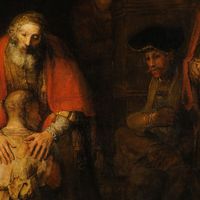
In this excerpt, the French monastic leader Frere Pierre Marie, shares an interpretation of Jesus as the true prodigal son—bringing all of us home with him: He, who is born not from human stock, or ...
The Danish philosopher, Kierkegaard, tells a parable of a theater where a variety show is proceeding. Each show is more fantastic than the last, and is applauded by the audience. Suddenly the manager ...
Mark 4:26-34, Matthew 13:31-32, Luke 13:18-19, Matthew 13:33, Luke 13:20-21, Matthew 13:44, Matthew 13:45-46
If we only had eyes to see and ears to hear and wits to understand, we would know that the Kingdom of God in the sense of holiness, goodness, beauty is as close as breathing and is crying out to born ...
Pearls were of much greater value in Jesus’ time than they are today. Queen Cleopatra is reputed to have had two pearls which together were worth around 15 million denarii. A denari was roughly a day’...
The kingdom is present not in grandiose accomplishments, but in showing practical love in humble ways, day after day, and in refusing to allow our failures and disappointments to hide God’s love from ...
Ancient lens What’s the historical context? A Historical Clue The superscript of Psalm 51 gives us a historical clue about the composition of this Psalm, “A Psalm of David. When Nathan the prophe...
John 1:1, Deuteronomy 10:2, Deuteronomy 31:24-26, 2 Kings 22:8
Love Loving the Word of God is a great pursuit, but it’s not always easy. Like most love relationships, there are inevitable highs and lows. And as teachers of the Bible, many of us walk a delicate...
How Will We Preach and Teach from Proverbs? Reading, let alone preaching, from The Book of Proverbs comes with its challenges. Sometimes those sayings can seem just plain obvious and not much help ...
John 11:35, Psalm 5:5, Psalm 6:1, Psalm 78:58, Psalm 78:40, Psalm 18:19, Psalm 25:6, Psalm 5:7, Exodus 20:5, Exodus 22:23, Isaiah 15:5, Luke 15:null, Genesis 23:2, Genesis 42:24, 1 Samuel 1:10, 2 Samuel 1:11-12, 2 Kings 8:11-12, 2 Kings 22:18-20, Mark 14:72, John 20:11, Acts 20:37, Revelation 5:4
When the Professor Weeps: A Personal Story About ten years ago, I was teaching a course on the psalms for my seminary students in the midst of a personal health crisis. It wasn’t in my notes, but I ...
Let us begin with a question. Do you really know how to enjoy the world? Do you know how to enjoy yourself? One of the greatest parables in the New Testament has to do with the search for enjoyment an...
In the day-to-day trenches of adult life, there is actually no such thing as atheism. There is no such thing as not worshipping. Everybody worships. The only choice we get is what to worship. And the ...
Matthew 2:1-4, Luke 15:3-7, John 8:1-11, Luke 19:10, John 1:16, Revelation 22:17
During a British conference on comparative religions, experts from around the world debated what, if any, belief was unique to the Christian faith. They began eliminating possibilities. Incarnation? O...
We're in the presence of a good story when the flaw that shatters shalom is also the doorway to redemption... Whether it be our own flaw or the sin of others, God uses the raw material of sin to c...
The sermon is no place for a virtuoso performance; it is a place for believers to explore together their common experience before God. The stories I tell from the pulpit are not just “my” stories but ...
Matthew 28:19-20, 1 Corinthians 2:4-5, Ephesians 6:19-20, 2 Corinthians 4:2-4, Romans 1:16, Mark 16:15
With his fabulous tale to proclaim, the preacher is called in his turn to stand up in his pulpit as fabulist extraordinary, to tell the truth of the Gospel in its in its highest and wildest and holies...