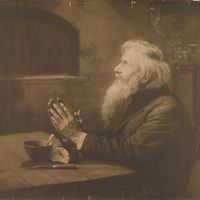
One of the areas often missed in a lot of Christian apologetics is the social setting in which a person encounters the gospel. For example, it is far easier to espouse "rational arguments" f...
Exodus 5:1-21, 1 Samuel 8:4-22, Isaiah 1:10-17 , Matthew 23:23-28 , Galatians 3:26-29, Psalm 146:3-9
One of the gravest dangers to the Christian faith is its wholesale appropriation of the larger culture. When this happens, the citizens of those places cannot recognize the difference between their cu...
In this short excerpt, the abolitionist and former slave Frederick Douglass describes the tension between faith in Christ and faith in a form of Christianity willing to enslave an entire race of peopl...
Genesis 11:1-9 , Jonah 1:4, Daniel 1:6 , Matthew 28:18-20, Acts 17:16-34, Psalm 2:
If one looks at the world scene from a missionary point of view, surely the most striking fact is that, while in great areas of Asia and Africa the church is growing, often growing rapidly, in the lan...
The United States is undergoing a marked change in its attitude toward religion, and Christians here face new challenges. When a blogger named Marc Yoder wrote about “10 Surprising Reasons Our Kids Le...
Mark 9:24, Romans 10:17, John 20:27, 1 John 4:1, 1 Thessalonians 5:21, Proverbs 3:5-6
Have you ever noticed that the phrases in our culture favor doubt over faith? The famed missionary and theologian Lesslie Newbigin pointed this out when we speak of “Honest doubts” and “blind faith”. ...
Isaiah 29:13, Judges 2:10-13 , 1 Samuel 8:4-9, Matthew 23:27-28 , 2 Timothy 3:1-5 , Psalm 10:4
Even though it’s now associated with him, Nietzsche didn’t coin the phrase God is dead. As the son of a Lutheran pastor, he would have heard that line in a Lutheran Holy Saturday hymn. And although...
In 1882—seven years before his descent into madness—Friedrich Nietzsche published a parable called The Madman . In the parable, a madman comes into a village on a bright, sunny morning holding al...
Exodus 5:1–2, 1 Kings 18:21–39, Daniel 3:16–18, Matthew 5:14–16, Acts 4:19–20, Psalm 2:1–2, 10–12
Most secularists are too politically savvy to attack religion directly or to debunk it as false. So what do they do? They consign religion to the value sphere—which takes it out of the realm of true a...
Isaiah 1:11–17, Jeremiah 7:1–11 , Amos 5:21–24, Luke 4:16–30 , John 1:1–14 , Psalm 50:16–23
The Enlightenment was, among many other things, a protest against a system that, since it was itself based on a protest [the Reformation], could not see that it was itself in need of further reform. (...
So it is that in most Western industrialized countries church and society have lost their identity, religion has become more and more a private affair, and morality has become secular. This process af...
Proverbs 29:25, Acts 4:13, John 15:18-19, 2 Timothy 1:7-8, Colossians 4:5-6, Matthew 5:14-16, Romans 1:16
Why is it so intimidating to talk about Jesus in contemporary western culture? One obvious reason might lie in the ubiquitous negative portrayals of Christians in mainstream media. Sam Chan makes this...
Proverbs 1:5, Jeremiah 9:23-24, Matthew 11:25, James 1:21, Colossians 2:3, Matthew 18:3
Becoming a teachable person has two prerequisites: There must be a teacher and a person willing to be taught. Increasingly, Western culture has become an environment that celebrates and platforms the ...
Introduction Sometimes verses 1-4 are separated from 5-10 in preaching. N. T. Wright points out, however, that in both sections, the need for humility binds the passages together. A teacher must prac...
Luke 17:5-10, Luke 17:1-4, 1 Corinthians 6:19-20, John 15:15
Introduction Our lectionary text is inextricably linked with the five verses that precede it. For that reason, I’ll give a summary of verses 1-4. It’s possible the lectionary authors chose to separat...
In this excerpt, author David Zahl challenges the common belief that religion is “in decline.” He argues that while Westerners, particularly younger generations, may be distancing themselves from the ...
Today, unlike almost any other earlier period, the money and the strong educational institutions of Christianity are in one part of the world, while a majority of the active believers are located else...
It is clear that this essential Christian doctrine gives a new value to human nature, to human history and to human life which is not to be found in the other great oriental religions.
How do you deliver the authentic faith and great wisdom of the past into the new cultural situation of the twenty-first century? The way into the future, I argue, is not an innovative new start for th...
Christianity is almost the only one of the great religions which thoroughly approves of the body—which believes that matter is good, that God Himself once took on a human body, that some kind of body ...
There’s a quote by H. Richard Niebuhr that I believe is absolutely true. “The great Christian revolutions,” he argued, “come not by the discovery of something that was not known before. They happen w...
My worldview, my philosophy, my attitudes, my relationships, my parenting, my marriage – everything has been transformed by my relationship with Christ.
Isaiah 29:13, Amos 5:21-24, Proverbs 1:7, James 1:22-25 , Matthew 23:27-28, Psalm 51:16-17
We artful dodgers act as if we do not understand the New Testament, because we realize full well that [if we let on that we did] we should have to change our way of life drastically. That is why we in...
Proverbs 2:2–6, Romans 12:1–2, Isaiah 1:18, Daniel 1:17–20, Matthew 22:37, Psalm 119:97–100
At a Christian high school, a theology teacher strode to the front of the classroom, where he drew a heart on one side of the blackboard and a brain on the other. The two are as divided as the two sid...
The fact that a cross became the Christian symbol, and that Christians stubbornly refused, in spite of the ridicule, to discard it in favour of something less offensive, can have only one explanation....
Isaiah 55:8-9, Jonah 4:1-11, Numbers 22:21-34, Matthew 9:10-13, Mark 2:23-28, Psalm 19:12-14
It takes a great deal of freedom and love to be therapeutic with a group. Many years ago when Emil Brunner, the great Swiss theologian, was lecturing in this country, it was reported that when he prea...
Far too easily we settle for holiness rather than wholeness, conformity rather than authenticity, becoming spiritual rather than deeply human, fulfillment rather than transformation, and a journey tow...
Matthew 5:48, 1 John 3:2-3, Galatians 5:16-17, Philippians 3:13-14, Colossians 3:1-2, Ephesians 4:22-24
The scholastics used to say: Homo non proprie humanus sed superhumanus est —which means that to be properly human, you must go beyond the merely human.
By misinterpreting the Enlightenment and the corresponding rise of empiricism as an existential threat to Christian faith, many frightened Christians sequestered themselves into rooms of certitude.