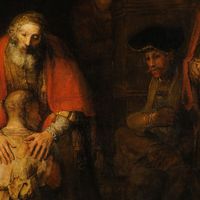
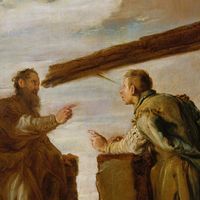
Mark 12:37, Matthew 19:24, Matthew 7:5, Mark 3:25, Mark 7:27, Mark 8:15, Luke 15:11–32, Luke 10:25–37, Luke 18:9–14-, 25:31–46
One of my daughters has been singing a song about Jesus that contains the line “Jesus was a story-tellin’ man.” When I first heard that line it seemed a bit flip, as so many contemporary Christian son...
Matthew 13:, Exodus 14:21-31, Daniel 3:13-30 , 1 Kings 18:20-40, Luke 15:11-32, Psalm 23:
In the second century before Christ the great rival to Roman power in the Mediterranean world was Carthage, the Phoenician city-state located on the north African coast. It had been founded in 822 B.C...
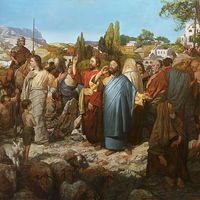
The key to interpreting most allegories [i.e., parables] lies in recognizing what a small handful of characters, actions or symbols correspond to and then fitting the rest of the story in with them.
Every happening, great and small, is a parable whereby God speaks to us, and the art of life is to get the message. To see all that is offered us at the windows of the soul, and to reach out and rece...
Rabbis spoke of parables as handles for understanding Torah; before parables no one understood the Torah, but when Solomon and others created parables, then people understood.
Matthew 13:, Mark 4:1-20, Luke 8:4-15, Mark 4:30-32, Matthew 13:47-50, Luke 18:1-8, Matthew 13:44
Parables were the means Jesus used most frequently to explain the kingdom of God and to show the character of God and the expectations that God has for humans.
Stories are inherently interesting. Discourse we tolerate; to story we attend. Story entertains, informs, involves, motivates, authenticates, and mirrors existence. By creating a narrative world, stor...
Luke 11:1-13, Matthew 18:23-35, Colossians 3:13, James 1:2-3
Context Jesus’ lesson on prayer in Luke’s gospel comes not in the context of a longer sermon (as with Matthew’s parallel in the Sermon on the Mount), but rather in response to a request from one of h...
Glimpses of God’s Kingdom In these parables, Jesus provides two glimpses of God’s Kingdom: the slow growth of a seed into a stalk of wheat and the growth of a humble mustard seed. Both of Jesus’ para...
Philippians 2:6-8, John 1:10-11, Isaiah 53:3-4, Matthew 11:19, Mark 15:34, Isaiah 53:12, Luke 15:20-24, Revelation 7:13-14
In this excerpt, the French monastic leader Frere Pierre Marie, shares an interpretation of Jesus as the true prodigal son—bringing all of us home with him: He, who is born not from human stock, or ...
Mark 4:26-34, Matthew 13:31-32, Luke 13:18-19, Matthew 13:33, Luke 13:20-21, Matthew 13:44, Matthew 13:45-46
If we only had eyes to see and ears to hear and wits to understand, we would know that the Kingdom of God in the sense of holiness, goodness, beauty is as close as breathing and is crying out to born ...
Glimpses of God’s Kingdom In these parables, Jesus provides two glimpses of God’s Kingdom: the slow growth of a seed into a stalk of wheat and the growth of a humble mustard seed. Both of Jesus’ para...
Coming to the end This is Jesus’s last story before his Last Supper, and while we do not want to put too much emphasis on salvation at the expense of Kingdom life in the present, we cannot ignore cle...
Luke 15:11-32, Matthew 18:22-35, Luke 16:19-31, Matthew 13:3-8, Matthew 20:1-16, Matthew 13:24-33, Matthew 13:44-50, Mark 4:26-29
The Parable is a form of speech that has a style all of its own. It is a way of saying something that requires the imaginative participation of the listener. Inconspicuously, even surreptitiously, a p...
Matthew 13:31-33, Matthew 13:44-52, Genesis 28:15-28, Romans 8:26-39
Intro These are incredibly rich texts. This guide recommends taking a detour through salvation history to put them in their right context. This helps your congregation expand their understanding of ...
Coming to the end This is Jesus’s last story before his Last Supper, and while we do not want to put too much emphasis on salvation at the expense of Kingdom life in the present, we cannot ignore cle...
Preaching Commentary Coming to the end This is Jesus’s last story before his Last Supper, and while we do not want to put too much emphasis on salvation at the expense of Kingdom life in the presen...
Matthew 13:1, 1 Corinthians 3:6, Romans 12:2, Matthew 7:22, Hebrews 6:4-5, Isaiah 6:9-10, Matthew 12:34-35
Preaching Angle: Preach the Word, Rest in God’s Work Maybe I tend to focus on the negative, but when I read the parable of the soils, I tend to focus on the soils that struggle (the soil too close to...
Matthew 13:24-30, Matthew 16:18, Ephesians 2:3, Romans 5:10, Luke 5:31, Matthew 10:30, 1 Peter 5:8, Psalm 73:4-7, 13, 18-20
Preaching Angle: Wheat and Weeds Grow Even in the Church God’s good creation grows food for all living creatures. God made the Earth, God made all the plants, and God made all the humans and animals ...
Matthew 13:24-30, 36-43, Matthew 16:18, Ephesians 2:3, Romans 5:10, Luke 5:31, Matthew 10:30, 1 Peter 5:8, Psalm 73:4-7, 13, 18-20
Preaching Commentary Preaching Angle: Wheat and Weeds Grow Even in the Church God’s good creation grows food for all living creatures. God made the Earth, God made all the plants, and God made all ...
Matthew 13:1-9, 18-23, 1 Corinthians 3:6, Romans 12:2, Matthew 7:22, Hebrews 6:4-5, Isaiah 6:9-10, Matthew 12:34-35
Preaching Commentary Preaching Angle: Preach the Word, Rest in God’s Work Maybe I tend to focus on the negative, but when I read the parable of the soils, I tend to focus on the soils that struggle...
A Special Kind of Story Most Christians have some idea of what a parable is. Ask an adult Sunday school class and you might hear: “It’s a story!” Another might chime in, “with a moral message!” Mer...
Luke 15:11-32, Matthew 18:22-35, Luke 16:19-31, Matthew 13:3-8, Matthew 20:1-16, Matthew 13:24-33, Matthew 13:44-50, Mark 4:26-29
The thrust of the parables is to subvert the distorted myths in which people live their lives. To understand what we mean by “living in a myth” just think of a couple of our own contemporary myths. Ta...
Luke 15:11-32, Matthew 18:22-35, Luke 16:19-31, Matthew 13:3-8, Matthew 20:1-16, Matthew 13:24-33, Matthew 13:44-50, Mark 4:26-29
The child became a man and the man became a preacher whose sermons were full of commonplace things: seeds and nets, coins and fishes, lilies of the field, and birds of the air. Wherever he was, he had...
Zechariah 9:9, Matthew 21:1-11, Mark 11:8-11, Luke 19:36-44, John 12:16-19
The entrance into Jerusalem was an acted parable. It gave the faithful the sign they had been waiting for. It inaugurated the Master’s final mission to his people and was a fitting prelude to the days...
Jesus showed his solidarity with the poor through his teaching, parables and lifestyle. It is no coincidence that in his very first recorded message he referenced the poor… Imagine God incarnate makin...
Pearls were of much greater value in Jesus’ time than they are today. Queen Cleopatra is reputed to have had two pearls which together were worth around 15 million denarii. A denari was roughly a day’...
The biblical writers and reciters make extensive use of metaphors, parables and dramatic actions. Jesus does not say, “God’s love is boundless.” Instead, he tells the story of the prodigal son. He doe...


![The key to interpreting most allegories [i.e., parables]](https://a-us.storyblok.com/f/1016915/1200x800/02a9b3a0ca/parables.jpg/m/200x200/smart)