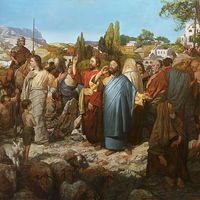
Matthew 28:19-20, 1 Corinthians 2:4-5, Ephesians 6:19-20, 2 Corinthians 4:2-4, Romans 1:16, Mark 16:15
With his fabulous tale to proclaim, the preacher is called in his turn to stand up in his pulpit as fabulist extraordinary, to tell the truth of the Gospel in its in its highest and wildest and holies...
Mark 12:37, Matthew 19:24, Matthew 7:5, Mark 3:25, Mark 7:27, Mark 8:15, Luke 15:11–32, Luke 10:25–37, Luke 18:9–14-, 25:31–46
One of my daughters has been singing a song about Jesus that contains the line “Jesus was a story-tellin’ man.” When I first heard that line it seemed a bit flip, as so many contemporary Christian son...
Stories are inherently interesting. Discourse we tolerate; to story we attend. Story entertains, informs, involves, motivates, authenticates, and mirrors existence. By creating a narrative world, stor...
Luke 15:11-32, Matthew 18:22-35, Luke 16:19-31, Matthew 13:3-8, Matthew 20:1-16, Matthew 13:24-33, Matthew 13:44-50, Mark 4:26-29
The child became a man and the man became a preacher whose sermons were full of commonplace things: seeds and nets, coins and fishes, lilies of the field, and birds of the air. Wherever he was, he had...
Luke 15:11-32, Matthew 18:22-35, Luke 16:19-31, Matthew 13:3-8, Matthew 20:1-16, Matthew 13:24-33, Matthew 13:44-50, Mark 4:26-29
The thrust of the parables is to subvert the distorted myths in which people live their lives. To understand what we mean by “living in a myth” just think of a couple of our own contemporary myths. Ta...
The key to interpreting most allegories [i.e., parables] lies in recognizing what a small handful of characters, actions or symbols correspond to and then fitting the rest of the story in with them.
Revelation 19:16, Matthew 2:2, John 18:36-37, Revelation 17:14, Zechariah 9:9, Isaiah 9:6, Psalm 24:7-10, Colossians 1:15-20, Matthew 21:1-11, Mark 11:1-11, Luke 19:28-40, John 12:12-16
The British novelist George MacDonald loved writing stories about princes and princesses. At one point in his life, someone asked him why he focused so much of his writing on them. His answer was prof...
Luke 15:11-32, Matthew 18:22-35, Luke 16:19-31, Matthew 13:3-8, Matthew 20:1-16, Matthew 13:24-33, Matthew 13:44-50, Mark 4:26-29
The Parable is a form of speech that has a style all of its own. It is a way of saying something that requires the imaginative participation of the listener. Inconspicuously, even surreptitiously, a p...
1 Corinthians 2:14, 2 Corinthians 4:4, Matthew 13:13-15, Acts 28:27, Hebrews 3:7-8, Jeremiah 7:24, John 10:27, Mark 6:52
Jesus is clear that it is dangerous to close one’s ears, eyes, and heart to the leadings of the Holy Spirit. In The Magician’s Nephew , a novel from C. S. Lewis’ Chronicles of Narnia series, Narnia i...
Matthew 13:, Mark 4:1-20, Luke 8:4-15, Mark 4:30-32, Matthew 13:47-50, Luke 18:1-8, Matthew 13:44
Parables were the means Jesus used most frequently to explain the kingdom of God and to show the character of God and the expectations that God has for humans.
Every happening, great and small, is a parable whereby God speaks to us, and the art of life is to get the message. To see all that is offered us at the windows of the soul, and to reach out and rece...
Matthew 5:14-16, Acts 1:8 , Mark 5:18-20, 1 Peter 3:15, John 4:28-30; 39-42, Romans 1:16 , 2 Timothy 1:7-8
Merciful God, you have moved and changed our lives in amazing ways, yet we have kept these stories to ourselves. We confess the times we have kept these stories to ourselves out of fear of rejection a...
Rabbis spoke of parables as handles for understanding Torah; before parables no one understood the Torah, but when Solomon and others created parables, then people understood.
1 Corinthians 3:3, Titus 3:3, James 3:16, 1 Samuel 18:10-16, Exodus 20:17, Mark 7:20-23
Joseph Epstein tells a joke that illustrates envy’s malicious and impotent character well. Once there was an Englishwoman, a Frenchman, and a Russian: Each [was] given a single wish by one of those ...
Psalm 148:7, 10-13, Matthew 6:26, Job 12:7-10, Genesis 1:20-21, Psalm 104:12, 24, Mark 16:15, Colossians 1:16-17
Unlike most of us, Francis of Assissi's love of preaching extended beyond just human beings. On one of his journeys through the valley of Spoleto, near Bevagna, Francis of Assisi came upon a large...
Philippians 2:5-8, Mark 10:45, John 13:3-5, 12-15 , Matthew 25:21, Colossians 3:23-24, Matthew 6:3-4, 1 Peter 5:5-6
The Swiss-German novelist Hermann Hesse published a short story in 1932 called "Journey to the East." In it, a group of men go on a long journey. Throughout their trip, they are accompanied ...
John 20:19-31, John 11:40, Mark 9:23, Romans 10:17, James 1:6, John 20:29
There is a Peanuts cartoon in which Lucy and Charlie Brown are walking home from school. Charlie Brown tells Lucy that he got straight As. Lucy responds, “I won’t believe it unless I see the report ...
The Text The Short Ending or the Long ending? This is not the Easter story we’re looking for. The short ending of Mark is not what we want or expect on Easter Sunday. We want celebration, big music,...
Save my soul, Good Gardener Evil flies in wanting to steal my hope Work piles up, insecure boulders ready to crash, leaving no room to root My faith begins to wither as does our relationship Distract...
Isaiah 41:10, 1 Kings 19:11-12, Daniel 6:16-22, Mark 4:35-41, Philippians 4:6-7, Psalm 46:1-2, 10
When Napoleon was bombing Vienna in 1805, his shells rained down across the city, striking buildings at random. One cannonball crashed into a schoolroom, shattering walls and windows. Inside, an eight...
Intertwined Narratives Jesus’ encounters with Jairus’ daughter and the bleeding woman are sandwiched together with the intention that the two narratives would unlock and help to interpret the other....
Intertwined Narratives Jesus’ encounters with Jairus’ daughter and the bleeding woman are sandwiched together with the intention that the two narratives would unlock and help to interpret the other....