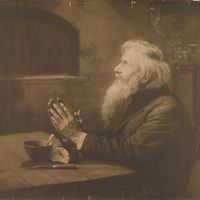
In 1889, the French novelist Paul Bourget penned The Disciple , where he depicted the life of a renowned philosopher and psychologist, whose existence was marked by a seemingly monotonous routine...
In 1882—seven years before his descent into madness—Friedrich Nietzsche published a parable called The Madman . In the parable, a madman comes into a village on a bright, sunny morning holding al...
“If there is no God, never was a God, why do we miss him so much?” asked one agnostic European Jew as he looked back on the horrors of the twentieth century.
Genesis 1:26-27 , Exodus 33:11-23 , Isaiah 43:1-4, John 10:1-15 , Luke 7:36-50, Psalm 139:1-6, 13-16
I am convinced that the scourge of our scientific and technological age is depersonalization. There is a heartbeat pulsating at the center of the universe, giving life and meaning to everything, but o...
Phillips Brooks, the author of the famous hymn “O Little Town of Bethlehem.” He wrote: Sad will be the day for every man when he becomes absolutely contented with the life he is living, with the thoug...
An attempt to wrest from God the prerogatives of absolute freedom and infinity leads to the inversion of Pentecost and what is in effect a new Babel. 'Postmodernism' represents that Babel perf...
Exodus 1:15–21, Daniel 3:16–18 , 1 Kings 3:16–28 , Matthew 4:1–11, Galatians 1:6–10, Psalm 73:
Pragmatism may be defined simply as the approach to reality that defines truth as “that which works.” The pragmatist is concerned about results, and the results determine the truth. The problem with t...
Exodus 3:1-14, 1 Kings 19:9-18, Mark 1:35, Matthew 11:28-30, Psalm 46:10
In Lancelot , one of Walker Percy’s final novels, the narrator reflects on his own struggle with idleness and addiction to entertainment. In a poignant scene set outside his Mississippi mansion, ...
To enter into the realm of contemplation one must in a certain sense die: but this death is in fact the entrance into a higher life. It is a death for the sake of life, which leaves behind all that we...
Exodus 24:15–18, 1 Kings 19:9–12, Isaiah 30:15, Mark 1:35, Luke 5:15–16, Psalm 2:1–2
Recently a professor shared with me a college student’s reflections in response to my earlier writings on solitude and silence: I was not born into a world relatively unaffected by technology lik...
Proverbs 18:21, Numbers 13:31-33, Deuteronomy 1:28, James 3:5-6, Exodus 14:12
Learned Helplessness can be easily seen in a research study when participants are given a math test. In this study, some participants are told, “men don’t tend to do well on this test,” or “Millennia...
In this excerpt, author David Zahl challenges the common belief that religion is “in decline.” He argues that while Westerners, particularly younger generations, may be distancing themselves from the ...
Exodus 14:10-16, 1 Kings 18:21-39, Matthew 14:28-31, James 1:5-6, Psalm 121:1-2
An atheist fell off a cliff. As he tumbled downward, he caught hold of the branch of a small tree. There he hung between heaven above and the rocks a thousand feet below, knowing he wasn’t going to be...
In his poem Cocktail Party , T. S. Eliot captures a fundamental truth about human nature and the source of much hurt in the world. People’s actions are rarely driven by outright malice—intended t...
It’s not just what you eat that matters, it’s what eats you. You can have all the right macrobiotics and organic food, but if your body is filled with resentment, worry, fear, lust, guilt, anger, bitt...
Genesis 27:18-29, Exodus 3:11-14, Ecclesiastes 2:10-11, Luke 15:11-32, Matthew 23:27-28 , Psalm 139:23-24
Thomas Merton once said, “Every one of us is shadowed by an illusory person: a false self, This is the man I want myself to be but who cannot exist, because God does not know anything about him. A...
Romans 5:18-19, Exodus 1:14, Luke 15:11-32, John 3:16-17, 1 Corinthians 15:22, Romans 3:23-24, Genesis 3:1-7
The first attempt at a response: there must have been a fall, a decline, and the road to salvation can only be the return of the sensible finite into the intelligible infinite.
Philippians 4:8, Exodus 32:, Ecclesiastes 12:13, Matthew 19:16-30, Proverbs 4:23, Romans 12:2, 1 John 2:15-17
Orwell feared we would become a captive culture. Huxley feared that we would become a trivial culture. . . . Orwell feared that what we hate will ruin us. Huxley feared that what we love will ruin us.
In embarking on the journey, we must leave the world of certainty. We must courageously journey to a strange place where there are a lot of risks and much is at stake, a place where there are new prob...
Introduction Leaning Toward the Light What does it mean to lean towards the light of Christ? What does it mean to be open to the work of God? For the Pharisee in Jesus’ time, the answer was clear: y...
The challenge each of these faced in their deconstruction—and what we may face—is walking the tightrope between becoming our own person and honoring our past. In The Homeless Mind , sociologist P...
Where there’s humility there is majesty; where there’s weakness, there’s might; where there is death, there’s life. If you want to get these things don’t disdain those.
Living in a society governed by technique conditions us to believe that in every way life is easier than it ever has been. Technique is the use of rational methods to maximize efficiency, and we...
True freedom is not found by seeking to develop the powers of the self without limits, for the human person is not made for autonomy but for true relatedness in love and obedience; and this also entai...
Aseity refers to God’s self-existence (a—from, se—oneself). God exists ‘from himself.’ God owes his existence and completeness as God to nothing outside himself. . . . God’s act of creation was not c...
Many have heard of the polymath and famous atheist Bertrand Russell (1872-1970), whose career as a public intellectual touched on a variety of disciplines, including philosophy (he is considered one o...
Exodus 3:1-12, 1 Kings 19:9-18, Genesis 32:22-32 , Psalm 62:1-2 , Matthew 4:1-11, Mark 1:35
Solitude is an opportunity to interrupt this cycle by turning off the noise and stimulation of our lives so that we can hear our loneliness and our longing calling us deeper into the only relationship...
As popularized in Richard Thaler and Cass Sunstein’s fascinating book by the same name, nudges are small changes in the environment around us that make it easier for us to make the choices we want to ...