To frame is to put a language boundary around our experience. It is to name what happens in particular ways, to say how we see the world, and to see the world how we say it is. Framing includes tellin...
Imagine a remote village in Africa. No modern Westerner has ever set foot there. The natives live off the land, using the same ancient methods and tools as their forefathers used for the last thousand...
Ancient Context What’s the historical context? The Tower of Babel The story of the Tower of Babel comes after many chapters relating the story of Noah, the flood, and the covenant with Noah and...
1 Peter 3:8, Psalm 133:1, Philippians 2:2, Acts 2:1-47
One of the most critically acclaimed fantasy films in recent years was a piece of science fiction called Arrival . It is the story of beings from outer space who arrive on earth, igniting a wildfire ...
Acts 2:1-21, Acts 1:8, Ezekiel 37:1-14, 1 Samuel 10:5-12, 1 Kings 19:9-13, Joel 2:28-32, Genesis 11:1-9
Clothed with Power I have a daughter who cannot acquire enough clothes. Every birthday, Christmas, or special occasion is an opportunity to shop online for something new. Fashionable rags give her a ...
Summary of the Text Ancient Context What’s the historical context? The Tower of Babel The story of the Tower of Babel comes after many chapters relating the story of Noah, the flood, and the ...
Rather than translating the culture, then, we need to try to enter the culture. When people want to study the Bible seriously, one of the steps they take is to learn the language. As I teach language ...
Matthew 28:16-20, 2 Timothy 2:1-2, Luke 9:23-24, Mark 8:34, John 13:34-35, Colossians 1:28-29, 1 Corinthians 11:1, 1 Corinthians 4:14-16, 1 Thessalonians 1:6-7, Hebrews 6:11-12
One of the fastest ways to learn a language is by immersion . This term can mean a few different things, but the basic idea in all of them is that you are exposed to that language in your social inte...
Acts 2:1-21, Luke 24:49, Acts 1:8, Acts 1:15, Exodus 20:null, Acts 2:9-11, 1 Samuel 10:10, Ezekiel 7:1-14, 1 Kings 19:11-12, Joel 2:28-32, Genesis 11:7-9
Preaching Commentary Clothed with Power I have a daughter who cannot acquire enough clothes. Every birthday, Christmas, or special occasion is an opportunity to shop online for something new. Fashi...
Ezra 4:7–24, Daniel 2:4–49, Nehemiah 8:1–8, Mark 5:41 , John 19:19–22, Acts 2:1–13
One development of the exile was an additional language for the Jewish people. The Babylonians and Persians spoke Aramaic, and out of necessity the Jews learned it. Some even became more conversant in...
John 6:15, Matthew 5:38-39, Matthew 7:24-27, Matthew 15:1-9, Matthew 16:13-17, John 18:36, Luke 4:18-19, Acts 9:1-9, Psalm 1:
Jesus is understood in the light of the assumptions which control our culture. When “reason” is invoked as a parallel or supplementary authority to “Scripture” and “tradition,” what is happening is t...
Across all barriers of land and language, wealth and poverty, knowledge and ignorance, we are one, created from the same dust, subject to the same laws, and destined for the same end. With this compas...
Why worship in our native language? Well, for one thing, it can keep people from distorting the Christian faith into a superstition: In one stream of church history, this can help explain worshipi...
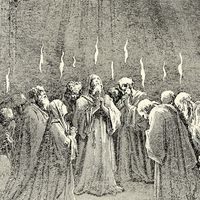
It is well known that Pentecost reverses Babel. The people who built the tower of Babel sought to make a name, and a unity, for themselves. At Pentecost, God builds his temple, uniting people in Chris...
My favorite scene in the 1987 movie Broadcast News is the moment when young Aaron, who has just graduated as valedictorian of his high school class, is attacked in the schoolyard after the ceremonies ...
Recently I (Stu) was watching a lecture on Old English (yes, the nerd levels are extremely high here), which looks almost nothing like the English we speak today. It is essentially the result of Germa...
James 3:5-6, Proverbs 18:21, Job 12:7-10, Psalm 19:1, Hebrews 1:1-2, John 1:14
The Christian gospel is rooted in language: God spoke a creation into being; our Savior was the Word made flesh. The poet is the person who uses words not primarily to convey information but to make a...
Words - so innocent and powerless as they are, as standing in a dictionary, how potent for good and evil they become in the hands of one who knows how to combine them.
“Learning how to read, has been shown to “powerfully shape adult neuropsychological systems. Brain scans have also revealed that people whose written language uses logographic symbols, like the Chines...
One of [Lamin] Sanneh's key arguments is that while the spread of Islam has drawn ever-increasing numbers to the globalizing influence of Arabic, the spread of Christianity binds ever-increasing n...
As a language-user, I’m bound to all the audacious capacities and frustrating limits of words. We label, we name, we frame all of our experiences, past, present, and future. We give words to our inner...
Writing to his parents while imprisoned on the day of Pentecost, the German Dietrich Bonhoeffer said this: At the tower of Babel all the tongues were confounded, and as a result men could no longe...
Pastor: In the name of the Father and of the Son and of the Holy Spirit. People: Amen. Pastor: With all the host of heaven, from every nation, in every language, we cry out: People:...
Psalm 119:105, 2 Timothy 3:16-17, Nehemiah 8:8, Acts 17:10-15, Galatians 5:1, Hebrews 4:12, Isaiah 55:10-11, John 15:15, 1 John 2:27
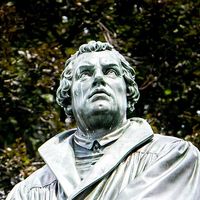
The Bible ceased to be a foreign book in a foreign tongue, and became naturalized, and hence far more clear and dear to the common people. Hereafter the Reformation depended no longer on the works of ...
Some people may wonder: why was the light of God given in the form of language? How is it conceivable that the divine should be contained in such brittle vessels as consonants and vowels? This questio...