Luke 2:6-7, Isaiah 9:6, Philippians 2:6-7, Luke 4:18-19, Mark 4:35-41, Colossians 1:15-17, Hebrews 1:3
‘Gentle Jesus, meek and mild’, Such a dainty, fragile child, But the one we know is bold and strong We can hear that in your dying song, Little boy, little boy. ‘Just a boy of flesh and b...
Pride, and its more serious cousin, narcissism, really shouldn’t have any place in leadership circles in the church. When I became a serious follower of Jesus at a teenager, Philippians 2 became one o...
Hebrews 4:15, Luke 2:52, Matthew 22:37, John 5:19, Philippians 2:5-8, John 17:4, Mark 12:30
Jesus was a whole human who had a head and a heart and a spirit. I forget that Jesus came to this earth, not as a brain in a Mason jar floating in formaldehyde, but as an embodied, incarnate, integral...
In this short excerpt, the scholar and Anglican clergyman N.T. Wright discusses the famous “weight of glory” passage in 2 Cornthians 4:17: For our light and momentary troubles are achieving for us an ...
John 4:7-26, Mark 10:46-52, Matthew 19:13-15, Luke 19:1-10, Mark 5:21-43, Philippians 2:3-4
A striking dimension of Jesus’ capacity to love was his ability to be totally present with people. In all the Bible, Jesus never says to anyone, “Huh? What did you say? I wasn’t paying attention. I wa...
Jesus, though you were in very nature God, you did not consider equality with God as something to be used to your own advantage. Rather, you humbled yourself, you made yourself nothing. Lord, you are ...
The servant role was completed in Jesus. Though there were auspicious sings that preceded and accompanied his birth, preparing the world for the majestic and kingly, the birth of Jesus itself was of t...
Philippians 2:5-8, Matthew 26:36-39, Matthew 4:1-11, Matthew 3:13-17, Luke 4:16-21, John 6:5-14, Matthew 17:1-5
Jesus loved the will of His Father. He embraced the limitations, the necessities, the conditions, the very chains of His humanity as He walked and worked here on earth, fulfilling moment by moment His...
Philippians 2:5-8, Isaiah 53:2-3, Luke 22:27, Mark 10:45, John 13:14-15
St. Paul tells us that Jesus Christ, the revelation of God become human, “set aside the privileges of deity and took on the status of a slave, became human! Having become human, he stayed human. It wa...
Ancient Lens What can we learn from the historical context? A letter of friendship Paul’s letter to the Philippians is from Paul and his companions to the saints in Philippi. It is a letter fro...
Isaiah 9:6, Philippians 2:6-8, John 16:33, Matthew 26:53, John 18:10-11, Hebrews 12:1-2
Athletes come up with creative portrayals of Jesus that elude modern scholarship. Norm Evans, former Miami Dolphins lineman, wrote in his book On God’s Squad, “I guarantee you Christ would be the to...
Philippians 2:5-8, Matthew 20:26-28, 1 Peter 5:5-6, Luke 14:11, Matthew 5:3, Mark 10:43-45
Lord Jesus Christ, you gave up everything to come down from heaven in order to love and serve us. Unlike you, we find self-sacrifice hard. Most of us look for ways to puff ourselves up, so that we loo...
Luke 2:46-47, Psalm 119:105, John 15:10, Matthew 4:1-11, Philippians 2:8, James 1:22
It is easy to observe that Jesus was far from uneducated. He was perfectly at home both in holy scripture and in oral tradition, and he knew how to apply this scholarly heritage.
Philippians 2:6-8, John 1:10-11, Isaiah 53:3-4, Matthew 11:19, Mark 15:34, Isaiah 53:12, Luke 15:20-24, Revelation 7:13-14
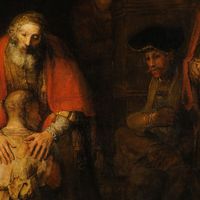
In this excerpt, the French monastic leader Frere Pierre Marie, shares an interpretation of Jesus as the true prodigal son—bringing all of us home with him: He, who is born not from human stock, or ...
Though Christ was by nature divine, Christ did not cling to equality with God, but in utter self-emptying, took the form of a slave, and was born as a human. God have mercy. Appearing in h...
Isaiah 9:6-7, Philippians 2:9-11, Mark 1:16-20, Matthew 11:28-30, John 10:10
H.G. Wells, himself an atheist, makes this point about the nature of greatness as it relates to Jesus: A historian like myself, who doesn’t even call himself a Christian, finds the picture centering...
John 1:14, Acts 4:12, Matthew 16:13-17, Philippians 2:6-8, Romans 5:8, 1 Corinthians 15:3-4, John 20:24-29
We must continue to affirm the uniqueness and finality of Jesus Christ. For he is unique in his incarnation (the one and only God-man), unique in his atonement (only he has died for the sins of the wo...
The Servant Leader The servant leader is the hero of this text. And the example, par excellence, is the Apostle Paul. He has never shied away from holding himself up as a person to be imitated, as...
Philippians 2:5-8, Luke 2:6-7, Isaiah 53:2-3, John 13:4-5, Hebrews 2:14-17, Luke 22:27, Mark 10:42-45
Humble. Before Jesus, almost no pagan author had used “humble” as a compliment. Yet the events of Christmas point inescapably to what seems like an oxymoron: a humble God. The God who came to earth ca...
John 3:6-17 , Ephesians 2:8-10, Acts 16:31-34, 1 John 1:7, Philippians 2:5-8 , Matthew 5:14-16, Romans 12:1-2
O Lord God, You have commanded us to believe in Jesus; and I would flee to no other refuge, wash in no other fountain, build on no other foundation, receive from no other fullness, res...
John 1:14, Matthew 9:36, Luke 19:10, John 15:15, Mark 10:45, Philippians 2:5-7, 1 John 4:9-10
The ways Jesus goes about loving and saving the world are personal: nothing disembodied, nothing abstract, nothing impersonal. Incarnate, flesh and blood, relational, particular and local. The ways em...
John 1:14, John 14:9, Revelation 1:12-16, Philippians 2:5-7, 2 Corinthians 4:4, Hebrews 1:3, Colossians 1:15-16
My friend and colleague Keas Keasler, who teaches a class on spiritual formation, recently asked the class to close their eyes and picture God. After a few moments he had them open their eyes and, if ...
Philippians 2:5-7, Romans 8:29, Matthew 5:16, Colossians 3:12-14, John 13:15
R.W. DeHann wrote of a missionary who, shortly after arriving on the field, was speaking for the first time to a group of villagers. He was trying to present the gospel to them. He began by describing...
Ancient Lens What can we learn from the historical context? Israel’s State of Mind The Book of Isaiah is a remarkable accounting of the history of the relationship people of Israel with God. By t...
Leader: Let the same mind be in you that was in Christ Jesus, who though He was in the form of God did not regard equality with God as something to be exploited, People: But emptied Himself, taking ...
John 1:14, Colossians 2:9, Hebrews 4:15, Mark 4:35-41, 1 Timothy 2:5, Philippians 2:6-8, Isaiah 9:6
If I am asked, “Do you believe in the divinity of Christ?” I answer, “Yes, otherwise how could he have been so wonderfully human?” And if I am asked, “Do you believe in the humanity of Christ?” I answ...
Mark 1:4-11, Isaiah 40:3, Mark 2:7, Philippians 2:7, Isaiah 53:null, Hebrews 4:15, 2 Corinthians 8:9, Mark 1:1-3
Enter John the Baptist John the Baptist enters the stage in Mark 1 as the “voice of one crying in the wilderness,” (Isaiah 40:3) whose message and ministry is to “prepare the way of the Lord.” Mark d...