Philippians 2:6-7, Galatians 2:20, John 10:30, Ephesians 5:21, Colossians 1:19-20, John 15:13, Matthew 20:28
There are two wonderful Greek words that the early church theologians used to describe the Trinity: kenōsis and perichōrēsis. Kenosis is the act of self-giving for the good of another. It is found in ...
The kingdom is present not in grandiose accomplishments, but in showing practical love in humble ways, day after day, and in refusing to allow our failures and disappointments to hide God’s love from ...
"Maundy" What? Maundy Thursday takes its name from the Latin version of John 13:34: "A new commandment I give to you, that you love one another: just as I have loved you, you also are ...
Ancient Lens What can we learn from the historical context? Paul’s Relationship to Philippi There is practically no debate that Philippians was written by Paul. This letter is an intimate portray...
Philippians 2:null, 1 Corinthians 15:22, Romans 6:4, John 12:24, Luke 24:5-6, Matthew 20:28
In the Christian story God descends to reascend. He comes down; down from the heights of absolute being into time and space, down into humanity; down further still, if embryologists are right, to reca...
Jesus, though you were in very nature God, you did not consider equality with God as something to be used to your own advantage. Rather, you humbled yourself, you made yourself nothing. Lord, you are ...
Pastor: "Have this mind among yourselves, which is yours in Christ Jesus, who, though he was in the form of God, did not count equality with God a thing to be grasped, but emptied himself, by tak...
Philippians 2:null, John 13:14-15, Galatians 6:2, 1 Peter 5:6, James 4:10, Matthew 23:12
Do nothing out of selfish ambition or vain conceit. Rather, in humility, value others above yourselves, not looking to your own interests but each of you to the interests of others. In your ...
Philippians 2:6-8, John 1:10-11, Isaiah 53:3-4, Matthew 11:19, Mark 15:34, Isaiah 53:12, Luke 15:20-24, Revelation 7:13-14
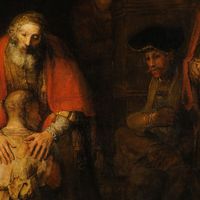
In this excerpt, the French monastic leader Frere Pierre Marie, shares an interpretation of Jesus as the true prodigal son—bringing all of us home with him: He, who is born not from human stock, or ...
For reading in unison: Have this mind among yourselves, which is yours in Christ Jesus, who, though he was in the form of God, did not count equality with God a thing to be grasped, but emptied him...
Isaiah 9:6, Philippians 2:6-7, Luke 2:10-12, Micah 5:2, Matthew 2:1-2, 11, John 1:14
For this purpose, then, the incorporeal and incorruptible and immaterial Word of God entered our world. In one sense, indeed, He was not far from it before, for no part of creation had ever been witho...
Transcendent God, you are the creator of time, You exist inside, outside, and around time and space. In your immeasurable power, you created and ordered the universe. Amazingly, you limited yourself b...
Romans 8:17, Ephesians 2:6, John 10:28-29, 2 Corinthians 5:21, 1 Peter 2:24, Philippians 2:6-8, 2 Corinthians 8:9
Pious souls can derive great confidence and delight from this sacrament, as being a testimony that they form one body with Christ, so that everything which is his they may call their own. Hence it fol...
Leader: Let the same mind be in you that was in Christ Jesus, who though He was in the form of God did not regard equality with God as something to be exploited, People: But emptied Himself, taking ...
Ancient Lens What can we learn from the historical context? A letter of friendship Paul’s letter to the Philippians is from Paul and his companions to the saints in Philippi. It is a letter fro...
Galatians 4:4-5, Titus 3:4-7, Philippians 2:8, Hebrews 2:14-15, 17-18, Hebrews 4:15, 1 Peter 4:8, Matthew 5:9
[I] try to get into their world a little bit [by listening to hip-hop], because if they’re only adapting to you and you’re not adapting to them in some way, I don’t think you’ve developed a relationsh...
John 15:13, Philippians 2:6-7, Matthew 2:13-15, Matthew 5:44, Romans 5:8, 1 John 4:19, 2 Corinthians 9:15
Jesus – Savior: Praise You. Thank You. We’d never have done what You did We’d never give up so much for someone else who cared so little about us. … and we can’t imagine anyone doing it for us. But Yo...
September 2018 The Millennial Stereotype There is perhaps no stronger stereotype of the millennial generation than that of “entitled.” For those of us who were born between 1981-1996, we’ve been lab...
Isaiah 26:3, 2 Corinthians 5:17, John 15:5, Colossians 3:3-4, Luke 9:23, Philippians 2:3-5, Romans 12:1-2
The word eccentric comes from a combination of the Greek terms ex (out of) and kentron (center). When combined, ekkentros means “out of center.” The term gained currency in the late Middle Ages, when ...
Ephesians 2:4-5, Hebrews 2:14-15, 1 Peter 2:24, Philippians 2:6-8, Isaiah 53:5, John 3:16-17, 1 John 4:9-10
Why should I, who have been living from all eternity in the enjoyment of the Father’s love, go to cast myself into such a furnace for them that never can requite me for it? Why should I yield myself t...
"But whatever gain we had We count as loss for the sake of Christ. We consider everything as loss because of the surpassing worth of knowing Christ Jesus our Lord." For his sake we will...
Jesus, you do not exploit Power over Power used as advantage Power plays You empty yourself of power’s privileges You choose solidarity, even with slaves You choose womb and flesh vulnerability and b...
Mark 1:4-11, Isaiah 40:3, Mark 2:7, Philippians 2:7, Isaiah 53:null, Hebrews 4:15, 2 Corinthians 8:9, Mark 1:1-3
Enter John the Baptist John the Baptist enters the stage in Mark 1 as the “voice of one crying in the wilderness,” (Isaiah 40:3) whose message and ministry is to “prepare the way of the Lord.” Mark d...
1 Peter 2:9, Colossians 1:13-14, Galatians 2:20, Ephesians 4:22-24, Matthew 16:24, Philippians 3:20-21, John 8:36
Gracious God, You have called us out of darkness and into the light of Your love. You have redeemed us and made us whole in order to set us free from bondage. The challenge You place before us is to d...
John 12:1-8, Mark 14:1-2, Matthew 26:3-13, John 11:45, Luke 7:44-47, Matthew 26:6, Mark 14:3, Luke 7:40, John 11:50-53, Luke 24:41-43, John 21:10-14, Acts 10:40-41, John 12:7, Philippians 2:6-8, Romans 6:1-10
Preaching commentary Introduction This narrative is slightly changed from the Synoptic accounts. Matthew and Mark’s Gospels place this narrative two days prior to the Passover (Matt: 26:6-13; Mark ...
Matthew 25:35-40, James 1:27, Philippians 2:3-4, John 13:3-5, Micah 6:8, Isaiah 58:6-7, 1 John 3:18
An ancient legend tells of a well-respected rabbi who would vanish from his synagogue for a few hours each Sabbath. His mysterious absences sparked curiosity among his students, who wondered if their ...
Philippians 2:5-8, Isaiah 53:2-3, Luke 22:27, Mark 10:45, John 13:14-15
St. Paul tells us that Jesus Christ, the revelation of God become human, “set aside the privileges of deity and took on the status of a slave, became human! Having become human, he stayed human. It wa...
Mark 1:4-11, Mark 1:1-3, Isaiah 40:3, Mark 2:7, Philippians 2:7, Isaiah 53:null, Hebrews 4:15, 2 Corinthians 8:9
Preaching Commentary Enter John the Baptist John the Baptist enters the stage in Mark 1 as the “voice of one crying in the wilderness,” (Isaiah 40:3) whose message and ministry is to “prepare the w...
Though Christ was by nature divine, Christ did not cling to equality with God, but in utter self-emptying, took the form of a slave, and was born as a human. God have mercy. Appearing in h...