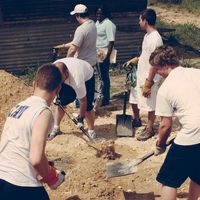
The success of every culture hinges not on big points of morality—there will always be issues like abortion or school prayer over which people differ—but on smaller values, like being considerate of o...
Revelation 21:10, Revelation 21:2, 10, 22-27, Revelation 22:1-5, 1 Kings 6:20, Genesis 12:1-3, Genesis 2:9, Genesis 3:23-24, Genesis 1:28, Genesis 2:15, Genesis 3:17-19, 1 Corinthians 15:58, Ephesians 6:5-9, Colossians 3:23, Genesis 1:26-27, Exodus 33:20-23, John 14:9, Colossians 1:15, Hebrews 1:3, Mark 15:34, 2 Corinthians 5:21, Exodus 28:15-21, 29-30, John 4:13-14, John 7:37-38, Matthew 27:46, John 3:2, Romans 8:29
Pulling Back the Curtain The Revelation of Jesus Christ is a “pulling back of the curtain” to reveal both the unseen realities of the present (what is really going on in the world from God’s perspect...
Revelation 21:10, 22-22:5, Revelation 21:2, 10, 22-27, Revelation 22:1-5, 1 Kings 6:20, Genesis 12:1-3, Genesis 2:9, Genesis 3:23-24, Genesis 1:28, Genesis 2:15, Genesis 3:17-19, 1 Corinthians 15:58, Ephesians 6:5-9, Colossians 3:23, Genesis 1:26-27, Exodus 33:20-23, John 14:9, Colossians 1:15, Hebrews 1:3, Mark 15:34, 2 Corinthians 5:21, Exodus 28:15-21, 29-30, John 4:13-14, John 7:37-38, Matthew 27:46, John 3:2, Romans 8:29
Preaching Commentary Pulling Back the Curtain The Revelation of Jesus Christ is a “pulling back of the curtain” to reveal both the unseen realities of the present (what is really going on in the wo...
Thomas Aquinas, the famous medieval theologian, created one of the greatest intellectual achievements of Western civilization in his Summa Theologica. It’s a massive work: thirty-eight treatises, thre...
Culture is like gravity. We never talk about it, except in physics classes. We don’t include gravity in our weekly planning processes. No one gets up thinking about how gravity will affect their day. ...
Intellect is therefore a vital force in history, but it can also be a dissolvent and destructive power. Out of every hundred new ideas ninety-nine or more will probably be inferior to the traditional ...
The earth had been completely unformed and empty; in the six-day process of development God had formed it and filled it—but not completely. People must now carry on the work of development: by being f...
Romans 12:1-2, Colossians 2:8, 1 John 2:15-17, 1 Corinthians 10:23-33, Mark 7:8-9
When my grandparents were in their eighties, their television developed a fault that made the screen permanently bright green. It was good for viewing garden shows or nature programs, but it was prett...
Here is the heart of the paradox: Technology is a brilliant, praiseworthy expression of human creativity and cultivation of the world. But it is at best neutral in actually forming human beings who ca...
The most powerful choices we will make in our lives are not about specific decisions but about patterns of life: the nudges and disciplines that will shape all our other choices. This is especially tr...
I recently visited a missions school at a large church in Waco, Texas, and decided to try a similar test in a class-sized proportion. “Tell me,” I said to the group, “what is the gospel?” A young lady...
Hebrews 12:5-11, Proverbs 3:11-12, Psalm 94:12, 1 Timothy 4:7-8, Philippians 3:12-14, Matthew 23:23-24, James 1:22-25, 1 Corinthians 9:24-27
While formally or structurally speaking, there are mechanisms of discipline operative in both the convent and the prison, in both the factory and the monastery, more specifically, these disciplines an...
Cultural diversity was built into the Christian faith…in Acts 15, which declared that the new gentile Christians didn’t have to enter Jewish culture…. The converts had to work out…a Hellenistic way of...
Proverbs 4:23, 1 Samuel 15:22, Matthew 7:24-27, 1 Corinthians 3:11, Psalm 127:1
The Great Wall of China was an immense and costly project, built with tremendous effort and resources, designed to provide security and protection. Yet, within a few years of its completion, it was br...
Whether the Hebrew Genesis account was meant to be science or not, it was certainly meant to convey statements of faith. As will be shown it is part of the biblical polemic against paganism and an int...
Matthew 22:39, Philippians 2:3-4, 1 Corinthians 10:24, Romans 15:1-2, Galatians 6:10, Romans 12:10, Acts 20:35, Matthew 25:35-40, Isaiah 58:6-7, Proverbs 19:17, Luke 10:30-37, James 2:15-16, 1 John 3:17, Proverbs 31:8-9, Matthew 25:40, Acts 11:29-30, 2 Corinthians 8:13-15, Acts 2:44-45, Acts 4:32-35, 1 Corinthians 12:25-26
Pursuing the common good has been a strong marker of the Christian church from the very beginning. The early church had many habits that they became known for, of course—including meeting frequently, ...
Acts 2:42-47, 1 Corinthians 1:9, 1 Timothy 3:1-13, 1 John 1:3, Acts 17:16-34, Romans 12:4-8, 1 Corinthians 1:18-25, John 14:6, Matthew 16:18
In the beginning the church was a fellowship of men and women centered on the living Christ. Then the church moved to Greece, where it became a philosophy. Then it moved to Rome, where it became an in...
Sanctification is a process. Basically, the word sanctified means “set apart.” The term saint comes from the same root and means “a set-apart one” to the Lord. Another word with the same meaning is ho...
Romans 16:17-18, 1 Corinthians 1:10-13, Titus 3:9-11, Mark 3:24-26
In the mid-2000s, a Trans-Atlantic movement emerged, characterized by a rejection of organized religion and the ascent of what came to be known as the “New Atheism.” This trend gained notable traction...
Philippians 3:13-14, Matthew 11:12, Galatians 1:10, Daniel 3:18, 1 Corinthians 1:27, Acts 17:6
The reasonable man adapts himself to the world; the unreasonable one persists to adapt the world to himself. Therefore all progress depends on the unreasonable man.
The True Self is all about right relationship, not requirements. It’s not about being correct; it’s about being connected, which you always were—you just didn’t realize it.
In a documentary film on the medieval statesmen William the Marshal, professor Thomas Asbridge shares his experience of the power behind Marshal’s knighting ceremony. It provides an interesting coroll...
The Book of Acts, like the Gospels before it, shows us that Christianity thrives when it is, as Kierkegaard put it, a sign of contradiction . Only a strange gospel can differentiate itself from the wo...
Matthew 27:57-60, John 19:41-42, Luke 23:50-56, Romans 6:4, Colossians 2:14-15, Isaiah 53:9-11, 1 Corinthians 15:20-22
They took the body down from the cross and one of the few rich men among the first Christians obtained permission to bury it in a rock tomb in his garden the Romans setting a military guard lest there...
One of [Lamin] Sanneh's key arguments is that while the spread of Islam has drawn ever-increasing numbers to the globalizing influence of Arabic, the spread of Christianity binds ever-increasing n...
It was this…intention that made the primitive Christians such eminent instances of piety, that made the goodly fellowship of the Saints and all the glorious army of martyrs and confessors. And if you ...
The Rabbi Jonathan Sacks, in his book The Home We Build Together , points out to the reader that in scripture the description of the creation of the universe in Genesis is given a mere thirty-fou...
Mark 1:14-15, Romans 1:16, 1 Corinthians 15:1-4, Luke 2:10-11, Colossians 1:23
It would be an understatement to say the term gospel is an important term in the Scriptures. Not only is it central in Scripture, but churches have adopted the term as their most beloved adjective. Yo...










![One of [Lamin] Sanneh's key arguments](https://images.unsplash.com/photo-1634128221889-82ed6efebfc3?ixid=M3w1NzU0OTZ8MHwxfHNlYXJjaHwxfHxsYW5ndWFnZXxlbnwwfDB8fHwxNzEzMjc2NzUwfDA&ixlib=rb-4.0.3&q=80&auto=compress&fit=crop&w=200&h=200)