John 1:18, John 6:46, Philippians 2:5-8, 1 Timothy 3:16, John 14:9, John 1:1-5, John 10:30, John 12:44-46, Colossians 1:15-20, Hebrews 1:
There is thus no God behind the back of Jesus Christ but only this God whose face we see in the face of the Lord Jesus. There is no deus absconditus , no dark inscrutable God, no arbitrary Deity ...
Luke 17:5-10, Luke 17:1-4, 1 Corinthians 6:19-20, John 15:15
Introduction Our lectionary text is inextricably linked with the five verses that precede it. For that reason, I’ll give a summary of verses 1-4. It’s possible the lectionary authors chose to separat...
Ancient lens What's the historical context? Jesus' Strangest Tales Occasionally Jesus tells a parable that just doesn’t quite fit the framework of his teaching. Already in Luke we had...
Introduction Sometimes verses 1-4 are separated from 5-10 in preaching. N. T. Wright points out, however, that in both sections, the need for humility binds the passages together. A teacher must prac...
Ancient lens What's the historical context? Jesus' Strangest Tales Occasionally Jesus tells a parable that just doesn’t quite fit the framework of his teaching. Already in Luke we had...
Discipleship on the Road Mark 10 is set along Jesus’ journey through Judea, on his way to Jerusalem. Along the way Jesus has a series of encounters with people who present very earthy and urgent issu...
Discipleship on the Road Mark 10 is set along Jesus’ journey through Judea, on his way to Jerusalem. Along the way Jesus has a series of encounters with people who present very earthy and urgent issu...
Ancient Lens What can we learn from the historical context? A Hard Saying There are (at least) two leaps that Jesus’s listeners have to make here. One is the reality of the incarnation and the o...
Ancient Lens What can we learn from the historical context? A Hard Saying There are (at least) two leaps that Jesus’s listeners have to make here. One is the reality of the incarnation and the o...
Mark 4:26-34, Matthew 13:31-32, Luke 13:18-19, Matthew 13:33, Luke 13:20-21, Matthew 13:44, Matthew 13:45-46
If we only had eyes to see and ears to hear and wits to understand, we would know that the Kingdom of God in the sense of holiness, goodness, beauty is as close as breathing and is crying out to born ...
Matthew 6:1-6, Deuteronomy 6:4-9, Matthew 23:4, 5, 13-36, Mark 12:42, Luke 21:2, Isaiah 58:6, Joel 2:1-2, 12-17
Ancient Lens What can we learn from the historical context? "Hear O Israel..." The Shema (Deuteronomy 6:4-9) commands the Israelites to love the Lord their God with heart, soul, and m...
The most striking feature of the teaching of Jesus is that he was constantly talking about himself. It is true that he spoke much about the fatherhood of God and the kingdom of God. But then he added ...
Introduction Hard Sayings These hard sayings of Jesus come at the end of a section spanning two chapters (Luke 13:10-14:35). In it, Jesus’s actions and teachings are set in parallel structure: hea...
Introduction Luke 16:1-13 isn’t an easy parable to preach on. It looks for all the world like Jesus is commending a guy who’s basically a dishonest rascal. You will sometimes see interpreters tying ...
This is one of Jesus’ most vivid parables. He paints a dramatic picture of two figures, with a twist to upend his hearer’s expectations. While the context of this passage involves the dynamics of an a...
Introduction Hard Sayings These hard sayings of Jesus come at the end of a section spanning two chapters (Luke 13:10-14:35). In it, Jesus’s actions and teachings are set in parallel structure: hea...
This is one of Jesus’ most vivid parables. He paints a dramatic picture of two figures, with a twist to upend his hearer’s expectations. While the context of this passage involves the dynamics of an a...
Ancient Lens What can we learn from the historical context? Small Town Boys The towns in this area were small and close together, but they were not particularly large. As such, even a few thousa...
Context: The Grumblers Jesus tells the three parables of Luke 15 to “the Pharisees and scribes” who were grumbling. Throughout Luke’s gospel account Jesus has been involved in controversy with the Ph...
1 Kings 19:11-13 , Exodus 33:12-14, Isaiah 30:15 , Mark 1:35-38, Luke 5:15-16, Psalm 46:10
Jesus’ actions, in and of themselves, often make no sense unless we see them as responses to some hidden invitation—an invitation received from time spent alone with his Father. When Jesus was interru...
Ancient Lens What can we learn from the historical context? Small Town Boys The towns in this area were small and close together, but they were not particularly large. As such, even a few thousa...
I’ve been reading Donald Miller’s Searching for God Knows What . Miller took this point to an even further extreme. In his book, he tells a story about one occasion when he was speaking to a class at...
Context: The Grumblers Jesus tells the three parables of Luke 15 to “the Pharisees and scribes” who were grumbling. Throughout Luke’s gospel account Jesus has been involved in controversy with the Ph...
Matthew 6:1-6, 16-21, Deuteronomy 6:4-9, Matthew 23:4, 5, 13-36, Mark 12:42, Luke 21:2, Isaiah 58:6, Joel 2:1-2, 12-17
AIM Commentary Ancient Lens What can we learn from the historical context? "Hear O Israel..." The Shema (Deuteronomy 6:4-9) commands the Israelites to love the Lord their God with h...
Philippians 2:6-8, John 1:10-11, Isaiah 53:3-4, Matthew 11:19, Mark 15:34, Isaiah 53:12, Luke 15:20-24, Revelation 7:13-14
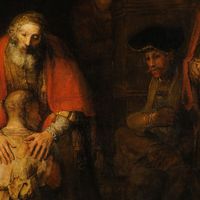
In this excerpt, the French monastic leader Frere Pierre Marie, shares an interpretation of Jesus as the true prodigal son—bringing all of us home with him: He, who is born not from human stock, or ...
Context This passage takes a number of turns that may, at first, seem disconnected from one another. Our text is part of a larger teaching discourse of Jesus in Luke’s gospel that has been causing te...
Context This passage takes a number of turns that may, at first, seem disconnected from one another. Our text is part of a larger teaching discourse of Jesus in Luke’s gospel that has been causing te...
Matthew 5:20, Romans 14:17, Luke 17:20-21, Matthew 28:18-20, Philippians 2:14-15
T. S. Eliot once described the current human endeavor as that of finding a system of order so perfect that we will not have to be good. The way of Jesus tells us, by contrast, that any number of syste...