The most striking feature of the teaching of Jesus is that he was constantly talking about himself. It is true that he spoke much about the fatherhood of God and the kingdom of God. But then he added ...
Pastor: By grace, through Jesus, God calls us His children so that we might become more like Him, setting our hope on His grace, and living as holy people who fear the Lord and love one another. Whe...
We hear of wild new theories about Jesus. Every month or two some publisher comes up with a blockbuster saying that he was a New Age guru, an Egyptian freemason or a hippie revolutionary. Every year o...
Introduction Hard Sayings These hard sayings of Jesus come at the end of a section spanning two chapters (Luke 13:10-14:35). In it, Jesus’s actions and teachings are set in parallel structure: hea...
Matthew 5:20, Romans 14:17, Luke 17:20-21, Matthew 28:18-20, Philippians 2:14-15
T. S. Eliot once described the current human endeavor as that of finding a system of order so perfect that we will not have to be good. The way of Jesus tells us, by contrast, that any number of syste...
Introduction Hard Sayings These hard sayings of Jesus come at the end of a section spanning two chapters (Luke 13:10-14:35). In it, Jesus’s actions and teachings are set in parallel structure: hea...
1 Kings 19:11-13, Exodus 33:12-14, Isaiah 30:15-21, Mark 5:25-34, Mark 1:35-38, Psalm 46:10
Jesus knew his spiritual journey depended on responsiveness to God’s invitations. Although his job was the most crucial in human history, Jesus did not get compulsive, preoccupied or unable to practic...
Matthew 6:1-6, Deuteronomy 6:4-9, Matthew 23:4, 5, 13-36, Mark 12:42, Luke 21:2, Isaiah 58:6, Joel 2:1-2, 12-17
Ancient Lens What can we learn from the historical context? "Hear O Israel..." The Shema (Deuteronomy 6:4-9) commands the Israelites to love the Lord their God with heart, soul, and m...
Matthew 6:1-6, 16-21, Deuteronomy 6:4-9, Matthew 23:4, 5, 13-36, Mark 12:42, Luke 21:2, Isaiah 58:6, Joel 2:1-2, 12-17
AIM Commentary Ancient Lens What can we learn from the historical context? "Hear O Israel..." The Shema (Deuteronomy 6:4-9) commands the Israelites to love the Lord their God with h...
Ancient Lens What can we learn from the historical context? A Hard Saying There are (at least) two leaps that Jesus’s listeners have to make here. One is the reality of the incarnation and the o...
Ancient Lens What can we learn from the historical context? A Hard Saying There are (at least) two leaps that Jesus’s listeners have to make here. One is the reality of the incarnation and the o...
Mark 13:1-8, Mark 11:, Mark 12:, Ezekiel 10:18-19, Ezekiel 11:22-23
Context In the Book of Mark Mark 13 contains the “Olivet Discourse,” also called “the Little Apocalypse.” At the beginning of this chapter (and our reading), the disciples marvel at Herod’s spectacu...
This is one of Jesus’ most vivid parables. He paints a dramatic picture of two figures, with a twist to upend his hearer’s expectations. While the context of this passage involves the dynamics of an a...
This is one of Jesus’ most vivid parables. He paints a dramatic picture of two figures, with a twist to upend his hearer’s expectations. While the context of this passage involves the dynamics of an a...
Introduction Luke 16:1-13 isn’t an easy parable to preach on. It looks for all the world like Jesus is commending a guy who’s basically a dishonest rascal. You will sometimes see interpreters tying ...
Introduction Luke 16:1-13 isn’t an easy parable to preach on. It looks for all the world like Jesus is commending a guy who’s basically a dishonest rascal. You will sometimes see interpreters tying ...
Context of the Passage Mark explicitly states at the beginning of our text that the Pharisees wanted to test Jesus. The important question to ask then, is why? This question wasn’t asked in a vacuum....
Context of the Passage Mark explicitly states at the beginning of our text that the Pharisees wanted to test Jesus. The important question to ask then, is why? This question wasn’t asked in a vacuum....
1 Kings 19:11-13 , Exodus 33:12-14, Isaiah 30:15 , Mark 1:35-38, Luke 5:15-16, Psalm 46:10
Jesus’ actions, in and of themselves, often make no sense unless we see them as responses to some hidden invitation—an invitation received from time spent alone with his Father. When Jesus was interru...
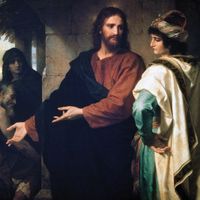
Discipleship on the Road Mark 10 is set along Jesus’ journey through Judea, on his way to Jerusalem. Along the way Jesus has a series of encounters with people who present very earthy and urgent issu...
Discipleship on the Road Mark 10 is set along Jesus’ journey through Judea, on his way to Jerusalem. Along the way Jesus has a series of encounters with people who present very earthy and urgent issu...
Jesus showed his solidarity with the poor through his teaching, parables and lifestyle. It is no coincidence that in his very first recorded message he referenced the poor… Imagine God incarnate makin...
John 14:6, Isaiah 55:8-9, Matthew 9:10-13, John 18:36, Luke 19:1-10
With a certain oversimplification we can trace easily enough the three options open to Jews in Jesus’ day. … First, the quietist and ultimately dualist option, taken by the writers of the Dead Sea Scr...
Luke 17:5-10, Luke 17:1-4, 1 Corinthians 6:19-20, John 15:15
Introduction Our lectionary text is inextricably linked with the five verses that precede it. For that reason, I’ll give a summary of verses 1-4. It’s possible the lectionary authors chose to separat...
A friend of mine, lecturing in a theological college in Kenya, introduced his students to “The Quest for the Historical Jesus.” This, he said, was a movement of thought and scholarship that in its ear...
Introduction Sometimes verses 1-4 are separated from 5-10 in preaching. N. T. Wright points out, however, that in both sections, the need for humility binds the passages together. A teacher must prac...
Philippians 2:6-8, John 1:10-11, Isaiah 53:3-4, Matthew 11:19, Mark 15:34, Isaiah 53:12, Luke 15:20-24, Revelation 7:13-14
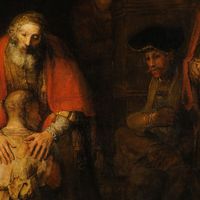
In this excerpt, the French monastic leader Frere Pierre Marie, shares an interpretation of Jesus as the true prodigal son—bringing all of us home with him: He, who is born not from human stock, or ...