Genesis 32:22-32, Exodus 5:1-21, 2 Samuel 12:1-14, Matthew 18:15-17, John 21:15-19, Psalm 141:5
The Latin term for confrontation means “to turn your face toward, to look at frontally.” It merely indicates that you are turning toward the relationship and the person. You are face-to-face, so to sp...
Jonah 1:4, Luke 15:11-32, Matthew 18:21-35, Psalm 34:8, Romans 8:28
Maltbie D. Babcock, author of This Is My Father’s World and a Presbyterian pastor in Brooklyn, introduced a free pew system in his church, upsetting a wealthy woman who found strangers in her us...
In his book Love Your Enemies: How Decent People Can Save America from the Culture of Contempt , author and professor Arthur C. Brooks charts the rise of anger — and more importantly, contempt — ...
Ezra 4:7–24, Daniel 2:4–49, Nehemiah 8:1–8, Mark 5:41 , John 19:19–22, Acts 2:1–13
One development of the exile was an additional language for the Jewish people. The Babylonians and Persians spoke Aramaic, and out of necessity the Jews learned it. Some even became more conversant in...
A conversation in 1784 between Charles Simeon (a Calvinist and believer in unconditional predestination) and John Wesley (a follower of Arminius, who denied unconditional predestination) can help us u...
Matthew 28:18-20, Acts 1:8, Acts 10:34-35, Galatians 3:28, Romans 1:16, John 4:21-24, Psalm 22:27-28
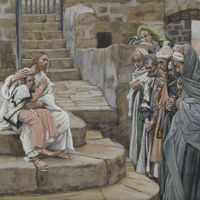
[Speaking of the early church] A cosmopolitan spirit grew, particularly in the cities, that transcended national barriers. Old tribal distinctions and identities were breaking down, leaving people rip...
There's a humorous, apocryphal story about a man standing by a river. On the opposite bank, a woman calls out, "How do I get to the other side of the river?" The man replies, "YOU A...
1 Samuel 3:9-10, John 10:27, 1 Kings 19:11-12 , Acts 9:3-6, Isaiah 30:21
Sunday dinner was finished, but we lingered around the table, savoring the good food and reflecting on the morning’s service at church. The congregation—where I then served as a very young (and very g...
Writing to his parents while imprisoned on the day of Pentecost, the German Dietrich Bonhoeffer said this: At the tower of Babel all the tongues were confounded, and as a result men could no longe...
John 18:36, Matthew 6:9-10, Matthew 6:33, Luke 17:20-21, Matthew 5:3, 10, Philippians 2:9-11
While I don’t agree with late professor and scholar Marcus Borg on significant theological positions, I appreciate how he described the context surrounding Jesus’ new paradigm of kingdom living: In hi...
Preaching Commentary Background to the Letter and Passage Paul’s letter to the Ephesians was probably intended for wider distribution and use among the various churches around Ephesus. As such, the...
Preaching Commentary A Christmastide Community A recent podcast reminded me that there is no such thing as a “neutral” marking of our time—our minutes and our hours, our days and our weeks, our mon...
Luke 3:8, 1 Samuel 16:7, Isaiah 1:17, Micah 6:8, James 2:1
In the Christian faith, we frequently take for granted how radically Jesus evens the playing field. No matter your wealth, your position, let alone your race or gender, all of us are equal in God’s ey...
Preaching Commentary What Are We Waiting For? Tom Petty and the Heartbreakers sang, “Every day you get one more yard, you take it on faith, you take it to the heart, the waiting is the hardest part...
Preaching Commentary Background of Writing Luke/Acts I don’t know about you, but as a kid, and even a teenager, I never really thought too much about how the Biblical canon was formed. If I had to ...
Ancient Lens What can we learn from the historical context? Corinth: "Young, Scrappy, and Hungry" Corinth was an up-and-coming city with an up-and-coming attitude. The Romans had conque...
Preaching Commentary Paul’s Gospel In 1 Corinthians 1:17-25 we find the gospel that Paul preaches summarized in Christ’s crucifixion. Here in 2 Timothy 2:8, Paul’s gospel is encapsulated in Christ’...
Tom and Angela had lived in their neighborhood for about twelve years without really getting to know many people. They lived in a cul-de-sac of eleven houses and had limited communication and interact...
Summary The gospel has been spreading in Acts and the gospel is meeting resistance, with apostles being imprisoned. By the Holy Spirit, they are released from jail. The Spirit then instructs them to ...
Ancient Lens What can we learn from the historical context? Corinth: "Young, Scrappy, and Hungry" Corinth was an up-and-coming city with an up-and-coming attitude. The Romans had conque...
Summary The lectionary texts since Easter have focused on the accounts of the spread of gospel after Pentecost. There has been opposition in Jerusalem, to the point of imprisoning apostles. But the b...
Introduction Sometimes verses 1-4 are separated from 5-10 in preaching. N. T. Wright points out, however, that in both sections, the need for humility binds the passages together. A teacher must prac...
Luke 17:5-10, Luke 17:1-4, 1 Corinthians 6:19-20, John 15:15
Introduction Our lectionary text is inextricably linked with the five verses that precede it. For that reason, I’ll give a summary of verses 1-4. It’s possible the lectionary authors chose to separat...
One of the most fascinating features of the Bible is that it tells what is ahead for our world. Both Old and New Testaments contend that history is moving to a climax and that the sovereign God is in ...
Grace to you—grace that crosses every boundary. And peace to you—peace that dismantles every wall. May grace and peace settle in your bones, may they calm your heart and mind, and may they spill out f...
Ephesians 2:11-22, 1 Corinthians 11:23-26, John 14:23-29
Jesus You are our peace You proclaim it You create it You bring us near Without you there is No safety No belonging No nurturing No identity rooted beyond this dust Without you we are Anchorless St...
Preaching Commentary An Introduction from Luke Our passage begins with a note from the author (Luke) to his reader (Theophilus), which reminds us that Luke-Acts was initially meant to be two parts ...





![[Speaking of the early church] A](https://a-us.storyblok.com/f/1016915/1200x801/ed572a4861/the-early-church.jpg/m/200x200/smart)