Jude 1:22, Mark 9:24, Hebrews 11:1, John 20:29, James 1:6, Romans 10:17
What is "Deconstruction"? What is it Not? Many pastors I know have told me that one of their most pressing pastoral concerns right now is knowing how to minister to people who are decons...
Mark 9:24, Romans 10:17, John 20:27, 1 John 4:1, 1 Thessalonians 5:21, Proverbs 3:5-6
Have you ever noticed that the phrases in our culture favor doubt over faith? The famed missionary and theologian Lesslie Newbigin pointed this out when we speak of “Honest doubts” and “blind faith”. ...
An attempt to wrest from God the prerogatives of absolute freedom and infinity leads to the inversion of Pentecost and what is in effect a new Babel. 'Postmodernism' represents that Babel perf...
All day long, all of us are framing and reframing our lives. We talk about the memory of our adorable but sexist grandpa. We label ourselves as movie critics or introverts or justice-lovers. We say th...
To frame is to put a language boundary around our experience. It is to name what happens in particular ways, to say how we see the world, and to see the world how we say it is. Framing includes tellin...
Romans 12:2, Galatians 6:1, Proverbs 9:10, James 1:4, Isaiah 61:3
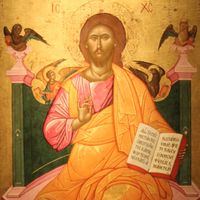
Think of an ancient icon of Christ. Imagine that a thousand-year-old Christ Pantocrator painted on a wooden panel is discovered in some forgotten monastery. The image of Christ is there, but it’s cove...
1 Peter 3:8-9, Galatians 3:28, Proverbs 31:8-9, Matthew 5:9, Romans 12:18
Just as Socrates felt that it was necessary to create a tension in the mind so that individuals could rise from the bondage of myths and half-truths to the unfettered realm of creative analysis and ob...
In this short (and humorous) excerpt, author David Zahl shares a definition of the secular: Perhaps secular warrants its own explanation, though. My most immediate association comes from the belov...
John 1:4, Hosea 1:3, Luke 15:11-32, Romans 5:8, Psalm 23:1-6
The goal in handling dragons is not to destroy them, not merely to disassociate, but to make them disciples. Even when that seems an unlikely prospect.
My friend Mike Metzger of the Clapham Institute once used the following example to demonstrate how important frames are if we are to make sense of reality’s puzzle. This may seem like a head scratcher...
In a futile attempt to erase our past, we deprive the community of our healing gift. If we conceal our wounds out of fear and shame, our inner darkness can neither be illuminated nor become a light fo...
Kevin Vanhoozer draws on 1 Corinthians 4 to argue powerfully for reading and teaching the Bible as drama. As Paul talks about his apostolic ministry, he says this: “For, I think, God has exhibite...
While brokenness is difficult, it’s beautiful because it makes God look good. Your natural gifts draw attention to yourself while brokenness draws attention to your Lord. With this in mind, power is d...
Galatians 2:20, James 1:2-4, Isaiah 53:5, Romans 8:28, Matthew 16:24-25
It is not what we do that matters, but what a sovereign God chooses to do through us. God doesn't want our success; He wants us. He doesn't demand our achievements; He demands our obedience. T...
The great danger is to always single out some aspect of God’s good creation and identify it, rather than the alien intrusion of sin, as the villain. Such an error conceives of the good-evil dichotomy ...
In 1889, the French novelist Paul Bourget penned The Disciple , where he depicted the life of a renowned philosopher and psychologist, whose existence was marked by a seemingly monotonous routine...
Recovery is not a process we can will, but consists of experiencing many small deaths, the passing of significant anniversaries, until our identity is solid and natural in the pronoun “I.”
Matthew 5:17-18, Ecclesiastes 12:13-14, Romans 6:23, Proverbs 14:12, James 4:17, 1 John 1:8-9
Postmodernism (the thinking of our age) is fiercely antinomian (without law). It is admitted that people make mistakes, but the word ‘sin’ is seldom mentioned and the idea that we all sin against God ...
Matthew 24:6-8, Isaiah 24:19-20, Judges 21:25, Romans 1:21-22, Luke 2:1-7, Revelation 19:11-16, 2 Thessalonians 2:3-4
Turning and turning in the widening gyre The falcon cannot hear the falconer; Things fall apart; the centre cannot hold; Mere anarchy is loosed upon the world, The blood-dimmed tide is loosed, and eve...
Christ is building His kingdom with earth's broken things. Men want only the strong, the successful, the victorious, the unbroken, in building their kingdoms; but God is the God of the unsuccessfu...
The recognition of humanity's flawed nature is not exclusive to Christianity. Aristotle, in his work Ethics , compares human nature to a warped piece of wood. To rectify this warp, a skilled ...
John 9:25, Romans 12:2, Isaiah 55:8-9, Proverbs 18:13, 2 Corinthians 2:14, Luke 24:32
I remember the first time I was blindsided by the idea of reconsideration. I was a senior in high school, and my AP English teacher, Mr. Lambert, gave us an exam that required us to react to a piece o...
In her book Keeping Place: Reflections on the Meaning of Home , Jen Pollock Michel reflects on the nature of home in a transient age. In this short excerpt, Michel reflects on the Biblical doctrine...




![[The decay of Logic results from an]](https://images.unsplash.com/photo-1709399610754-921b7a9ef3b7?ixid=M3w1NzU0OTZ8MHwxfHNlYXJjaHw0NXx8bG9naWN8ZW58MHwwfHx8MTcxMjA3NTI4Mnww&ixlib=rb-4.0.3&q=80&auto=compress&fit=crop&w=200&h=200)