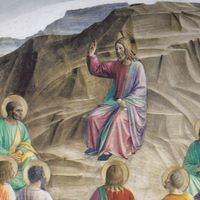
The Sermon on the Mount is probably the best-known part of the teaching of Jesus, though arguably it is the least understood, and certainly it is the least obeyed. It is the nearest thing to a manifes...
Matthew 5:10, Philippians 2:8-9, Luke 6:20, 2 Corinthians 12:9, Psalm 37:11, James 4:10
The Sermon on the Mount is, spiritually speaking, actually the sermon from the valley. It starts low. It starts with those who feel very unlike mountains!
The Sermon on the Mount is, spiritually speaking, actually the sermon from the valley. It starts low. It starts with those who feel very unlike mountains!
Pastor: Jesus said, “You have heard that it was said, ‘You shall not commit adultery.’ But I say to you that everyone who looks at a woman with lustful intent has already committed adultery with her i...
Imagine Jesus at the beginning of his ministry He calls his first disciples – the educated and advantaged? No. Some fishermen. He travels around his home region of Galilee proclaiming the good news o...
Preaching Commentary Imagine Jesus at the beginning of his ministry He calls his first disciples – the educated and advantaged? No. Some fishermen. He travels around his home region of Galilee proc...
Matthew 5:38-48, Psalm 51:10, James 5:16, Luke 6:27-28, 1 John 1:9, Ephesians 4:32
Lord Jesus Christ, you call us to high standards, and we continuously fall short. You tell us to turn the other cheek and go the extra mile; to love our enemies and pray for those who persecute us. No...
In the Sermon on the Mount, Jesus likens his followers to salt and light. While the concept of light may resonate more easily with us today, the significance of salt might be less apparent. But not so...
The Sermon on the Mount contains some of the most difficult ethical injunctions in all of scripture. Many of us do not know how to love our enemies and pray for those who persecute us. Martin Luther K...
There’s a quote by H. Richard Niebuhr that I believe is absolutely true. “The great Christian revolutions,” he argued, “come not by the discovery of something that was not known before. They happen w...
The Bruderhof is one such Christian community with many locations around the world. Unlike most such attempts to build radical communities, the Bruderhof has not only survived, it is thriving. In 2021...
Matthew 5:1-48, Matthew 6:1-34, Matthew 7:1-29, 2 Timothy 3:16-17, Romans 15:4, Isaiah 55:11, Hebrews 4:12-13, Matthew 4:4, Matthew 24:35
After a sojourn in the United States where he experienced the vibrancy of Black churches, Dietrich Bonhoeffer returned to Germany in 1931 to teach at the University of Berlin. His pastoral ministry co...
Matthew 5:21-37, Matthew 23:23, Matthew 5:13, Matthew 7:2
Preaching Commentary The teachings contained in this passage are, for my money, as difficult to preach as any lectionary text. Not only is each teaching difficult in its own right, but each has also...
More simply, as both the Reformers and the Puritans used to summarize it, the law sends us to Christ to be justified, and Christ sends us back to the law to be sanctified.
Matthew 5:43-45, Romans 12:17-21, Luke 17:20-21, Matthew 6:25-33, Acts 4:18-20, 2 Corinthians 10:3-4, Isaiah 2:4, James 3:17-18, Philippians 3:20, John 18:36
A young Russian, deeply moved by the teachings of Tolstoy and the New Testament, had become a conscientious objector. Standing before a magistrate, he spoke passionately about a life that loves its en...
Matthew 5:21-37, Matthew 23:23, Matthew 5:13, Matthew 7:2
The teachings contained in this passage are, for my money, as difficult to preach as any lectionary text. Not only is each teaching difficult in its own right, but each has also been used (and in some...
Self-made and self-sufficient people live in a fantasy world, empty of the reality of God. In contrast, the poor in spirit are deeply aware of being God-made and God-sufficient:
Matthew 5:13-16, Ephesians 5:8-9, Colossians 4:6, John 8:12-20, Luke 14:34-35
Salt and light are indispensable household commodities. Several commentators quote Pliny’s dictum that nothing is more useful than ‘salt and sunshine’ (sale et sole). The need for light is obvious. Sa...
Matthew 5:null, 1 Peter 2:9, Galatians 5:22-23, James 2:17, Romans 12:1, Mark 4:21, Philippians 2:15
Jesus describes his followers as being “salt” and “light” in the world in Matthew 5. When you think about salt, it doesn’t really have a whole lot of value when it’s just sitting in a salt shaker. Si...
Matthew 13:31-33, 44-52, 2 Corinthians 12:9, Matthew 6:10, Matthew 5:3, 6, 10, 1 Corinthians 1:27, Matthew 26:28, Matthew 19:24, Philippians 3:7, Hebrews 12:2, Matthew 5:6, Matthew 28:19
preaching commentary The context The parables we hear this week are part of a collection of parables of the Kingdom collected by Matthew in chapter 13 of his gospel account. As with the Sermon on t...
How does the theme of glory that predominates in Epiphany fit with the large amount of space devoted to the Sermon on the Mount during the season? It all depends on what one means by glory. The “g...
Expect Suffering, but Do Not Fear This text shines its light on two critical truths of the gospel: suffering for and with Christ, and Christ as our most priceless treasure. First, in the larger cont...
Preaching Commentary Expect Suffering, but Do Not Fear This text shines its light on two critical truths of the gospel: suffering for and with Christ, and Christ as our most priceless treasure. Fi...
Matthew 11:16-19, 25-30, Ephesians 4:14, Mark 10:14, 1 Samuel 16:7, 1 Thessalonians 2:4, 1 Corinthians 6:14, 2 Timothy 2:15, Proverbs 23:12, Proverbs 3:5, Acts 26:24
Preaching Commentary The Missing “Advent” Text A lectionary preacher moving from the fifth to the sixth Sunday after Pentecost in Year A will notice that a familiar chunk is missing, sent back in t...
Matthew 13:31-33, 2 Corinthians 12:9, Matthew 6:10, Matthew 5:3, 6, 10, 1 Corinthians 1:27, Matthew 26:28, Matthew 19:24, Philippians 3:7, Hebrews 12:2, Matthew 28:19
The context The parables we hear this week are part of a collection of parables of the Kingdom collected by Matthew in chapter 13 of his gospel account. As with the Sermon on the Mount (Matthew 5-7),...
Isaiah 1:1, 10-20, 2 Corinthians 12:9, Matthew 6:10, Matthew 5:3, 10, 1 Corinthians 1:27, 2 Corinthians 12:9, Matthew 26:28, Matthew 19:24, Philippians 3:7, Hebrews 12:2, Matthew 5:6, Matthew 28:19
The context The parables we hear this week are part of a collection of parables of the Kingdom collected by Matthew in chapter 13 of his gospel account. As with the Sermon on the Mount (Matthew 5-7),...
Matthew 5:13-20, James 3:1, Matthew 4:16, Matthew 6:23, Matthew 10:27, 1 John 1:4-7, 1 John 1:7, 1 John 2:9-10
Preaching Commentary Restored or Thrown Out? Having grown accustomed to the redemption theme that permeates Scripture, I find the answer that Jesus provides to his own question in v. 13 unexpected ...
Matthew 10:40-42, John 20:21, Acts 1:18, 2 Peter 2:13, Luke 17:10, John 3:18, Matthew 28:19, Ephesians 5:20, James 5:14, Colossians 3:17, Acts 3:6, 1 Corinthians 6:11, Acts 20:35
preaching commentary The Transitive Property of Welcoming In elementary school math you learn various basic principles of working with numbers…the commutative property, the associative property, th...
Matthew 5:13-20, James 3:1, Matthew 4:16, Matthew 6:23, Matthew 10:27, 1 John 1:4-7, 1 John 1:7, 1 John 2:9-10
Restored or Thrown Out? Having grown accustomed to the redemption theme that permeates Scripture, I find the answer that Jesus provides to his own question in v. 13 unexpected and unsettling—like get...