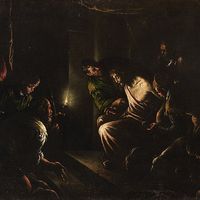
Genesis 3:1-24, Isaiah 6:1-8, Genesis 50:15-21, John 8:1-11, Luke 15:11-32, Psalm 51:1-17
In Guilt and Grace , Swiss physician and Christian, Paul Tournier, writes… I cannot study this very serious problem of guilt with you without raising the very obvious and tragic fact that rel...
The word “acceptance” has an interesting origin. It comes from the Latin ad capere, which means to “take to oneself.” What does that mean? It’s a paradoxical truth, but in order for us to accept other...
Exodus 20:1–17, Genesis 22:1–14 , Micah 6:6–8 , Luke 10:25–37 , Matthew 5:17–20, Psalm 82:3–4
Interpretive strategies have gone through cycles of strict-constructionist (or Originalism) and broad-constructionist (or Living Constitution) perspectives. Originally the procedure of interpreting th...
If the Book of Job reaches across two and a half millennia to teach anything to men and women who consider themselves normal, decent human beings, it is this: Human beings are sure to wander in ignora...
Romans 12:1, Matthew 5:44, Proverbs 15:1, 1 Peter 3:9, Luke 6:31, Galatians 6:9, Colossians 3:12-13, 1 Corinthians 13:4-5, Genesis 50:20, Philippians 2:3-4, James 1:19-20, 1 Samuel 24:17
Some years ago, the syndicated newspaper columnist Sidney J. Harris shared an interesting anecdote from one of his friends. Each evening, this friend would stop at the same newsstand to buy a newspape...
Carl Jung, one of the early pioneers of modern psychology, wrote this from his years of experience as a therapist: The acceptance of oneself is the essence of the moral problem and the epitome of ...
Genesis 4:6-7, Exodus 32:7-10, Jonah 1:1-4, John 8:3-11, Psalm 51:10-12
Imagine you’ve just purchased a brand-new car—it’s no ordinary car, it’s a luxury vehicle, with the highest trim levels, equipped with all the latest technology. Among its many upgrades is a voice ale...
1 John 4:1, 1 Corinthians 12:10, 1 Kings 19:11-13 , Genesis 41:15-40 , Isaiah 30:20-21, Matthew 4:1-11, 1 John 4:1-3, Psalm 42:5-11
Scripture also speaks of “discernment of spirits” and encourages us to “test the spirits to see whether they are from God.” This aspect of discernment helps us to distinguish the real from the phony, ...
The great danger is to always single out some aspect of God’s good creation and identify it, rather than the alien intrusion of sin, as the villain. Such an error conceives of the good-evil dichotomy ...
The problem is not recognizing the importance of the individual. The problem is the glorification of the individual. When the individual self is glorified over the greater good of the community, right...
Genesis 15:1-6, Exodus 14:10-14, Job 1:42, Matthew 14:22-33, Psalm 23:
We should aim for rational confidence in these sorts of pursuits because certainty is a mere will-o’-the-wisp. Finite minds simply can’t pull it off. Though the distinction between aiming at certainty...
We might not say we believe a Jesus-plus-our-efforts idea of the gospel, but when we place our performances on the pedestal of personal progress, we’re not relying on the grace of God. We’re worshipin...
Genesis 16:, 2 Samuel 9:, Jonah 3:4 , Luke 7:36-50, Matthew 9:9-13 , Psalm 146:7-9
In his book Breaking the Rules , Fil Anderson talks about the scandalous reputation of Jesus: He breaks all social etiquette in relating to people. He acknowledges no barriers or human divisions....
Genesis 4:8-10, Exodus 23:2-3, 1 Kings 3:16-28 , Luke 18:1-8, Matthew 27:24 , Psalm 82:2-4
As any parent of small children will tell you, children have an amazingly acute sense of justice. Even the most fractional disparity in the distribution of the most trivial family good will be met wit...
Whenever the gospel is invoked to diminish the dignity of any of God’s children, then it is time to get rid of the “so-called” gospel in order that we may experience the gospel.
Faith and pessimism are incompatible. To be sure, we are not starry-eyed idealists; we are down to earth realists. We know well that sin is ingrained in human nature and in human society. We are not e...
Proverbs 18:21, Genesis 3:1-6 , Numbers 13:30–14:4, James 3:5-10 , Matthew 12:36-37 , Psalm 141:3
The book of Proverbs is, in ways, a treatise on talk. I would summarize it this way: words give life; words bring death—you choose . What does this mean? It means you have never spoken a neutral ...
Many economic fallacies are due to conceiving of economic activity as a zero-sum contest, in which what is gained by one is lost by another. This in turn is often due to ignoring the fact that wealth ...
While I was born much too late to be the legal property of a person in America, I have been the recipient of racism. When a classmate called me a racial epithet in my first year of college, I was deva...
John 8:1-11, Genesis 32:22-32, Luke 15:11-32, Luke 22:54-62, Ephesians 2:8-9, 2 Corinthians 12:9-10
When I get honest, I admit I am a bundle of paradoxes. I believe and I doubt, I hope and get discouraged, I love and I hate, I feel bad about feeling good, I feel guilty about not feeling guilty. I am...
Reject Christianity, if you will, out of motives of cynicism; turn away from it because you believe. Reality is malign and punitive; choose a God that is cantankerous, vindictive, or forgetful, or det...
Whenever I have encountered any kind of deep problem with civilization anywhere in the world—be it the logging of rain forests, ethnic or religious intolerance or the brutal destruction of a cultural ...
Matthew 10:15, John 5:22, Genesis 2:null, Judges 4:4-5, Matthew 10:15, Genesis 2:9, Judges 4:4-5
The word krisis was used by the Greeks to refer to “a legal process of judgment.” Aristotle used it to refer to a legal procedure that secured civic order. In his case, it was a judgment that helped k...
At the core of every project of self-salvation is the staunch unwillingness to believe that God’s love and forgiveness can be unmerited. Those who would try and save themselves prefer work to rest, ef...
Richard Attenborough’s movie Gandhi has a scene set in South Africa where the young Indian lawyer and a white clergyman are walking together on a boardwalk, contrary to South African law at the time. ...
So how can we form deep Christian convictions without dividing the church? Let’s take a deeper look at convictions themselves. Convictions are like light: they come in many colors and form across a sp...
Genesis 2:15, 1 Kings 19:11-13, Ecclesiastes 3:1, Matthew 25:14-30, Luke 16:10-12, Psalm 16:5-6
When we speak of being the steward of our life, something else must be stressed. We are called to be the steward not of some ideal life or even the life we wish we had; rather we are called to be stew...