Nehemiah 1:1-11, Acts 16:25-34, Mark 4:35-41, Acts 2:1-13, Luke 10:25-37, Matthew 11:28-30, Acts 1:8
Lord–Father, Son and Holy Spirit: Thank You that there’s no place we can hide from Your Spirit, no place we can flee from Your presence. We can’t go beyond the reach of Your love, nor out-distance the...
The Lord calls us to examine the wounds of the Risen One and to see there the depth of his love for us. Let us therefore approach the throne of God in confidence as we pray for the people of God in Ch...
The surest way to suppress our ability to understand the meaning of God and the importance of worship is to take things for granted. Indifference to the divine wonder of living is the root of sin.
Introduction Sometimes verses 1-4 are separated from 5-10 in preaching. N. T. Wright points out, however, that in both sections, the need for humility binds the passages together. A teacher must prac...
Luke 17:5-10, Luke 17:1-4, 1 Corinthians 6:19-20, John 15:15
Introduction Our lectionary text is inextricably linked with the five verses that precede it. For that reason, I’ll give a summary of verses 1-4. It’s possible the lectionary authors chose to separat...
Introduction This text is used in the first week of Advent, but preparing for Jesus' return isn't something for just one time of the year. For a treatment that is more focused on Advent, see ...
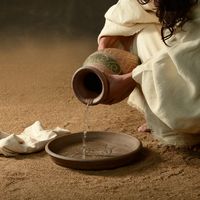
Introduction Only John’s Gospel tells us that Jesus washed his disciple’s feet during his last meal with them. The other texts for this day remember the Passover and the context it sets for Jesus’s w...
Zechariah 9:9, Isaiah 53:3–5, Exodus 12:1–28, Matthew 21:1–11 , Luke 22:24–27, Psalm 118:25–26
I heard a woman named Veda Gill who is the Executive Director, Presbyterian Education Board in Pakistan preach on a Palm Sunday. Perhaps you’ve heard this story before, but it is so powerful that I th...
Easter after Resurrection Sunday One of the challenges of the Christian calendar for pastors is that we often put so much energy into Holy Week, that by the time we reach Easter Sunday , and parti...
Colossians 1:15, John 14:6, John 8:12, 2 Corinthians 4:6, John 14:9, Hebrews 1:3, John 1:14
At Trafalgar Square in the city of London stands a statue of Lord Nelson. Resting atop a tall pillar, it towers too high for passersby to distinguish his features. For this reason, about forty years a...
Luke 2:10-11, John 1:4-5, 2 Corinthians 5:17, Matthew 5:14-16, Acts 9:1-22, Hebrews 13:8, Revelation 7:9-10
It is impossible to conceive how different things would have turned out if that birth had not happened whenever, wherever, however it did ... for millions of people who have lived since, the birth of ...
John 13:1-17, Ephesians 2:8-9, Galatians 2:21, Hebrews 9:14, Mark 10:45, Romans 5:8
To accept this [Jesus' self-humiliation in washing the disciples' feet] is to be converted. And nothing can be added to this. If you imagine that you can add something to what is given in the ...
Intellectually we all know that we will die, but we do not really know it in the sense that the knowledge becomes a part of us. We do not really know it in the sense of living as though it were true. ...
Ephesians 2:8-9, Luke 15:11-32, Romans 5:8 , 1 John 4:10, Titus 3:4-5 , Psalm 103:10-12, Isaiah 49:15-16
Gracious Father, too often we base our worth on our performance. We believe if we do well, your love grows, and if we falter, your love lessens. Our God, how far this is from the truth. We confess our...
Living in a society governed by technique conditions us to believe that in every way life is easier than it ever has been. Technique is the use of rational methods to maximize efficiency, and we...
John 15:5, Philippians 4:13, 1 Corinthians 4:7 , James 1:17, Deuteronomy 8:17-18, 2 Corinthians 3:5, Luke 18:18-30
Almighty God, we trust in our own strength, abilities, and resources. We think too highly of what we have to offer this world. The truth is we cannot do anything without your strength and all we have ...
Ancient lens? What can we learn from the historical context? Context and Tone Paul was writing from prison to a Christian community that he didn’t establish. Rather, it was his co-laborer, Epaphr...
Living for what gives or maintains the greatest amount of personal comfort is our long-established habit. At the core, that’s what comfort is—it’s a habit, a way of life. Comfort has become the defaul...
Introduction Hard Sayings These hard sayings of Jesus come at the end of a section spanning two chapters (Luke 13:10-14:35). In it, Jesus’s actions and teachings are set in parallel structure: hea...
1 Corinthians 13:, Ruth 1:16-18, 2 Corinthians 11:23-28, Luke 10:25-37, 1 Kings 19:1-18, Matthew 26:36-46, Isaiah 41:10
Adapted from Ch 4 of On Getting out of Bed. Why is Existence Good? Living for the sake of living—doing things so that you can continue to efficiently do things—begs the question, Why live? To live...
Context 1 Peter is traditionally attributed to the apostle Peter. It is addressed to Christian communities in diaspora, scattered across Asia Minor (modern-day Turkey), who were experiencing social m...
Context 1 Peter is traditionally attributed to the apostle Peter. It is addressed to Christian communities in diaspora, scattered across Asia Minor (modern-day Turkey) who were experiencing social ma...
Jeremiah 2:4-13, Jeremiah 2:null, Jeremiah 1:, John 4:14
Ancient Lens What can we learn from the historical context? Passage Context - Divided Kingdom, Common Struggles The prophet, Jeremiah, conducted the bulk of his ministry in the latter half of the...
South of where I live by just over an hour is Henry Cowell State Park. The park features redwood trees that are upward of 1,600 years old. For some perspective, only seven nations on earth are older t...
Guests? Or Hosts? After picking up the first verse of the chapter in order to provide a setting for Jesus’ words, this week’s gospel reading contains two teachings. The first (v. 7-11) is addressed t...
Guests? Or Hosts? After picking up the first verse of the chapter in order to provide a setting for Jesus’ words, this week’s gospel reading contains two teachings. The first (v. 7-11) is addressed t...