Matthew 7:16-20, Matthew 7:16-20, Galatians 6:7-8, 1 Kings 10:1-10, Colossians 3:12-13, Matthew 25:14-30, Titus 2:7-8
One of my favorite things to do is to sit on the aft deck of a boat going across the ocean and just watch the wake. It is such a beautiful, ever-changing creation as the ship continues on its path. Yo...
In each action we must look beyond the action at our past, present, and future state, and at others whom it affects, and see the relations of all those things. And then we shall be very cautious.
Words can never adequately convey the incredible impact of our attitudes toward life. The longer I live the more convinced I become that life is 10 percent what happens to us and 90 percent how we res...
Christ as incarnate Word does not ‘exercise an influence’ on finite agents like that of ordinary finite causal agencies, nor does he introduce extra causal factors into the finite world or simply init...
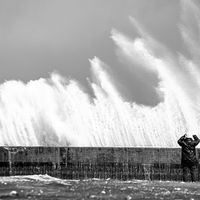
We know only too well that what we are doing is nothing more than a drop in the ocean. But if the drop were not there, the ocean would be missing something.
In one of his letters, the philosopher and psychologist William James shares a conviction regarding his focus not on big, grand things, but with the small “almost invisible” decisions: I am done wit...
Looking through the lens of Holy Scripture, human work must be seen first and foremost as value contribution, not economic compensation. We can have a flourishing, fruitful life even if we don’t get a...
An individual can march for peace or vote for peace and can have, perhaps, some small influence on global concerns. But the same individual is a giant in the eyes of a child at home. If peace is to be...
Scripture is filled with examples of men and women whom God used late in life, often with great impact - men and women who refused to use old age as an excuse to ignore what God wanted them to do.
James 3:1-12, James 1:17, Jeremiah 17:9, Proverbs 18:21
The Dangers of Our Words No matter how much we might wish it weren’t the case, the perception others have of us is directly connected to the words (and actions) we use throughout our lives. Most of u...
I preached my first sermon at National Community Church on January 14, 1996. The only thing I remember about that message is my opening illustration. I can’t remember the original source, but I think ...
As we become more intentional about living according to our deepest desires, it becomes increasingly important to notice the effects of technology on our mind, our soul and our relationships. The ...
1 Corinthians 1:27, Romans 12:15, Luke 4:18-19, Psalm 34:18, James 1:27
God bless us with discomfort at easy answers, half-truths and superficial relationships, so that we may live deep within our hearts. God bless us with righteous anger at injustice, oppression, and exp...
Sometimes what seems like a failure is actually the seed of God’s work. As Mark Batterson tells the story, it started with David and Svea Flood. Sent to the Congo by a church in Sweden, they helped es...
Genesis 16:, 2 Samuel 9:, Jonah 3:4 , Luke 7:36-50, Matthew 9:9-13 , Psalm 146:7-9
In his book Breaking the Rules , Fil Anderson talks about the scandalous reputation of Jesus: He breaks all social etiquette in relating to people. He acknowledges no barriers or human divisions....
The cross is the center of the world's history; the incarnation of Christ and the crucifixion of our Lord are the pivot round which all the events of the ages revolve. The testimony of Christ was ...
Excellence is an art won by training and habituation: we not act rightly because we have virtue or excellence, but rather have these because we have acted rightly; these virtues are formed in man by d...
Isaiah 9:6-7, Philippians 2:9-11, Mark 1:16-20, Matthew 11:28-30, John 10:10
H.G. Wells, himself an atheist, makes this point about the nature of greatness as it relates to Jesus: A historian like myself, who doesn’t even call himself a Christian, finds the picture centering...
Matthew 18:12-14, 1 Corinthians 12:12-27, 1 Peter 4:10, Philippians 4:13, Luke 12:48
Edward Everett Hale (1822-1909), an American Unitarian minister and writer, who lived and worked in Boston, Massachusetts, and inspired many by his story Ten Times One Is Ten : I’m only one, but I ...