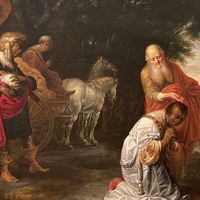
Mark 6:14-29, Mark 6:6b-13, Mark 6:30, John 1:14, Mark 6:30, Mark 8:29, Mark 6:4, Mark 8:27-28, 1 Kings 19:1-10, 1 Kings 21:17-26, Mark 9:13, Romans 7:18-25, Mark 14:1-12
Between the Sending and Return of the Twelve The fate of John the Baptist appears in a Markan ‘sandwich,’ where the story is told almost as a detour between the sending (ἀποστέλλω) of the Twelve (6...
Mark 6:14-29, Mark 6:6b-13, Mark 6:30, John 1:14, Mark 6:30, Mark 8:29, Mark 6:4, Mark 8:27-28, 1 Kings 19:1-10, 1 Kings 21:17-26, Mark 9:13, Romans 7:18-25, Mark 14:1-12
Context Between the Sending and Return of the Twelve The fate of John the Baptist appears in a Markan ‘sandwich,’ where the story is told almost as a detour between the sending (ἀποστέλλω) of the ...
Ancient Lens What can we learn from the historical context? Broader Context of Philippians Paul is concerned that Judaizers (those that require Christians to follow the Torah) are going to corrup...
Ancient Lens What can we learn from the historical context? The Waiting Hurts For all the Prophets and the Law prophesied until John, and if you are willing to accept it, he is Elijah who is ...
Today, unlike almost any other earlier period, the money and the strong educational institutions of Christianity are in one part of the world, while a majority of the active believers are located else...
The twentieth-century writer A. W. Tozer made a stunning claim: “What comes into our minds when we think about God is the most important thing about us.” Really? The most important thing? M...
According to a December 2014 article in The Economist, there is a “distinct correlation between privilege and pressure.” We may earn more money, but we can never earn more time. And because we’re work...
The challenge each of these faced in their deconstruction—and what we may face—is walking the tightrope between becoming our own person and honoring our past. In The Homeless Mind , sociologist P...
Pop psychology is wrong when it tells you to look inside yourself and find your value. The magazines are wrong when they suggest you are only as good as you are thin, muscular, pimple-free, or perfume...
A Multi-faceted Church Who loses by the church and parachurch’s lack of unity and cooperation? Absolutely everyone : congregations, ministry organizations, ministry leaders, individual believers . ....
As long as we continue to live as if we are what we do, what we have, and what other people think about us, we will be filled with judgments, opinions, evaluations, and condemnations. We will remain a...
The Christian who cares only for God’s approval lives free of the tyranny of conformist pressures, relaxed under the steady direction of the God who loves us and gives himself for us. Those who try to...
Ancient Lens What can we learn from the historical context? After the Baptism Jesus, still wet from his baptism in the Jordan. Jesus, with the affirmation of the Father still ringing in his ears...
Genesis 50:20, Exodus 4:10–12, 1 Samuel 17:, Matthew 18:1–4 , Romans 5:3–5, Psalm 139:14
A young boy was heard talking to himself as he wandered through his backyard, sporting a full baseball uniform, jersey and cap included, as well as a ball and bat. "I'm the best hitter in the...
AIM Commentary Ancient Lens What can we learn from the historical context? After the Baptism Jesus, still wet from his baptism in the Jordan. Jesus, with the affirmation of the Father still ri...
All crises are judgments of history that call into question an existing state of affairs. They sift and sort the character and condition of a nation and its capacity to respond. The deeper the crisis,...
Galatians 5:22-23, Ruth 1:16, Luke 10:38-42, Luke 10:25-37, Colossians 3:17, 1 John 3:18, Matthew 22:37-40
Identities—what makes us who we are, the kind of people we are—is what we love. More specifically, our identity is shaped by what we ultimately love or what we love as ultimate—what, at the end of the...
Our selves are fashioned; we are adorned with histories that incline us to saunter, swagger, or shuffle. Given our histories, some of us move through the world with a cape; some of us don baggy sweate...
In 2014, researchers at Northwestern University, Boston College, and the University of Melbourne published an article in the Proceedings of the National Academy of Sciences , a prestigious academ...
Stories, after all, are one of the most basic modes of human life and are a characteristic expression of worldview. Human life is constituted by a series of stories, implicit and explicit, that makes ...
Ancient Lens What can we learn from the historical context? Context of 2 Corinthians At times you read the soaring rhetoric of Paul and assume he is coming from a place of inner-tranquility, but ...
A group of researchers sought to study the nuances of self-control. They conducted a study with a few dozen kindergarten students and gave them a painfully boring, repetitive task designed to test how...
Isaiah 26:3, 2 Corinthians 5:17, John 15:5, Colossians 3:3-4, Luke 9:23, Philippians 2:3-5, Romans 12:1-2
The word eccentric comes from a combination of the Greek terms ex (out of) and kentron (center). When combined, ekkentros means “out of center.” The term gained currency in the late Middle Ages, when ...
Almighty God, from the very beginning, You have designed us for glorious work. You have given us Your Spirit and spread before us limitless resources. Because You have made us a royal priesthood, we n...
Before my mentor, Dallas Willard, passed over to glory, I asked him what he thought about the rapid rise of the Christian spiritual formation movement. He said, “It is a wonderful thing, but my fear i...
Human beings are at their core defined by what they worship rather than primarily by what they think, know, or believe. That is bound up with the central Augustinian claim that we are what we love.
Matthew 6:33, Colossians 3:23, Psalm 39:6, Luke 12:15, Acts 15:29, Matthew 5:14-16, Ephesians 2:10, 1 Corinthians 10:31, Jeremiah 9:23-24, Matthew 16:24, Luke 9:62, 2 Corinthians 4:8-9, James 1:12, Romans 8:16-17, Galatians 2:20
The true story of Eric Liddell and Harold Abrahams, two British sprinters who qualified for the 1924 Olympic Games, illustrates two contrasting approaches to life and identity. Abrahams was driven by ...
Each one of us is called to live the truth of our unrepeatable uniqueness. We are not meant to model ourselves after others, however wonderful they may be. A delightful Jewish parable makes this point...