2 Kings 5:1-14, Joshua 12:1-3, Joshua 12:1-3, Luke 4:27
For purposes of practicality and relatability, this series considers the Sea of Galilee to be a lake and classifies other fresh or mostly fresh water locations together under the same banner. Th...
Ancient Lens What's the historical context? Dissolving the Divisions Generally speaking, the Psalms divide the people of the earth into two groups: “Israel” and “the nations.” Psalm 98 surpr...
On April 12, 1963, eight clergy—two Methodist bishops, two Episcopal bishops, one Roman Catholic Bishop, a Rabbi, a Presbyterian, and a Baptist—wrote a letter addressed to the citizens of Alabama. Thi...
It’s perfectly possible to have an orthodox Christianity that understands itself to be at the center of making human culture, while interacting with non-Christians and their cultural products who are ...
Preaching Commentary Dissolving the Divisions The Psalms divide—we would call it an over-simplification—the earth’s inhabitants into “Israel” and “the nations” (the earth). Psalm 98, quite interest...
Different Attitudes on Prayer This past Sunday was the first time I've been in worship at our local church in some time, and it was a wonderful service. The liturgy was inspiring, the praise musi...
Matthew 25:15-22, Matthew 20:18-19, Matthew 21:45-46, Matthew 22:18-20, Exodus 20:4, Acts 5:29, Matthew 20:25-28
Preaching Commentary A Notoriously Difficult Passage This passage includes one of the most iconic and quotable of Jesus’s interactions with his contemporary opponents. Jesus deftly steps out of a t...
We individualists generally belong to what anthropologists term low-context cultures. That means that when we communicate, we assume a low level of shared information. We therefore assume it is good c...
God did not canonize Israel’s culture. Rather, he simply used that culture as a vehicle through which to communicate the eternal truth of his character and his will for humanity.
Matthew 22:15-22, Matthew 20:18-19, Matthew 22:18-20, Acts 5:29, Matthew 20:25-28
A Notoriously Difficult Passage This passage includes one of the most iconic and quotable of Jesus’s interactions with his contemporary opponents. Jesus deftly steps out of a trap set for him by the ...
John 17:6-19, Matthew 20:20-21, Matthew 6:22-23, Exodus 3:2-5
Jesus Prepares for Departure John 17 is part of a larger section of John’s gospel known as the farewell discourses (13:31-17:26), in which Jesus prepares for his imminent departure from earth after h...
John 17:6-19, Matthew 20:20-21, Matthew 16:22-23, Exodus 3:2-5
Jesus Prepares for Departure John 17 is part of a larger section of John’s gospel known as the farewell discourses (13:31-17:26), in which Jesus prepares for his imminent departure from earth after h...
Mark 10:42-45, Matthew 20:25-28, 1 Corinthians 1:12-13, 1 Timothy 4:12, John 7:16, Galatians 1:10, 2 Timothy 4:3-4, 2 Corinthians 4:5, John 3:30, 1 Corinthians 2:1-2
When Martin Luther discovered that some had begun calling the first Protestants “Lutherans,” he strongly objected. It is funny to think that some 500 years later, many are still known by his name: ...
The Book of Acts, like the Gospels before it, shows us that Christianity thrives when it is, as Kierkegaard put it, a sign of contradiction . Only a strange gospel can differentiate itself from the wo...
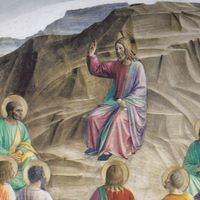
The Sermon on the Mount is probably the best-known part of the teaching of Jesus, though arguably it is the least understood, and certainly it is the least obeyed. It is the nearest thing to a manifes...
Luke 15:11-32, Psalm 23:null, John 21:15-19, Luke 19:1-10, Genesis 45:4-7, Psalm 23:5, 2 Corinthians 5:18-19
In the old American South (and in many places in the American North) a European American who invited an African American as a guest to an expensive restaurant in a white section of town would subject ...
Leader: God of mercy, we come before you with honest hearts. We bring not only our praise, but also our pain. We confess that at times we have lost heart. Hear now our lament, and kindle in us your ho...
There Are No Ordinary Things J. R. R. Tolkien tells a short story about an ordinary fellow who just wants to finish a painting. Over time, he is constantly distracted by the requests of his neighbors...
In the novel The Second Coming one of Walker Percy’s characters says about Christians, “I cannot be sure they don’t have the truth. But if they have the truth, why is it the case that they are rep...
In 1882—seven years before his descent into madness—Friedrich Nietzsche published a parable called The Madman . In the parable, a madman comes into a village on a bright, sunny morning holding al...
A strong church once inscribed these words on an archway leading to the churchyard. Over time, two things happened: the church lost its passion for Jesus and His gospel, and ivy began to grow on the a...
John 15:16 , Micah 6:6-8, Amos 5:21-24, Matthew 25:31-46 , James 2:14-17, Psalm 82:3-4
Pastor: Gracious Father, You have chosen us for a purpose – that we might bear lasting fruit for Your Kingdom. You call us to walk humbly before You and to share in the struggle with the least of thes...
Note from TPW: Kara Martin addresses life in the secular workplace, sharing insights to help you lead your congregations to understand their faith and work and also to bring the Kingdom into your o...
Colossians 1:15-17, Hebrews 1:3, 2 Corinthians 4:4, John 1:18, John 10:30, John 14:9
Christmas in May I’m pretty sure it was Stephen Covey, back in the day ( The Seven Habits of Highly Effective People ) who originally said, “The main thing is to let the main thing be the main thing...
Exodus 3:7–10, Isaiah 58:6–10 , Amos 5:21–24, Luke 4:16–21, James 2:1–7, Psalm 9:9–10
I can count on the fingers of one hand the number of times that I have heard a sermon on the meaning of religion, of Christianity, to the man who stands with his back against the wall. It is urgent th...
Isaiah 1:11–17, Jeremiah 7:1–11 , Amos 5:21–24, Luke 4:16–30 , John 1:1–14 , Psalm 50:16–23
The Enlightenment was, among many other things, a protest against a system that, since it was itself based on a protest [the Reformation], could not see that it was itself in need of further reform. (...
Loving and grace-filled God, we confess that it is difficult to keep you first in our lives. There are so many urgent demands on us that we find it hard to focus ourselves on you. The culture around u...
There are no ordinary people. You have never talked to a mere mortal. Nations, cultures, arts, civilizations—these are mortal, and their life is to ours as the life of a gnat.
1 Corinthians 13:2, James 2:19-20, 1 Corinthians 8:1-2, Ecclesiastes 1:18, 1 Corinthians 2:5, Philippians 3:10, Matthew 7:21, 24-27, James 1:22
The Oxford scholar and apologist C. S. Lewis... once closed a lecture to a group of apologists like this: I have found that nothing is more dangerous to one’s own faith than the work of an apologis...