John 8:12-20, Psalm 136:, Psalm 27:, Isaiah 60:1-5, Ephesians 5:5-20, Matthew 5:13-16
Lord Jesus Christ, your light shines within us. Let not my doubts nor my darkness speak to me. Lord Jesus Christ, your light shines within us. Let my heart always welcome your love. Amen.
John 4:7-26, John 6:1-15, Galatians 4:21-31, Psalm 42:7, Psalm 121:null
New Testament Mountains Like the Old Testament, the New Testament has plenty of references to mountains. There’s the Sermon on the Mount, obviously. Jesus often went onto hills or mountains to pray...
John 4:7-26, 1 Corinthians 2:12, 1 Peter 12:12-23, John 6:1-15, Galatians 4:21-31, Psalm 42:7, Psalm 121:null
New Testament Mountains Like the Old Testament, the New Testament has plenty of references to mountains. There’s the Sermon on the Mount, obviously. Jesus often went onto hills or mountains to pray...
Since Jesus isn’t attached to the same things we are, he can take the God-view, which is about more than redeeming our individual lives. God means to redeem the world, which is going to require some m...
The challenge each of these faced in their deconstruction—and what we may face—is walking the tightrope between becoming our own person and honoring our past. In The Homeless Mind , sociologist P...
An attempt to wrest from God the prerogatives of absolute freedom and infinity leads to the inversion of Pentecost and what is in effect a new Babel. 'Postmodernism' represents that Babel perf...
Exodus 20:1–17, Genesis 22:1–14 , Micah 6:6–8 , Luke 10:25–37 , Matthew 5:17–20, Psalm 82:3–4
Interpretive strategies have gone through cycles of strict-constructionist (or Originalism) and broad-constructionist (or Living Constitution) perspectives. Originally the procedure of interpreting th...
All day long, all of us are framing and reframing our lives. We talk about the memory of our adorable but sexist grandpa. We label ourselves as movie critics or introverts or justice-lovers. We say th...
To frame is to put a language boundary around our experience. It is to name what happens in particular ways, to say how we see the world, and to see the world how we say it is. Framing includes tellin...
One discovery was a time-released revelation to me. On my way to classes each week, I had been passing Emerson Hall, the building that houses the philosophy department at Harvard. The enormous inscrip...
In this short (and humorous) excerpt, author David Zahl shares a definition of the secular: Perhaps secular warrants its own explanation, though. My most immediate association comes from the belov...
John 1:4, Hosea 1:3, Luke 15:11-32, Romans 5:8, Psalm 23:1-6
The goal in handling dragons is not to destroy them, not merely to disassociate, but to make them disciples. Even when that seems an unlikely prospect.
Isaiah 43:19, Song of Solomon 4:7, Philippians 4:8, 2 Corinthians 4:16, Ecclesiastes 3:11, Psalm 147:3, Isaiah 61:3
If the too obvious, too straight branches of Truth and Good are crushed or amputated and cannot reach the light—yet perhaps the . . . unexpected branches of Beauty will make their way through and soar...
James 1:5, Matthew 16:15, Jeremiah 6:16, Psalm 11:3, 2 Chronicles 7:14, Lamentations 3:40, Isaiah 6:5
All crises are judgments of history that call into question an existing state of affairs. They sift and sort the character and condition of a nation and its capacity to respond. The deeper the crisis,...
My friend Mike Metzger of the Clapham Institute once used the following example to demonstrate how important frames are if we are to make sense of reality’s puzzle. This may seem like a head scratcher...
2 Corinthians 11:13-15, 1 John 4:1, Proverbs 14:15, John 8:32, Psalm 119:105
It’s important, then, to have our eyes open to this deception. How is it that so many modern promises sound true but in the end lead to our deception, or even our destruction? A long, long time ago, t...
God uses our identity crises to reveal who we are and who he is. Sometimes these crises come out of nowhere. Something devastating happens. Someone close to us dies. We are diagnosed, or someone we kn...
John 6:15, Matthew 5:38-39, Matthew 7:24-27, Matthew 15:1-9, Matthew 16:13-17, John 18:36, Luke 4:18-19, Acts 9:1-9, Psalm 1:
Jesus is understood in the light of the assumptions which control our culture. When “reason” is invoked as a parallel or supplementary authority to “Scripture” and “tradition,” what is happening is t...
In a futile attempt to erase our past, we deprive the community of our healing gift. If we conceal our wounds out of fear and shame, our inner darkness can neither be illuminated nor become a light fo...
While brokenness is difficult, it’s beautiful because it makes God look good. Your natural gifts draw attention to yourself while brokenness draws attention to your Lord. With this in mind, power is d...
1 John 4:1, 1 Corinthians 12:10, 1 Kings 19:11-13 , Genesis 41:15-40 , Isaiah 30:20-21, Matthew 4:1-11, 1 John 4:1-3, Psalm 42:5-11
Scripture also speaks of “discernment of spirits” and encourages us to “test the spirits to see whether they are from God.” This aspect of discernment helps us to distinguish the real from the phony, ...
In the land whose founding metaphor was the mutuality of John Winthrop’s seventeenth-century vision of a “city set on a hill,” we live more and more in estranged, hostile, exclusive enclaves, linked o...
As a stranger walked down a quiet residential street, he noticed a man struggling with a washing machine at the doorway of his house. The homeowner was clearly having a hard time, so the passerby, wan...
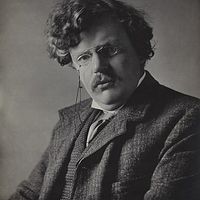
G. K. Chesterton was well-known (and iconoclastic) in his defense of tradition in a time when progress was all the rage in Western Europe- in technology, in the sciences, in philosophy. Chesterton, on...
The great danger is to always single out some aspect of God’s good creation and identify it, rather than the alien intrusion of sin, as the villain. Such an error conceives of the good-evil dichotomy ...