Psalm 86:5, Joel 2:13, Exodus 34:6, 1 John 1:9, Micah 7:18, Romans 2:4
God, our heavenly Father and the Father of our Lord Jesus Christ: We praise and thank you today and always! You are worthy of our praise simply for who You are: You are good and You are strong, ...
John 11:17-44, 1 Peter 2:9, Matthew 5:14-16, Philippians 4:6-7, Psalm 46:1-2
Meister Eckhart, the late 13th century German Christian theologian and mystic, reminds us that "If the only prayer you said in your whole life was,"thank you," that would suffice."...
John 1:12-13, Luke 15:11-32, Ephesians 1:3-6, John 3:1-2, Galatians 4:4-7, Romans 8:14-17
Leader: For you did not receive the spirit of slavery to fall back into fear, but you have received the Spirit of adoption as children, by whom we cry, “Abba! Father!” The Spirit himself bears witne...
Paul’s insight that Gentiles are co-heirs, co-members, and co-participants in the gospel is not a mere sociological adjustment—it is a radical theological revelation.
1 John 5:14, James 4:3, Matthew 13:45-46, Jeremiah 29:13, Matthew 6:33, Matthew 7:7-8, Romans 8:15-16, Mark 10:46-52
May we ask according to your will, not according to our desires, for you will give us what is right for us. May we seek you as the pearl of great price, not half-heartedly but with our whole being, fo...
Philippians 2:6-8, John 1:10-11, Isaiah 53:3-4, Matthew 11:19, Mark 15:34, Isaiah 53:12, Luke 15:20-24, Revelation 7:13-14
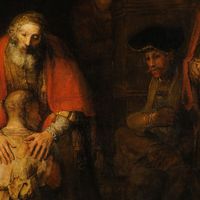
In this excerpt, the French monastic leader Frere Pierre Marie, shares an interpretation of Jesus as the true prodigal son—bringing all of us home with him: He, who is born not from human stock, or ...
Introduction This passage is often used on Maundy Thursday to accompany either the story of Jesus instituting the Lord's Supper or Jesus washing the disciples' feet. This psalm is part of t...
Micah 7:18-19, Isaiah 55:6-7, Romans 8:1-4, Psalm 32:1-5, John 3:16-17
Pastor: Brothers and sisters in Christ, as we gather on this Thursday of Holy Week, let us humbly draw near to the Lord to remember what He has done and to receive what He gives to us by His Word an...
1 John 1:8-9, 1 Peter 1:3-4 , Jonah 3:1-10, Psalm 51:, 2 Corinthians 5:17-21
Pastor: If we say we have no sin, we deceive ourselves, and the truth is not in us. People: But if we confess our sins, God, who is faithful and just, will forgive our sins and cleanse us ...
Pastor: If we say we have no sin, we deceive ourselves, and the truth is not in us. People: But if we confess our sins, God, who is faithful and just, will forgive our sins and cleanse us ...
John 20:1-18, Luke 8:1-2, 1 Corinthians 15:49, John 20:29
Preaching Commentary Death Is Common to All Shakespeare’s Queen Gertrude of Denmark implores her son Hamlet to move past mourning his deceased father, Thou know’st ‘tis common,—all that live must...
As a study assistant to the Anglican pastor and writer John Stott during my early years as a believer, I witnessed John’s faithfulness in public and private, as a highly visible speaker and as a nearl...
Ephesians 5:1-2, Philippians 2:12-13, 2 Corinthians 3:18, 1 Corinthians 11:1, 1 Peter 2:21-23, John 13:15
My father was an artist. He had a black leather sketchbook filled with cartoons and doodles. As a boy I was enthralled by his drawings and wondered how I could learn to draw like him. I began by traci...
With what confidence would anyone address God as ‘Father’? Who would break forth into such rashness as to claim for himself the honour of a son of God unless we had been adopted as children of grace i...
Deuteronomy 30:19-20, Isaiah 58:6-12, John 15:1-8, Matthew 28:18-20, Psalm 1:1-3
Pastor: Go now, as God’s children, chosen and dearly loved, to bear fruit for His Kingdom – fruit that will last. May the almighty and merciful Lord, the Father, the Son, and the Holy Spirit, bless...
John 14:26, 2 Peter 1:12-13, Philippians 4:8, Luke 2:19, Proverbs 2:1-5
Memory researchers reveal that memory and creativity are linked historically. The Latin root inventio is the basis for two words in our modern English vocabulary: inventory and invention. And to ...
Philippians 2:null, 1 Corinthians 15:22, Romans 6:4, John 12:24, Luke 24:5-6, Matthew 20:28
In the Christian story God descends to reascend. He comes down; down from the heights of absolute being into time and space, down into humanity; down further still, if embryologists are right, to reca...
Romans 8:17, Ephesians 2:6, John 10:28-29, 2 Corinthians 5:21, 1 Peter 2:24, Philippians 2:6-8, 2 Corinthians 8:9
Pious souls can derive great confidence and delight from this sacrament, as being a testimony that they form one body with Christ, so that everything which is his they may call their own. Hence it fol...
John 1:16-17, Romans 5:8, Ephesians 2:8-9, Acts 2:38, 2 Corinthians 12:9, Titus 3:5-6, Galatians 4:6
The piling on of grace upon grace is incredible. God had given us his Son. We killed him. In response God says, “I want to forgive you and offer another ‘family member,’ so to speak.” It was a case of...
Unless God is our Father, we are orphans. But God’s own Son has become our Older Brother. He comes through His Spirit, with His Father, to live with us. The Holy Spirit dwells in our lives, making us ...
1 Peter 2:9, James 5:14-15, 2 Corinthians 5:20, Matthew 9:37-38, Galatians 6:9-10, Romans 12:5, 1 John 3:1
Father–Father of the Lord Jesus and our Father: You’ve blessed us beyond imagination. You redeem us, forgive us and lavish Your gifts on us: Thank You. You choose us, when we wouldn’t choose ourselves...
Colossians 1:6, Matthew 13:24-30, John 12:24, Luke 13:20-21, Luke 13:18-19, Matthew 13:33, Matthew 13:31-32
Jesus made clear that the Kingdom of God is organic and not organizational. It grows like a seed and it works like leaven: secretly, invisibly, surprisingly, and irresistibly.
1 John 3:9, Genesis 1:11-13, 1 John 3:9, Matthew 13:23, Galatians 6:7-8, John 15:5
The seed of God is in us. Given an intelligent and hard-working farmer, it will thrive and grow up to God, whose seed it is; and accordingly its fruits will be God-nature. Pear seeds grow into pear tr...
C.S. Lewis on the Incarnation: We catch sight of a new key principle—the power of the Higher, just in so far as it is truly Higher, to come down, the power of the greater to include the less. . . . ...