Will the Real Jesus, Please Stand Up? Quite a few years have passed since I sat through a systematic theology class and had the professor pitch a variety of difficult to hit balls at us regarding the...
Preaching Commentary Will the Real Jesus, Please Stand Up? Quite a few years have passed since I sat through a systematic theology class and had the professor pitch a variety of difficult to hit ba...
Since then we have a great high priest who has passed through the heavens, Jesus, the Son of God, let us hold fast our confession. For we do not have a high priest who is unable to sympathize with o...
Psalm 72:1-14, Matthew 2:1-12, Hebrews 7:1-2, Genesis 14:8, John 10:10-14
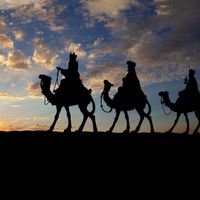
Preaching Angles Having celebrated Christ’s reign on Christ the King Sunday in November and having sung (most likely) to the “King of kings” (forever and ever!) in the Hallelujah Chorus at some poi...
Psalm 72:1-7, 10-14, Matthew 2:1-12, Hebrews 7:1-2, Genesis 14:8, John 10:10-14
Context Psalm 72 is one of two psalms (along with 127) that is attributed to Solomon, and it fits within a slightly larger group of psalms traditionally considered “royal psalms,” perhaps used as cor...
Mark 1:4-11, Mark 1:1-3, Isaiah 40:3, Mark 2:7, Philippians 2:7, Isaiah 53:null, Hebrews 4:15, 2 Corinthians 8:9
Preaching Commentary Enter John the Baptist John the Baptist enters the stage in Mark 1 as the “voice of one crying in the wilderness,” (Isaiah 40:3) whose message and ministry is to “prepare the w...
Matthew 28:16-20, Acts 1:8, Hebrews 1:1-4, John 1:1-5
Preaching Summary An Incomplete Trinity? Protestant churches who lean evangelical but not charismatic have occasionally been accused of being more “binitarian” than “trinitarian.” The suggestion i...
Mark 1:4-11, Isaiah 40:3, Mark 2:7, Philippians 2:7, Isaiah 53:null, Hebrews 4:15, 2 Corinthians 8:9, Mark 1:1-3
Enter John the Baptist John the Baptist enters the stage in Mark 1 as the “voice of one crying in the wilderness,” (Isaiah 40:3) whose message and ministry is to “prepare the way of the Lord.” Mark d...
Hebrews 4:12-16, Hebrews 3:1-4, Mark 10:17-31, Mark 10:21-22, Job 23:16-17
Unbelief in the Wilderness The author of Hebrews concludes chapter 3 with the history of Israel’s unbelief in the wilderness which kept the unfaithful among them from entering into the rest of His pr...
Psalm 142:4-5, Isaiah 49:15-16, Psalm 34:18, Hebrews 4:15, Matthew 28:20, John 14:18, Romans 8:38-39, Lamentations 3:21-23, Psalm 40:1-12
This story is probably apocryphal, but conveys a truth nonetheless. During the early 19th century, following the Napoleonic Wars, a French soldier was captured and imprisoned. He was thrown into a...
Hebrews 4:15, Hebrews 5:7-9, Matthew 27:57-75, Matthew 28:, Mark 14:43-65, Mark 15:, Luke 23:26-56, John 19:1-37
We gather today to remember To hear again the story of God’s suffering To hear the cry of our lives echoed on Jesus’ lips: My God, my God, why have you abandoned me? We gather today to remember That ...
Hebrews 4:15, Hebrews 5:7-9, Isaiah 53:1-12, 1 Peter 4:1, 1 Peter 3:18, Matthew 27:57-75, Matthew 28:, Mark 14:43-65, Mark 15:, Luke 23:26-56, John 19:1-37, 1 Peter 2:24, Romans 8:3
A God who cannot suffer is poorer than any human. For a God who is incapable of suffering is a being who cannot be involved. Suffering and injustice do not affect him. And because he is so completely ...
A student who had recently lost his sight was sent to the Seeing Eye Institute for the Blind in Morristown, New Jersey, for specialized training. Upon arrival, he was greeted by another young ma...
Psalm 34:17-18, 2 Corinthians 1:3-4, 2 Corinthians 12:9-10, Hebrews 4:15-16, Hebrews 2:18, Matthew 26:38, Matthew 11:28-30
When do we hear God’s voice most clearly? It is often in our deepest struggles that we hear God’s voice. In the 1640s, George Fox, who would later establish the Quaker or Friends movement, wandered th...
Psalm 34:14, Luke 15:20, Hebrews 4:14, Romans 6:4, Acts 1:8, 2 Corinthians 12:9, Psalm 25:4-5, Matthew 11:28-30, Isaiah 41:10, John 14:13, James 1:5, 2 Corinthians 9:8, Habakkuk 3:2, Isaiah 6:8, Matthew 28:19-20
Father: Thank You for always being ready to welcome us and listen to us. Thank You for sending Jesus Christ, Your Son, our Savior: born like us, experiencing all that we experience yet sinless, who d...
Jesus, Lord—because you took on flesh, You know what it’s like to be us. You know what keeps us awake at night, or yanks us out of sleep in the early morning. You know what it’s like to have good days...
2 Timothy 3:16-17, Romans 15:4, Isaiah 55:11, Hebrews 4:12-13, 2 Peter 1:19-21, Matthew 4:4, Matthew 24:35, Isaiah 41:8-10, 2 Corinthians 1:3-4, Psalm 46:, Genesis 37:12-36, 1 Samuel 19:, 1 Samuel 20:, 2 Corinthians 11:23-30, 2 Corinthians 4:17, Acts 21:27-36
For seven years, Terry Anderson was held as a hostage of Shiite Muslim fundamentalists. The former reporter for the Associated Press had been taken captive and held as a political prisoner, and for se...
Elie Wiesel was a survivor of the dreaded Nazi concentration camp Auschwitz. He wrote of his experiences in the book The Night. In that book he relates the harrowing story of two Jewish men and a Jewi...
Matthew 5:18, John 1:1-14, Colossians 2:9, 1 Corinthians 15:20-22, Philippians 2:9-11, 2 Timothy 3:16-17, Hebrews 4:12, 2 Peter 1:20-21
The great American statesman and president Thomas Jefferson was a man of science who did not believe in miracles but really liked Jesus. Unfortunately, right next to Jesus’ ethical teachings are stori...
1 Kings 18:41–45, Daniel 9:3–19 , Matthew 7:7–8 , Luke 18:1–8, Hebrews 4:16 , Psalm 145:18–19
“The Prince of Preachers”, Charles Haddon Spurgeon once shared a thoughtful analogy for the life of prayer in most people’s lives: Prayer pulls the rope down below and the great bell rings above i...
Hebrews 4:15-16, James 5:16, Matthew 11:28-30, Psalm 147:3, Romans 8:28, Psalm 34:18
What often continues to shape our stories (interpretations) are the implicit emotional responses to our wounds. We must be willing to attend to our wounds and address the emotions embedded in our woun...
While brokenness is difficult, it’s beautiful because it makes God look good. Your natural gifts draw attention to yourself while brokenness draws attention to your Lord. With this in mind, power is d...
Healing begins when, in the face of our own darkness, we recognize our helplessness and surrender our need for control… we face what is, and we ask for mercy.
Ancient Lens What’s the historical context? Background Structure This Psalm of David is unique. “It is the only hymn in the Old Testament composed completely as a direct address to God.” [1] It e...
Mark 12:28-34, Deuteronomy 6:4-9, Matthew 22:35–40, Mark 12:28–34, Luke 10:27, Leviticus 19:17-18, Ruth 1:1-18, Psalm 146:, Deuteronomy 6:1-9, Psalm 119:1-8, Hebrews 9:11-14
Ancient Lens What's the historical context? An Honest Inquiry from the Religious Leaders It is easy—perhaps tempting—to read this passage with built-in sarcasm because we know the general ton...
Ancient Lens What’s the historical context? Background Structure This Psalm of David is unique. “It is the only hymn in the Old Testament composed completely as a direct address to God.” [1] It e...
Therefore, brothers and sisters, since we have confidence to enter the holy places by the blood of Jesus, by the new and living way that he opened for us through the curtain, that is, through his fles...