Titus 3:4-5, Ephesians 2:8, Luke 15:11-32, 1 Corinthians 2:9, Psalm 30:5, Ruth 4:13-17
J. R. R. Tolkien coined the term "eucatastrophe" to refer to the unexpected happy ending at the end of a fairy tale, achieved by grace rather than effort. The consolation of fairy-stories,...
This elementary wonder, however, is not a mere fancy derived from the fairy tales; on the contrary, all the fire of the fairy tales is derived from this…. We all like astonishing tales because they to...
Matthew 7:1-2, John 7:24, Proverbs 3:5, Ecclesiastes 7:9
A man named Jack was driving on a dark country road one night when he got a flat tire. He saw a cabin in the woods and began to walk towards it. He told himself that the person who answered the door w...
It is a mark of the essential morality of fairyland (a thing too commonly overlooked) that happiness, like happiness anywhere else, involves an object and even a challenge; we can only admire scenery ...
“He held up a book then. “I'm going to read it to you for relax.” “Does it have any sports in it?” “Fencing. Fighting. Torture. Poison. True Love. Hate. Revenge. Giants. Hunters. Bad men. Good men...
Samuel Taylor Coleridge famously declared that experiencing a story—any story—requires the reader’s “willing suspension of disbelief.” In Coleridge’s view, a reader reasons thus: “Yes, I know Coleridg...
Stories are inherently interesting. Discourse we tolerate; to story we attend. Story entertains, informs, involves, motivates, authenticates, and mirrors existence. By creating a narrative world, stor...
Why a story? We all think of our lives as stories, each with a main character (us) theme, and plot (interesteing so far, but as yet unfinished). We also love to hear stories about others and even abou...
“Yes, that’s so,” said Sam. “And we shouldn’t be here at all, if we’d known more about it before we started. But I suppose its often that way. The brave things in the old tales and songs, Mr. Frodo: a...
Groundbreaking work by Dr. Uri Hasson has shown that the brain of an individual listening to a story actually synchronizes with the brain of the individual telling the story—an event known as neural c...
The merchant’s success depends on his or her ability to tell a story. What people see or hear or smell or do when they enter a space guides their feelings, enticing them to celebrate whatever the sell...
Tragedy gives movement to our story as we attempt to change or give meaning to our taste of death. Yet we are always much more than our tragedies. Each one of us is unique. We have a different name, f...
The American writer and journalist Frank Lyman Baum found that his first book began when a band of children, including his own four sons, asked him to tell a story one night in their home in Chicago. ...
I have a word for you. I know your whole life story. I know every skeleton in your closet. I know every moment of sin, shame, dishonesty and degraded love that has darkened your past. Right now I know...
The simple truth of our being gets lost in the metanarratives we spin. We become the fictions we live. Consequently, our way of being in the world is so false and unnatural that our presence is thorou...
Robert C. McFarlane was a well-known businessman in the Los Angeles area. He had moved to California from Oklahoma in 1970, and within just a few days of his arrival—due to a disastrous misunderstandi...
For many of us, life can easily become disorienting and discouraging. Existential questions often emerge that never have before. As stressful as modern life can be, it is somewhat comforting to know t...
Joining the Story “We read to know that we are not alone” (Anthony Hopkins as C. S. Lewis in Shadowlands ). That’s also why we listen to sermons. Someone once told me that in every sermon they hope ...
Stories, it turns out, are not optional. They are essential. Our need for them reflects the very nature of perceptual experience, and storytelling is embedded in the brain itself.
Jeremiah 31:3, John 3:16, Ephesians 2:4-5, Romans 8:38-39, 1 John 4:9-19
There was what an Orthodox Hasidic rabbi had said on a flight westward. He’d put his prayer shawl in the overhead compartment and sat down, sweeping aside the tassels dangling from his pockets. And so...
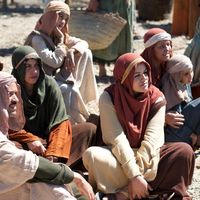
The key to interpreting most allegories [i.e., parables] lies in recognizing what a small handful of characters, actions or symbols correspond to and then fitting the rest of the story in with them.












![The key to interpreting most allegories [i.e., parables]](https://a-us.storyblok.com/f/1016915/1200x800/02a9b3a0ca/parables.jpg/m/200x200/smart)