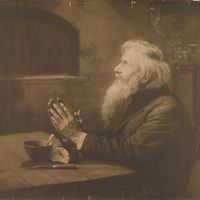
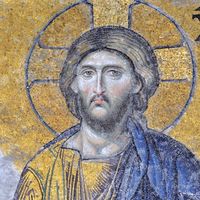
Noteworthy in this regard is the contribution of the Reformers, particularly Martin Luther, though John Calvin’s contribution is also very significant. Both called for a spirituality in the world that...
Isaiah 29:13, Judges 2:10-13 , 1 Samuel 8:4-9, Matthew 23:27-28 , 2 Timothy 3:1-5 , Psalm 10:4
Even though it’s now associated with him, Nietzsche didn’t coin the phrase God is dead. As the son of a Lutheran pastor, he would have heard that line in a Lutheran Holy Saturday hymn. And although...
In the land whose founding metaphor was the mutuality of John Winthrop’s seventeenth-century vision of a “city set on a hill,” we live more and more in estranged, hostile, exclusive enclaves, linked o...
People today are trying to hang on to the dignity of man, but they do not know how to, because they have lost the truth that man is made in the image of God. . . . We are watching our culture put into...
Spiritual timekeeping is nourished by Jesus’s promise that the Spirit will guide us into all truth across time… This stands in contrast to what I’ll call the “primitivism” of so much American Christia...
There is no mere world or matters of fact for covenant theology; there is always the wonder and duty to the concrete moment at hand, where God’s illimitable gift of life is given into our hands – to h...
There’s a quote by H. Richard Niebuhr that I believe is absolutely true. “The great Christian revolutions,” he argued, “come not by the discovery of something that was not known before. They happen w...
In 1882—seven years before his descent into madness—Friedrich Nietzsche published a parable called The Madman . In the parable, a madman comes into a village on a bright, sunny morning holding al...
The ironic fact is that humanism which began with man's being central eventually had no real meaning for people. On the other hand, if one begins with the Bible's position that man is created ...
Holy and Merciful God, We acknowledge that this crisis has exposed our idols. We accept that we have placed our trust and hope in stability, in consistency, and technology. And now, as we recognize o...
The great danger is to always single out some aspect of God’s good creation and identify it, rather than the alien intrusion of sin, as the villain. Such an error conceives of the good-evil dichotomy ...
Martin Heidegger said that being is presence. Whatever else this means, it suggests that in some way presence is a basic property of simply being. Everything that exists has presence by virtue of its ...
One key difference between much of the early church vs. the church of today (at least in the West) was the belief in, and regular experience of, miracles. As Joel Green, the noted professor and writer...
Deep, solemn optimism, it seems to me, should spring from this firm belief in the presence of God in the individual; not a remote, unapproachable governor of the universe, but a God who is very near e...
What comes into our minds when we think about God is the most important thing about us…. Where we able to extract from any man a complete answer to the questions… we might predict with certainty the s...
1 Peter 2:12, Galatians 3:26-28, 1 Corinthians 12:12-13, John 13:34-35, Acts 2:42-47, Matthew 28:19-20, James 2:17-18
In Silence, Shusaku Endo writes of the journey of Portuguese Jesuits journeying to Japan. It is a conversation about those who intend to take the path of Jesus, only to find they are on the path of Ju...
Genesis 3:1-7 , Exodus 32:1-6 , Ecclesiastes 2:1-11, Psalm 73:25-26, Matthew 4:1-11 , James 1:13-15
The church fathers consistently acknowledged the beauty and goodness of desire (e.g., Augustine, above), but they were not naive to the potential for desire to be bent by sin. They knew that our longi...
Faith and pessimism are incompatible. To be sure, we are not starry-eyed idealists; we are down to earth realists. We know well that sin is ingrained in human nature and in human society. We are not e...
We are complicit and we do not even realize it, O Holy God. Every day we participate in systems of idolatry, and we promote the captivity of a nation to gods. We have bought the subtle lies of our cul...
Ancient Lens What can we learn from the historical context? Relevant Background 1. The Purpose of Paul’s Letter Recall that 1 Corinthians is written to a local church with the purpose of reproof...
1 Corinthians 2:1-16, Matthew 5:13-20, Isaiah 6:1-13, Psalm 112:1-10
Ancient Lens What can we learn from the historical context? Relevant Background 1. The Purpose of Paul’s Letter 1 Corinthians is written to a local church with the purpose of reproof and cor...
God intended man to have all good, but in . . . God’s time; and therefore all disobedience, all sin, consists essentially in breaking out of time. Hence the restoration of order by the Son of God ha...
Matthew 1:22-23, Isaiah 7:14, Luke 1:46-55, Luke 2:1-7, Micah 5:2, Luke 2:8-11, Isaiah 9:6-7
When we turn toward Advent, the name on our lips is Emmanuel, God with us . So much in Christian faith relies on what the faithful actually mean when we say that name. Western Christianity has fo...
Exodus 32:1-6 , 1 Samuel 4:3-10, Isaiah 40:18-25, Matthew 16:13-20, Acts 5:1-11 , Psalm 115:4-8
A. W. Tozer once wrote, Left to ourselves we tend immediately to reduce God to manageable terms. We want to get Him where we can use Him, or at least know where He is when we need Him. We want a ...
Ancient lens? What can we learn from the historical context? Context and Tone Paul was writing from prison to a Christian community that he didn’t establish. Rather, it was his co-laborer, Epaphr...
What you do in the present by painting, preaching, singing, sewing, praying, teaching, building hospitals, digging wells, campaigning for justice, writing poems, caring for the needy, loving your neig...
Romans 8:6-11, Psalm 130:, John 11:1-41, Ezekiel 37:1-14
Ancient Lens When Paul writes to the church about struggles between body and spirit, he is not the first to join this discussion. Even if you limit the conversation to just the Mediterranean world,...